What is Light Leather Craft? A Complete Beginner’s Guide to Japanese-Style Leatherworking
yassy
Crafters!

Hello, this is Yassy from Crafters! (・∀・)
Making your own tableware or accessories by hand, or hunting for your favorite dishes at craft markets and shops, is so much fun, isn't it? I love making, admiring, and buying ceramics, and my home is filled with many beloved pieces.
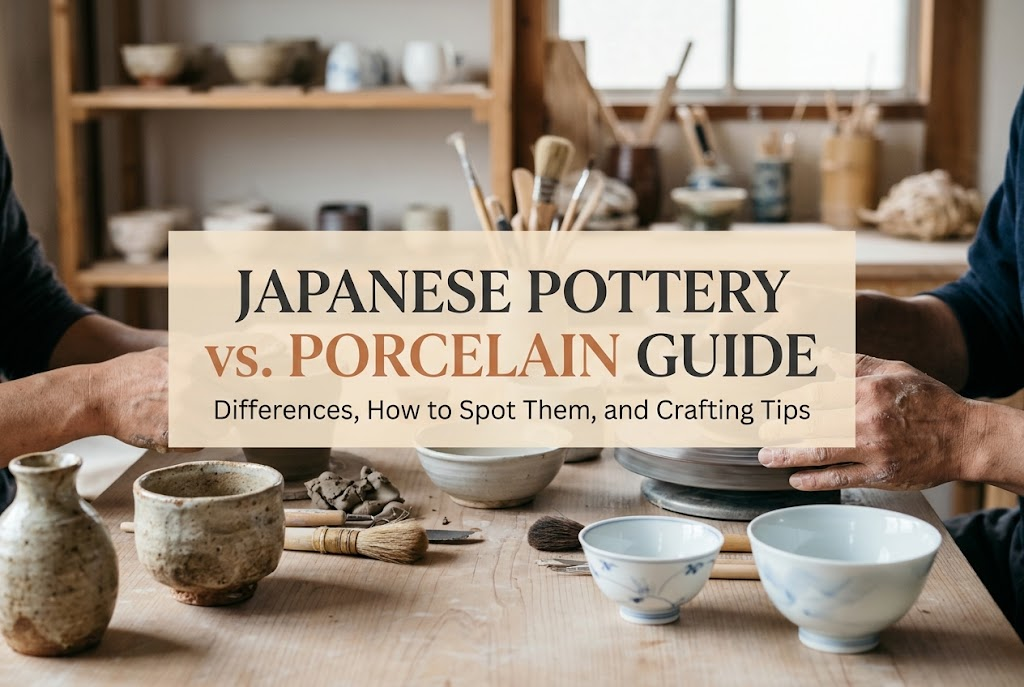
However, when starting ceramics or handmade crafts, everyone inevitably hits one big question: "What is the actual difference between pottery and porcelain?"
While many people notice they look a little different, not many accurately understand how they differ in detail, or how those differences affect crafting and selecting tableware.
Pottery and porcelain aren't just stylish in appearance—their properties, raw materials, and ease of crafting are completely distinct. Understanding these differences prevents mistakes when selecting materials for your handmade projects. Plus, you will master the proper care needed to keep your purchased tableware from breaking or wearing out prematurely.
In this guide for handmade craft beginners, I will break down the differences between pottery and porcelain in the most clear and thorough way possible! Drawing on my experience and knowledge, I will share everything from basic concepts and identification tips to choosing the right material for your own creations.
To put it simply right from the start: while both fall under the broad category of ceramics, their material origins are fundamentally different.
In traditional Japanese classification, pottery is called tsuchimono (earth things), while porcelain is called ishimono (stone things). These Japanese names describe the core difference best.
Pottery is made primarily from clay (earth). Because clay dug from the earth is shaped and fired as it is, its defining feature is the natural warmth and earthy texture retained in the finished piece.
On the other hand, porcelain is made mainly from powdered stone obtained by finely crushing a rock known as pottery stone (tsuseki). A small amount of clay is mixed into this stone powder, shaped, and fired at extremely high temperatures, yielding a hard, smooth, glass-like texture.
In short, is the main raw material "earth" or "stone"? That is the single biggest dividing line between pottery and porcelain.
This difference in raw materials completely flips properties such as hardness, weight, and water permeability by 180 degrees.
It is not a matter of one being better or worse. Both have wonderful charm and unique characteristics, making it essential to have the knowledge to select the right one based on your intended use, whether you are crafting or buying.
To clarify the core differences between pottery and porcelain, let's look closer at each key element step by step.
The main raw material for pottery is clay. Clay is rich in iron and organic matter, and its particle sizes are uneven. As a result, minute air bubbles and gaps remain inside the ceramic body after firing.
The main raw material for porcelain is pottery stone powder (quartz and feldspar). It contains very few impurities and consists of fine, white particles. This powder melts during firing and turns into a glassy substance.
Pottery is fired at relatively lower temperatures, around 800°C to 1,200°C (1,472°F to 2,192°F). Because it is fired at a lower temperature, the clay particles do not completely melt, leaving a rustic texture.
Porcelain is fired at very high temperatures, around 1,200°C to 1,400°C (2,192°F to 2,552°F). High heat completely melts the feldspar components of the stone, fusing it solid like glass.
Pottery lets zero light pass through. The body is thick and opaque, casting only a shadow even when held up to a strong light.
Porcelain allows light to pass through if the piece is thin. Holding it up to a light bulb or sunlight reveals a soft glow shining through—a unique attraction of porcelain symbolizing its delicate beauty.
Pottery has a very important characteristic: it absorbs water. Because there are microscopic, invisible pores throughout the body, it absorbs water and oils.
Porcelain has zero water absorption. Dense firing at high heat creates a completely vitrified surface through which neither water nor oil can penetrate.
When you gently tap pottery with your fingertip or fingernail, it emits a low, soft, dull sound like "ton-ton" or "poko-poko."
Tapping porcelain in the same way produces a high-pitched, metallic ringing sound like "kin-kin" or "chin-chin." The high density and hardness of its glass-like composition create this clear, high note.
When looking at dishes in a shop or organizing tableware at home, here is a reliable method to instantly tell whether something is pottery or porcelain.
Professionals and ceramic artists check five key points the moment they look at a piece. By remembering these steps, you will be able to distinguish them immediately.
The most reliable and easiest check is to look at the unglazed foot ring at the bottom of the dish, known in Japanese as the kodai.
Checking color and feel alone helps you identify the material correctly more than 80% of the time.
Pay attention to the rim of the dish. Pottery is generally made thicker to maintain structural strength, giving it a cozy, substantial feel when held.
Porcelain is extremely hard, allowing it to be crafted very thin. Its edges are sharp and thin, giving it a dense, heavy feel relative to its visual delicacy.
Hold the dish up to a bright light or near a window. If light faintly shines through near the edges, it is definitely porcelain. If it creates only a dark shadow regardless of light intensity, it is pottery.
Flick the rim lightly with your fingernail. A clear, high-pitched "kin!" sound indicates porcelain, while a dull, low "kon…" sound indicates pottery. (Note: Cracked porcelain can also produce a dull sound, so tap gently!)
Place a single drop of water on the unglazed foot ring. If the drop slowly soaks in and darkens the color, it is pottery. If the water beads up and refuses to absorb, it is porcelain.
Next, let's talk about choices specifically for handmade crafters looking to create their own pieces!
Whether attending a ceramics class or enjoying clay crafts at home, the difficulty level and required tools change dramatically depending on whether you choose pottery or porcelain.
Based on my own crafting experience, here is a realistic guide to choosing your material and understanding difficulty.
If you are just starting ceramics or clay crafting, I strongly recommend starting with pottery. There is no need to hesitate—pottery is the way to go.
Pottery clay (to-do) offers high plasticity (the ability to hold its shape), making it easy to form whatever shape you envision. Whether using hand-building techniques (tebizune) or rolling out slabs to press into molds (tatara), the clay is manageable and forgiving. Even if the thickness is slightly uneven, there is a low risk of warping or cracking during firing.
Additionally, popular home-oven clays have a texture and ease of handling very close to traditional pottery clay. If you want to craft pottery-style accessories or small decor items easily at home, oven clay is the shortest path to success.
On the other hand, making porcelain is quite difficult and not recommended for craft beginners.
Porcelain clay (jido) contains little clay content, giving it almost no stickiness or elasticity. It feels similar to touching damp cornstarch, and attempts to shape it can cause it to collapse easily.
When throwing on a potter's wheel in particular, porcelain clay sags quickly under the influence of water with even slight pressure. Without master-level technique, it is extremely difficult to pull up thin, uniform walls.
Furthermore, porcelain shrinks significantly during drying and firing. Any slight variance in thickness leads directly to cracks or distortion in the kiln.
While wanting to craft pure white accessory parts or delicate, translucent small dishes is understandable, mastering clay handling through pottery first before tackling porcelain is the absolute rule to avoid failure.
When using your handmade creations or enjoying purchased tableware, maintenance differs completely between pottery and porcelain. Improper care can cause mold, stains, or cracking. Here are the crucial rules for keeping your pieces in great condition.
When you buy or craft new pottery, there is a traditional Japanese preparation process you should always perform before first use called medome (rice-water sealing).
Because pottery contains countless microscopic pores, placing food directly on fresh pottery allows oils, soy sauce colors, or soup aromas to seep into the pores, causing permanent stains and odors.
Medome is performed using the starch-rich water left over from rinsing white rice (kome no togijiru).
The rice starch fills the microscopic pores in the pottery, dramatically preventing stains and smells from absorbing. This simple step extends the life of your pottery remarkably.
After daily use, wash pottery promptly and let it dry completely before storing it in a cupboard. Storing pottery while moisture remains inside causes dark mold to grow internally.
Avoid microwaves and dishwashers for pottery as well. Absorbed water inside the clay can heat rapidly in a microwave, causing the piece to crack or shatter.
Caring for porcelain is amazingly simple!
Because it has zero water absorption, performing medome before use is completely unnecessary. You can wash and use it the day you bring it home.
Even when serving oily foods or heavily pigmented sauces, there is no worry about staining. It boasts perfect functionality for daily dishes serving curry or pasta.
Dishwashers and microwave reheating are generally fine as well. If convenience and easy handling are your top priorities, porcelain is undeniably excellent.
However, there is one critical caution: porcelain decorated with gold or silver luster (kinsai/ginsai). Placing gold- or silver-accented porcelain in a microwave causes sparks, burning, and peeling of the metallic design. Hand-washing and avoiding the microwave are strict rules for metallic-decorated porcelain.
Also keep in mind that while porcelain is very hard, strong impacts can cause it to snap cleanly. Broken edges become glass-sharp, so handle broken pieces carefully.
Buying ceramic works from artists at handmade events, craft markets, or online handmade marketplaces like minne or Creema is one of the great joys of craft culture. I often buy lovely dishes whenever I attend craft fairs!
Developing an eye as a buyer enriches your handmade lifestyle even further. Here are my personal tips for choosing pieces without regret.
When buying dishes, try not to buy based solely on impulse or visual design. The secret is calmly considering whether the piece fits your daily routine.
If you are busy every morning and prefer washing everything together in a dishwasher or quickly reheating meals in a microwave, porcelain is the right choice. If you buy pottery without considering your routine, the effort of hand-washing and initial sealing might become a burden, leaving the dish unused.
Conversely, if you enjoy brewing coffee slowly on weekends or want the comforting warmth of handcrafted items, pottery is highly recommended. The tactile warmth of pottery when held in your hands is a special experience unique to clay.
Some people believe that tableware on a dining table must be unified as all pottery or all porcelain, but that is a misconception!
Mixing pottery and porcelain thoughtfully is actually the secret to creating a stylish table setting.
For instance, use a sleek, smooth porcelain plate for main pasta or meat dishes, and pair it with a rustic, thick-walled pottery soup cup. The cool, sharp feel of porcelain combined with the soft, warm impression of pottery creates a delightful contrast, adding depth and a professional touch to your table.
When shopping at craft markets or online platforms, try searching with the mindset of: "This pottery cup would look charming next to the porcelain plates I already own!" It makes shopping so much more enjoyable.
We have explored the differences between pottery and porcelain in detail, covering raw materials, identification tricks, crafting difficulty, and everyday maintenance.
Let's review the main takeaways:
Understanding these differences clarifies material selection for your own handmade projects. Furthermore, when browsing works by ceramic artists, you will appreciate their techniques and dedication on a much deeper level than before.
Knowing your materials is the fastest route to elevating the quality of your handmade crafts.
Both the warm, cozy feel of earthy pottery and the sharp, refined brilliance of white porcelain are full of wonderful charm.
I hope you use this knowledge to enjoy your craft projects and tableware selection to the absolute fullest! I am cheering for your handmade journey to become even more wonderful and rich.
If you enjoyed this guide, sharing it with friends on social media would mean the world to me! See you in the next article! This was Yassy from Crafters!






For example, if you are looking for articles about mizuhiki, try searching for "mizuhiki"; if you are interested in tools, try keywords like "nippers" or "pliers."
