Mastering Final Polishing in Japanese Kintsugi: Step-by-Step Guide and Burnishing Tips
yassy
Crafters!

Hello, this is Yassy from Crafters! (・∀・)
Everyone has experienced accidentally dropping and breaking a beloved mug or favorite small dish. Many of us have felt disheartened, thinking, "It's ruined, I have no choice but to throw it away." However, instead of discarding broken ceramics, there is a traditional Japanese technique called Kintsugi (金継ぎ) that uses natural lacquer and gold powder to transform them into something even more captivating than before—and it is currently taking the world by storm.
Overseas, it is widely known simply as "Kintsugi." Beyond being a mere ceramic repair technique, it has garnered massive support as a lifestyle that enriches daily living and as a form of mental self-care. On social media feeds every day, you can see crafters from all over the world proudly displaying their vessels adorned with brilliantly gleaming gold seams.
In this article, I will dive deep into why this traditional Japanese craft has captured hearts across borders and cultures, exploring the underlying aesthetic philosophy, cultural background, and its appeal as a modern craft!
Kintsugi is a traditional Japanese craft technique that developed around the Muromachi period (1336–1573). It involves joining broken or chipped ceramics with natural urushi (漆 – Japanese lacquer) and decorating the seam by dusting it with gold or silver powder. Its core philosophy is fundamentally different from Western restoration techniques, which aim to restore an item completely to its original state and conceal damage. Kintsugi, in contrast, embraces the philosophy of "cherishing the scars as part of the object's history."
In recent years, Kintsugi workshops have been springing up in major cities like New York, London, and Paris, with reservation waiting lists extending for months. It has also transcended craft boundaries to establish itself as a global culture, featured in major museum exhibitions and adopted as design motifs by famous fashion brands.
This is not just a superficial trend driven by curiosity about an exotic craft. Kintsugi has gained such sustained and passionate support because its philosophy aligns astonishingly deeply with the shifting values of people living in the modern world.
The fascination with Kintsugi overseas goes beyond technical uniqueness. What resonates most strongly is the philosophy flowing at its core and its positive approach to addressing modern challenges. Let us break this down into three key perspectives:
In traditional Western restoration concepts, the goal for broken ceramic is "how to restore it to a flawless, like-new state without leaving any visible repair marks." Scars are generally seen as flaws to be hidden and negative elements.
Kintsugi, however, makes no attempt to hide cracks or chips. Instead, it boldly highlights them using gold—the most beautifully shining material—affirming the "event of breaking" as a new, unique characteristic of the vessel. The uniquely Japanese spirit of wabi-sabi (侘寂)—finding beauty in imperfection—brought a powerful sense of awe and relief to people abroad who were feeling exhausted by perfectionism.
The accidental patterns created by the broken lines result in a one-of-a-kind design that cannot be replicated anywhere in the world. Many people are deeply moved by a beauty that exists precisely because an item has weathered time and borne scars—something flawless, mass-produced items can never offer.
In overseas book markets, self-help and psychology books inspired by Kintsugi have become bestsellers. This is because the process of repairing broken ceramics so they shine even stronger and more beautifully mirrors the human journey of overcoming life's wounds and trauma to achieve rebirth.
Everyone experiences failures or deep emotional hurts in life. In modern society, we tend to hide these setbacks as signs of weakness, but the philosophy of Kintsugi teaches us that "the experience of being hurt is precisely the valuable history that makes you shine even brighter."
The act of sitting down with a damaged vessel, patiently bringing broken pieces together one by one, creates a calm, mindful moment. The high therapeutic effect of working with your hands while engaging in inner reflection strongly resonates with audiences overseas who are highly conscious of mental health.
As the era of mass production and mass consumption is re-evaluated, global awareness around using items thoughtfully for a long time and reducing waste is rapidly rising. Within this context, Kintsugi, which embodies the Japanese spirit of mottainai (もったいない – a sense of regret over wastefulness), has been rediscovered as the ultimate eco-friendly upcycling method.
Rather than casually tossing broken items into the trash, investing time and care into repairing them to keep using them as cherished lifetime companions represents an ethical lifestyle that cares for the environment.
For eco-conscious Millennials and Gen Z in Europe and North America in particular, Kintsugi is chosen proudly not just as a handicraft, but as a sincere action toward environmental responsibility.
There are interesting differences between Japan and overseas in how people approach and enjoy Kintsugi. Understanding these differences gives us an even better appreciation of the versatility of this craft.
In Japan, because Kintsugi has historically developed in close connection with tea ceremony culture, many people perceive it as a prestigious service where you ask a professional master craftsman to restore antique heirlooms or expensive tea wares. People tend to feel a high threshold of entry out of deep respect for the advanced skills of traditional artisans.
Abroad, on the other hand, Kintsugi has been embraced as a very open, accessible, and creative craft. The mainstream culture involves people repairing affordable mugs bought at 100-yen stores or mass retailers, or modern Western tableware, with their own hands for daily use. Some contemporary artists even intentionally break new plates to add custom gold seam designs, enjoying it as modern art.
While maintaining respect for traditional Japanese craftsmanship, overseas crafters enjoy Kintsugi lightly as a form of personal expression—an attitude that provides great inspiration for craft lovers here in Japan as well!
If you think, "I want to try Kintsugi too!", there is a major crossroads every beginner will face: the difference between Hon-Kintsugi (traditional technique) and Simplified Kintsugi (modern technique). Understanding this correctly is crucial, or you won't be able to safely use your repaired tableware.
This method uses only 100% natural hon-urushi (tree sap lacquer) along with natural materials like rice flour and tonoko (clay powder). This is authentic Kintsugi passed down for centuries.
This modern adaptation replaces urushi with commercially available two-part epoxy adhesives or epoxy putty, finishing with brass powder or synthetic gold paint. It is widely used in overseas DIY kits.
While Kintsugi is a fascinating craft, choosing the wrong materials or misusing tools can lead to issues. Here are important points where beginners often stumble:
It is very dangerous to choose simplified Kintsugi just because "it's quick and easy" after watching online videos or buying craft kits, and then use it on daily soup mugs or rice bowls. Standard industrial epoxy adhesives contain ingredients that do not comply with food safety regulations.
If you want to repair tableware for daily eating and drinking, always choose Hon-Kintsugi using natural urushi. If you use simplified Kintsugi, commit from the start to using the item purely as a decorative object or trinket holder. Always read manufacturer instructions and warnings for adhesives and putties carefully and use them accordingly.
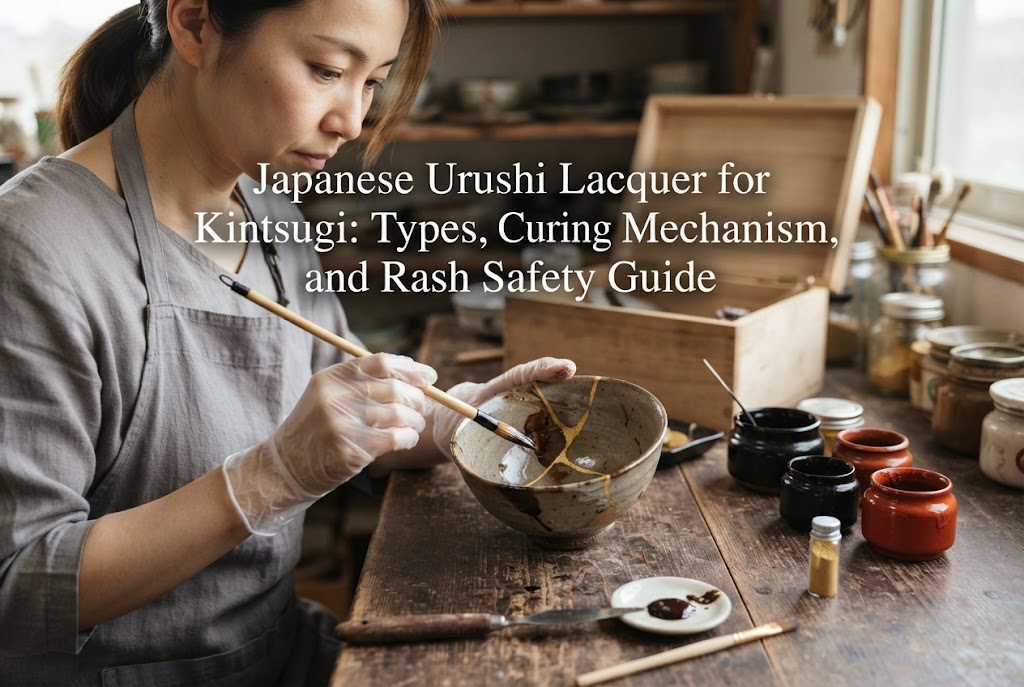
When attempting Hon-Kintsugi, taking strict precautions against allergic reactions (rashes) caused by urushiol in lacquer is non-negotiable. Regardless of constitution, direct skin contact poses a risk of contact dermatitis for anyone.
Always wear long sleeves and put on double-layered thick rubber or nitrile gloves during work. Secure glove cuffs with masking tape to eliminate skin exposure. If urushi accidentally touches your skin, do not rub it with water. Immediately rub vegetable oil (such as cooking oil or olive oil) into the skin to lift the lacquer, wipe it off, and then wash thoroughly with soap and water.
A common mistake for beginners is having broken pieces shift during gluing, creating uneven ridges. Once adhesive or urushi hardens out of alignment, returning the vessel to its smooth original shape becomes extremely difficult.
Before gluing, thoroughly degrease and clean the broken edges with ethanol to remove old dirt, dust, and oils. Before applying adhesive, dry-fit the pieces together to confirm with your fingertips the exact angle where they fit perfectly. Once glued, use masking tape under firm tension to hold the pieces tightly together and do NOT move them until completely cured. This is the golden rule for a beautiful finish.
If someone asks me, "I want to start Kintsugi now, but I don't know where to begin," I recommend a sensible, two-step approach:
First, start with a commercial simplified Kintsugi kit using non-food ceramics like flower vases, ring dishes, or cracked plant pots. This allows you to get a hands-on feel for the sequential workflow: gluing pieces, filling gaps, sanding smooth, and drawing gold lines. Experiencing the satisfaction of finishing a project in a short time lets you appreciate the structural fun of Kintsugi.
Once you are hooked on the joy of repairing vessels and the beauty of gold lines, step up to a starter kit for traditional Hon-Kintsugi using real urushi. Enjoy the luxurious experience of spending weeks applying layers of lacquer to slowly restore a cherished family heirloom or favorite coffee mug. The time invested will make your affection and emotional connection to the finished piece immeasurably deeper!
The reason Kintsugi is passionately loved around the world goes beyond simple craft technique—it touches hearts because of its warm philosophy of "not denying damage, but accepting it as an irreplaceable history."
A broken plate is not trash whose role has ended. By applying the magic of Kintsugi, it transforms into an even more meaningful, one-of-a-kind art piece. This mirrors the stories of growth and change we all experience throughout our lives.
If you have a chipped favorite vessel sitting unused in the back of your cupboard, why not breathe new life into it through the handcraft of Kintsugi? A vessel reborn in gold will brighten your daily life more warmly than ever before!
If you enjoyed this article, I would be so happy and encouraged if you shared it with your friends on social media or messaging apps!
Until next time, see you in the next post! This was Yassy from Crafters!

For example, if you are looking for articles about mizuhiki, try searching for "mizuhiki"; if you are interested in tools, try keywords like "nippers" or "pliers."
