Why Japanese Kintsugi is Captivating Crafters Worldwide: The Philosophy & Appeal of Broken Pottery Art
yassy
Crafters!
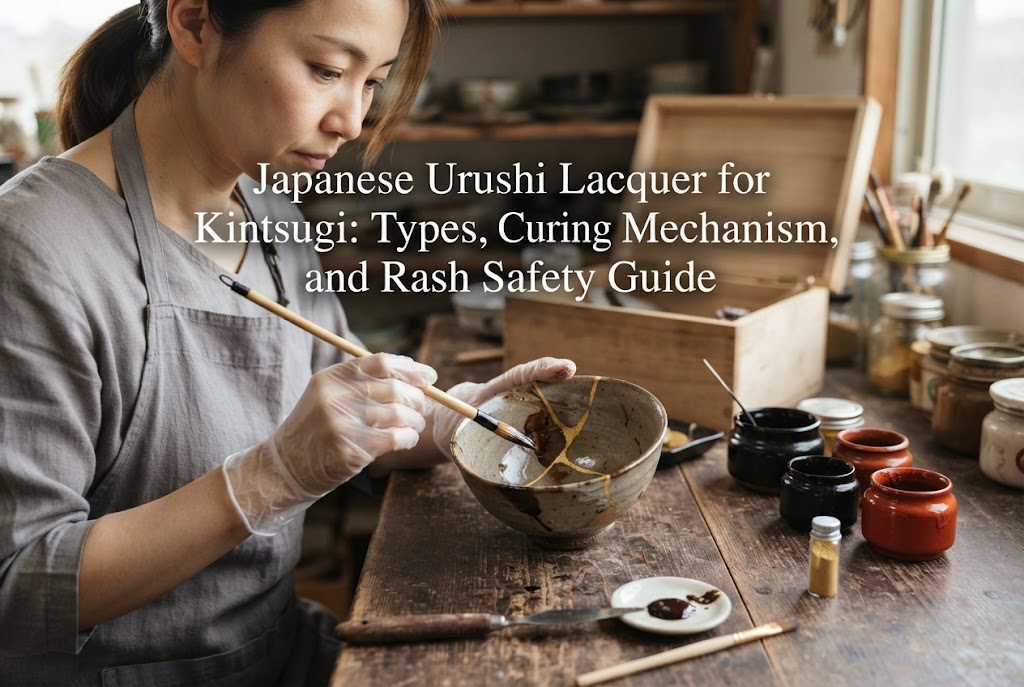

Hello, this is Yassy from Crafters! (・∀・)
When a cherished piece of pottery breaks or chips, Kintsugi—the traditional Japanese art of ceramic repair—restores it beautifully. As a handmade craft, it has gained immense popularity worldwide, and more and more people are eager to give it a try.
When researching how to start Kintsugi, one material always takes center stage: Urushi (Japanese natural lacquer). However, many beginners have questions and worries like "What is Urushi in the first place?", "There are so many types, how do I know which one to use when?", or "I'm scared of getting a skin rash."
In this article, I will explain everything from the fundamental knowledge of Urushi used in Kintsugi, the roles of each type, the fascinating science of how it hardens, to safety measures to prevent lacquer rash. Understanding the unique characteristics of Urushi will make your Kintsugi work much more enjoyable and dramatically improve your finished results!
In Kintsugi, Urushi plays an active role in every single step—from filling chipped areas to joining broken shards. First, let's understand its core properties as a material.
Urushi is a natural sap harvested from trees belonging to the Anacardiaceae (cashew/sumac) family. A single Urushi tree yields only about 200 grams of sap in its entire lifetime. It is truly a precious gift from nature.
Raw sap harvested from the tree, once filtered to remove debris, forms the foundational form of Urushi used across all Kintsugi steps. Once Urushi hardens, it becomes exceptionally durable, showing incredible resistance to water, heat, acids, alkalis, and even alcohol.
The fact that centuries-old Japanese lacquerware still survives today in pristine condition demonstrates its phenomenal strength. Long before synthetic coatings or commercial glues existed, Urushi was relied upon as the ultimate natural paint and adhesive.
The biggest misconception among beginners is how Urushi hardens. Typical paints and adhesives dry as water or solvents evaporate. However, Urushi will never harden through mere evaporation.
Urushi hardens because an enzyme called laccase contained within it acts on the main component, urushiol, causing it to absorb moisture (oxygen) from the air and undergo a chemical reaction. In other words, Urushi does not "dry"—it cures through enzymatic reaction.
For this chemical reaction to thrive, a specific environment is required: specifically, a temperature around 20–25°C (68–77°F) and a relative humidity of 70–80%. If you leave it in a bone-dry room, Urushi will never harden no matter how long you wait.
Blow-drying it because "it won't dry" is completely counterproductive. It strips away moisture and halts the curing reaction entirely. To harden Urushi properly, you need to maintain humidity by placing your piece inside a box lined with a damp towel (known as a urushi-furo or lacquer drying box).
Opening a Kintsugi tool kit can be overwhelming with several types of Urushi included. Each type has a clear, distinct purpose, so it's important to use them correctly.
Ki-urushi (raw lacquer) is the simplest form of Urushi, consisting of raw tree sap filtered to remove impurities and adjusted for moisture content. It has a translucent brownish appearance.
Ki-urushi has exceptionally high penetrative power and creates a strong bond upon hardening. Thus, it is used for katame (sealing the porous raw edges of broken ceramics), as well as the base material for making mugi-urushi (adhesive mixed with flour) and sabi-urushi (putty mixed with stone powder).
It supports the foundation of every step in Kintsugi and is the most consumed type of lacquer. It's no exaggeration to say that Kintsugi cannot begin without Ki-urushi.
Kuro-urushi is created by mixing iron powder into raw lacquer to induce a chemical reaction that dyes it black. It features a deep, lustrous black color.
In Kintsugi, it is mainly used during the naka-nuri (intermediate coating layer between base prep and top coat). Because the applied area turns black, you can easily see where you've painted, making it much easier to smooth out uneven surfaces.
Additionally, when applying silver powder for the final finish, using Kuro-urushi as a base layer brings out the silver radiance beautifully. It can also be used as-is for kuro-tsugi (finishing the repair with sleek black lines).
Bengara-urushi is made by mixing raw lacquer with a reddish-brown pigment called bengara (red iron oxide). It has a vivid red-brown hue.
It is primarily used in the e-tsuke (top coat painting) step right before sprinkling gold powder. The reason a red-brown lacquer is used under gold powder is that when the reddish base shows subtly through the gaps between gold grains, it creates a remarkably vibrant, warm, and rich golden luster.
After applying Bengara-urushi, gold powder is dusted onto it when it reaches a semi-dry state (tacky to the touch without transferring to fingers), allowing the metal powder to adhere firmly.
Refined lacquer (seisei-urushi) refers to lacquer processed by removing excess moisture and stirring to refine the particle size. Among these, kijiro-urushi is a highly transparent lacquer with no added pigments.
It is used to lock in and protect sprinkled gold or silver powder, as well as in the final polishing process for gloss. It creates an extremely smooth, beautiful coating layer, essential for showcasing artisan craftsmanship.
Urushi is not only painted on directly; when mixed with other ingredients, it transforms into bonding adhesives or hole-filling putties. Let's look at how these preparations maximize Urushi's capability as a binder.
Mugi-urushi is made to bond broken ceramic pieces together. It is prepared by kneading wheat flour with water, then mixing in an equal amount of Ki-urushi.
The elasticity of gluten in wheat flour combined with the powerful adhesive strength of Ki-urushi firmly bonds ceramics together. While it takes several weeks to a month to fully harden, once cured, it boasts incredible strength that won't peel off even under tension.
Sabi-urushi is used to fill slight uneven seams after joining or small chips along the rim. It is made by mixing Ki-urushi with tonoko (a powder made from natural clay earth) dissolved in water.
Sabi-urushi takes on a clay-like putty texture and hardens firm once dry. After curing, it can be sanded or carved smooth with a blade, making it indispensable for creating a seamless base layer.
For large missing gaps where ceramic shards are completely lost, kizami-urushi is used. It is made by mixing finely chopped hemp fibers or wood powder (shino-ko) into Mugi-urushi or Sabi-urushi.
The fibers act like a structural framework, preventing cracking even when applied thickly. It is a compounding technique that enables 3D sculpting.
When looking for Kintsugi supplies, you might encounter synthetic coatings such as "Shin-urushi" or cashew nut-based paints alongside "Hon-urushi" (natural lacquer). These are completely different materials, so it's vital to understand the distinctions.
The biggest difference lies in whether it is food-safe. Hon-urushi, made 100% from tree sap, becomes completely harmless once fully cured, making it safe for tableware that holds hot food or touches the lips.
On the other hand, synthetic paints like Shin-urushi are chemical coatings based on urethane or synthetic resins. While quick-drying and easy to handle, most are not recommended for food contact. They are convenient for decorative objects or flower vases, but if you want to repair tableware for daily use, always choose authentic Hon-urushi.
Synthetic paints dry in a few hours without requiring humidity control, making them simple to use without rash risks.
In contrast, Hon-urushi takes days to cure and requires precise temperature and humidity management. However, over time, natural lacquer gains greater clarity and depth, and far from deteriorating, it deepens in character over decades. If you want to experience authentic Kintsugi, natural Hon-urushi is well worth the effort.
When working with Urushi, skin rash (urushi-kabure) is the number one concern for beginners. However, with proper knowledge and preparation, rash can be effectively prevented.
Urushi rash is an allergic contact reaction to the component urushiol present in the sap. It occurs when liquid lacquer comes into direct contact with skin.
Symptoms do not appear immediately; intense itching, redness, or tiny bumps typically emerge 1 to 3 days after contact. While sensitivity varies by individual, it is safest to assume anyone can develop a rash upon contact.
When handling Urushi, zero skin exposure is the fundamental rule. Whenever I work with Urushi, I enforce the following protective steps:
Pay extra attention to unconsciously touching your face or hair during work. A common cause of facial rash is brushing back hair or adjusting glasses while wearing contaminated gloves. Keep a strict mindset not to touch your body during a session.
If Urushi accidentally touches your skin, do not panic and do not wash it immediately with water! Urushi is oil-soluble, so washing with water or soap will actually make it harden or stick worse.
The correct response is to dissolve and wipe it off with vegetable oil, cooking oil, or cleansing oil. Apply oil to dissolve the lacquer, gently wipe it off with tissues or a soft cloth, and then thoroughly wash off the oil residue with warm water and soap.
If severe itching or a rash develops a few days later, do not try to suppress it with over-the-counter creams; visit a dermatologist promptly and inform them that you had contact with Urushi.
Urushi is a delicate, living material. Improper handling or storage can ruin your lacquer. Keep these key points in mind.
Craft Urushi is usually sold in tubes. After use, always wipe the nozzle thoroughly clean before screwing the cap back on. If lacquer remains on the threads, it will harden and permanently seal the cap shut.
Urushi is sensitive to light (especially UV), oxygen, and extreme heat. To store, seal the tube tightly in plastic wrap, place it in a light-blocking bag or tin, and keep it in a cool, dark place (the vegetable drawer of a refrigerator is ideal).
Properly stored, it maintains its quality for about 1 to 2 years. However, older Urushi cures more slowly, so it is best to use it as soon as possible after opening.
The most common mistake in Urushi work is applying it thickly to finish quickly. Urushi cures by absorbing atmospheric moisture from the surface inward.
If applied heavily at once, the surface hardens first and forms a skin, blocking moisture from reaching the interior. This results in the worst kind of failure: a wrinkled, gooey surface with liquid lacquer trapped inside (shiwa-yori).
The golden rule is to apply Urushi so thinly it hardly feels like you've painted anything. Apply thinly, let it cure, lightly sand, and apply thinly again. This patient layering is the only shortcut to a beautiful, durable Kintsugi finish.
If your lacquer hasn't cured after several days, 90% of the time it's due to a lack of humidity. Always prepare a muro (lacquer curing box, urushi-furo) when doing Kintsugi.
No expensive equipment is needed. Simply lay a damp, wringing-wet towel at the bottom of a cardboard box or plastic storage tote to make a fantastic muro. Place your repaired pieces inside, close the lid, and keep it in a spot where humidity stays above 70%.
In cold weather or winter rooms, enzymatic activity slows down. Keep the box in a warm room (above 20°C / 68°F). As long as you provide the right environment, Urushi will reliably cure into a beautiful finish.
In this guide, we explored the types, roles, curing science, and safe handling of Urushi, the heart of traditional Japanese Kintsugi.
Urushi is a fascinating natural material that cures through moisture and enzymes. By understanding the differences between Ki-urushi, Kuro-urushi, and Bengara-urushi, and mixing them with flour or tonoko powder, you can turn it into a versatile compound capable of repairing all kinds of ceramic damage.
By wearing protective gloves and long sleeves, managing humidity, and sticking to the "thin coat" rule, even beginners can enjoy authentic Kintsugi using genuine Urushi without mishaps.
Taking the time to patiently restore broken pottery offers a rich, mindful break from the bustle of daily life. Enjoy the beauty of Urushi as you breathe new life into your favorite dishes!
If you enjoyed this article, sharing it with your craft friends on social media would mean the world to me and keep me motivated!
Until next time, happy crafting! This was Yassy from Crafters!





For example, if you are looking for articles about mizuhiki, try searching for "mizuhiki"; if you are interested in tools, try keywords like "nippers" or "pliers."
