How to Use Japanese Bamboo Craft for Home Storage: Embracing Natural Materials in Daily Life
yassy
Crafters!

Hello, everyone! It’s Yassy from Crafters! (・∀・)
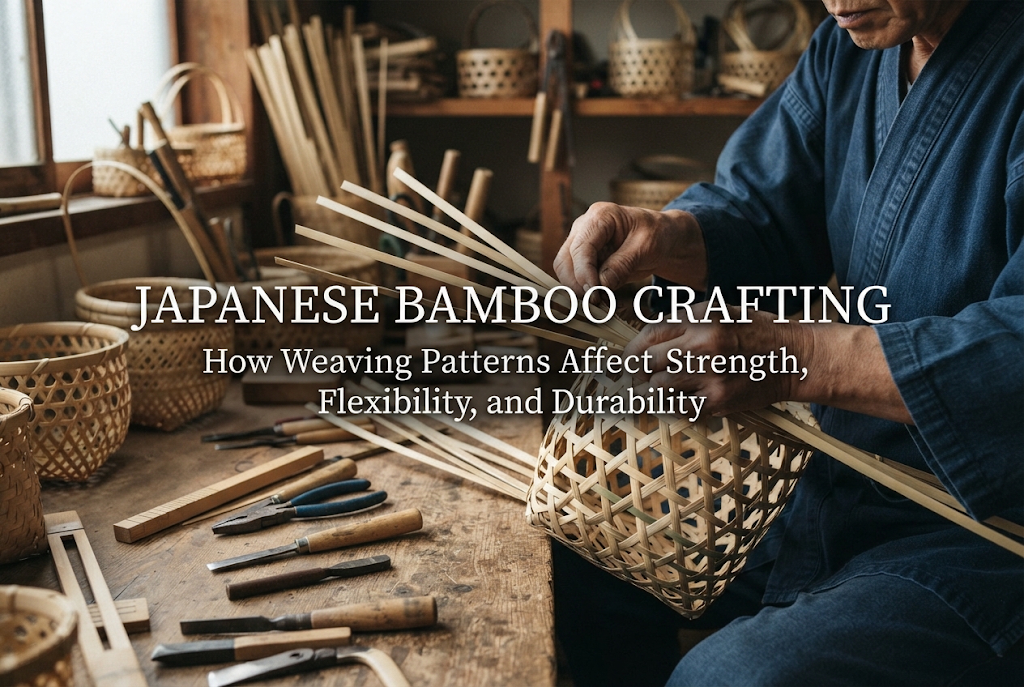
Splitting natural bamboo into thin strips and weaving them into functional items is a wonderful traditional handcraft that has supported daily life in Japan for centuries. From baskets and colanders to handcrafted bags, Japanese bamboo craft (takezaiku) is a craft that many DIY enthusiasts and makers dream of trying.
When looking at bamboo craftwork, you quickly notice a vast variety of patterns—from clean, orderly grid patterns to intricate, gapless geometric designs. However, these weaving patterns are not chosen purely for their aesthetic appeal.
In fact, the structural design of the weave is the single most important factor directly determining a piece's strength, durability, flexibility, and weight. Depending on the weave you select, a project can turn into a rigid basket capable of holding heavy objects or a supple colander designed to softly absorb impacts.
In this guide, whether you are looking to start Japanese bamboo crafting or want to deepen your structural knowledge, I will break down the relationship between traditional weaving patterns and structural integrity, explaining their unique characteristics and practical uses!
Before diving into specific patterns, let’s look at why the weave structure plays such a crucial role in determining the properties of a bamboo item.
As a plant material, bamboo possesses extraordinary tensile strength along its vertical direction (where the fibers run). However, a single thin bamboo strip (takehigo) cannot withstand lateral pressure or twisting forces on its own. By crossing these bamboo strips vertically, horizontally, and diagonally, the basic structure of bamboo crafting works by distributing external forces across the entire network.
The spots where bamboo strips overlap are called "intersection points." The more intersection points a structure has—and the more tightly packed the strips are without gaps—the faster a concentrated load is transferred and dissipated to neighboring strips.
Tightly woven, gapless patterns are ideal for load-bearing areas, such as basket bottoms or heavy-duty containers. However, because the dense strips push against one another, the overall piece becomes rigid, reducing its flexibility to bend or absorb shocks.
On the flip side, openwork patterns (weaving techniques that intentionally leave gaps) offer generous leeway at the intersection points. When pressure is applied, the bamboo strips flex naturally, allowing the structure to softly yield to impact without breaking.
Furthermore, openwork patterns offer outstanding ventilation and drainage, and because they use fewer bamboo strips, the finished piece is remarkably lightweight. "High strength" doesn't always mean "the ultimate unbreakable weave." The real magic of bamboo craft lies in designing the right balance of strength and flexibility needed for a specific purpose.
While there are hundreds of traditional bamboo weaving techniques in Japan, beginners should start by learning a few core patterns. Let’s compare their key characteristics and structural balances.
Yotsume-ami is created by crossing vertical and horizontal bamboo strips at right angles with equal spacing, forming square openings. It is the absolute foundation of Japanese bamboo craft and one of the first patterns beginners practice.
Because of its square grid layout, yotsume-ami has a structural vulnerability: it yields easily to diagonal forces (which deform squares into parallelograms). When used for the bottom of a basket, crafters often reinforce it by inserting thicker diagonal strips called chikara-dake (reinforcing strips) or securing the rims firmly.
Despite this, its clean geometric beauty and ability to harness bamboo’s natural flexibility make square weaving enduringly popular.
Mutsume-ami weaves strips in three directions (horizontal, right diagonal, and left diagonal) to form regular hexagons composed of small triangles. It is also famous as the Kagome pattern.
Utilizing the same principle behind truss structures in architecture, mutsume-ami relies on triangles as its fundamental unit, making it exceptionally resilient to forces from all directions. Unlike square weave, it will not warp diagonally.
Because it retains open spaces, it remains lightweight and drains water well, while providing the durability needed to keep basket bottoms from sagging. It is no surprise that this robust weave has been favored for daily utility baskets for centuries.
Ajiro-ami packs vertical and horizontal bamboo strips tightly without gaps, passing over and under two or more strips in a regular rhythm. This creates a beautiful diagonal stepped pattern reminiscent of twill fabric.
The strength of twill weaving is among the highest in bamboo craft. The strips press tightly against each other, locked in place by friction, so the base won't sag even under heavy loads like books. It protects its contents effectively against external impacts.
The trade-off is reduced flexibility when shaping curves. Creating sharp corners or raising three-dimensional walls requires advanced techniques, such as carefully shaving strip thickness and pre-soaking strips in water.
In gozame-ami, thicker bamboo strips serve as vertical warp ribs, while thinner, narrower strips are woven densely back and forth horizontally. It mirrors the structural design of traditional Japanese tatami mats (goza).
The key highlight of mat weaving is its anisotropic nature: "sturdy in one direction, yet flexibly bendable in the other." While vertical core strips hold heavy loads, the horizontal structure rolls effortlessly into cylindrical or oval shapes.
Its tight weave prevents small items from falling through, making it a staple kitchen tool material in Japan since ancient times.
Yatsume-ami builds upon the square grid of yotsume-ami by layering diagonal strips across the openings, creating elegant octagonal openwork.
The diagonal strips physically lock the tendency of square grids to warp sideways. As a result, this pattern delivers excellent rigidity and shape retention while maintaining a breezy, refined look.
When starting bamboo crafting, many makers focus solely on building an indestructible basket and run into unexpected problems. Here are two common misconceptions to avoid:
This is a rite of passage for almost every beginner. If you leave your bamboo strips thick thinking it adds strength, the bamboo will resist bending during weaving, hurting your fingers and snapping at sharp corners along its grain.
True strength in bamboo craft doesn't come from the thickness of an individual strip, but from the combined friction and tension of properly shaved strips tightly interlocking. In fact, a piece made by layering thin, evenly shaved, supple bamboo strips will absorb shock without cracking and last for decades.
Attempting to use a single weave pattern across the bottom and sides for visual uniformity can compromise practical function.
For instance, if you weave a basket bottom entirely in airy square weave (yotsume-ami), heavy items can cause the base to drop out. Conversely, using dense, heavy twill weave (ajiro-ami) for the side walls can make the basket unnecessarily heavy and stiff to carry.
If you examine masterwork Japanese bamboo baskets, you'll see that craftsmen alternate techniques: a sturdy hexagonal or mat weave for the base, a light openwork pattern for the sides, and a reinforced wrapped rim (waguchi) at the top opening.
When making a basket or colander, how should you combine weaving patterns? Let's look at the functional roles of each section:
The base endures the harshest conditions, holding the weight of contents and suffering friction whenever set on tables or floors.
For round colanders, the radial starburst base called kikuzoko-ami is standard. It distributes loads evenly from the center outwards, delivering outstanding strength.
The sides keep items contained and preserve the basket’s 3D silhouette without taking on direct vertical load.
The rim (fuchi) finishes off the raw bamboo ends and dictates the item’s lifespan. It clamps down on the tension of all woven strips.
Thick bamboo strips shaped over heat form inner and outer ring frames (fuchidake) that sandwich the woven edges. These are tightly bound with fine rattan (tou) or paper-thin bamboo strips. If the rim loosens, even a tightly woven basket body will unravel, so this area requires maximum structural security.
Even with good structural understanding, loose handling during crafting can dramatically reduce finished strength. Here are practical techniques for durable results:
If bamboo intersections remain loose during weaving, the finished pattern will slide diagonally out of alignment at a light touch, indicating lack of friction.
Solution: As you complete each row, use the pads of your thumbs to firmly pack each strip against the previous row (a technique called me-o-yoseru). Tightly packing the weave creates natural mechanical traction between the bamboo strips without adhesives.
Bamboo strips consist of a hard, smooth outer skin (epidermis) and a softer, paler inner flesh. Over 80% of bamboo's natural strength is concentrated near the outer skin.
Solution: If you shave away too much outer skin and use mostly inner flesh, even a dense twill weave will end up weak and prone to fraying. Always weave so that the resilient outer skin faces outward.
As bamboo dries out, it hardens and becomes brittle. Bending dry strips under high tension will cause the fibers to snap.
Solution: Before weaving or bending strips upward into 3D shapes, mist the strips with water or wrap them in a damp towel. Absorbing moisture restores dramatic flexibility to the plant fibers, allowing smooth curves without fracturing.
If you're wondering which pattern fits your specific project idea, here is how I recommend pairing weaves with project goals:
Bamboo weaving patterns in traditional Japanese crafting are far more than decorative flourishes—they are functional engineering solutions refined over centuries by master artisans.
From the airy simplicity of square weave (yotsume-ami) and the balanced stability of hexagonal weave (mutsume-ami) to the solid strength of twill (ajiro-ami) and directional flex of mat weave (gozame-ami), understanding the unique advantages of each technique unlocks endless creative possibilities.
Rather than asking "which weave is strongest?", ask yourself "what blend of strength, weight, and flexibility does my tool require?" When you weave in harmony with bamboo's natural elasticity, your finished handmade pieces will serve you reliably for years to come.
If you enjoyed this article, please share it with your fellow crafters on social media or messaging apps—it truly means a lot and keeps me inspired!
See you in the next article! This was Yassy from Crafters!

For example, if you are looking for articles about mizuhiki, try searching for "mizuhiki"; if you are interested in tools, try keywords like "nippers" or "pliers."
