Mastering Handmade Branding: How to Build a Cohesive Brand Identity for Your Craft Business
yassy
Crafters!

Hello everyone, it's Yassy from Crafters! (・∀・)
When you love making things and create items every day, family or friends might often tell you, "You're so talented! You should totally sell these!" Getting compliments on your handmade work is wonderful, and it is natural to feel excited thinking, "Maybe I really can start selling my creations."
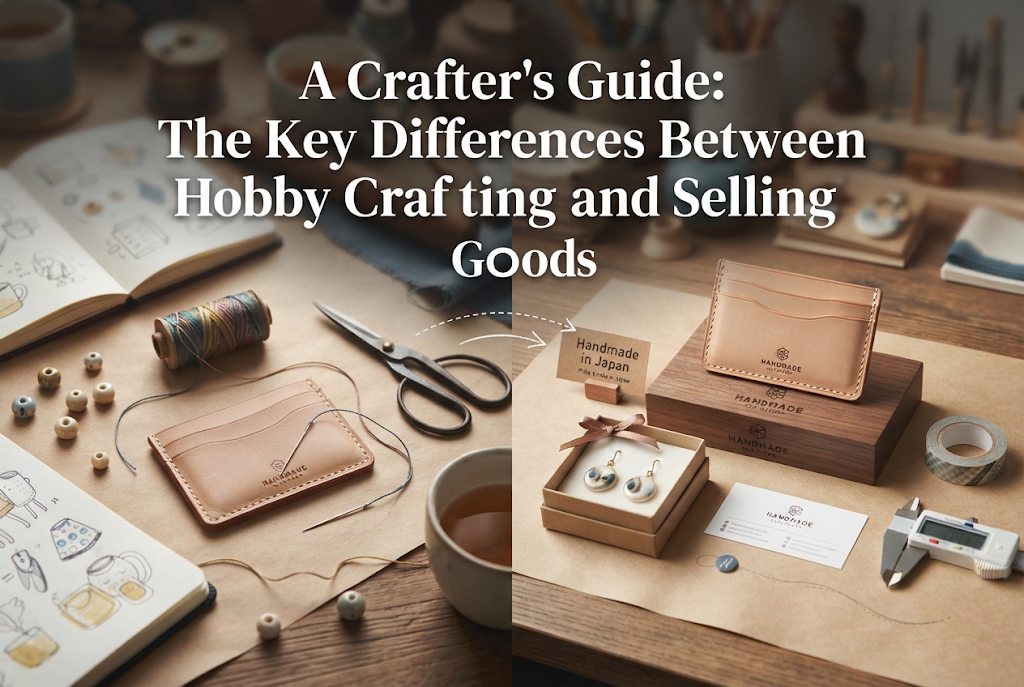
However, when you decide to take that step, you will find a surprisingly large gap between making crafts as a hobby and creating items for sale. If you launch your shop without understanding this distinction, it can lead to unexpected customer complaints, troubles, or even turn crafting into a stressful chore.
In this article, I will explain the essential differences between hobby crafting and commercial selling, covering everything from maker mindset to practical finishing techniques and quality control. If you are planning to launch your journey as a handmade artisan, please read this through to the end!
The single biggest difference between a hobby piece and a commercial product lies in your perspective: Who is this item made for? If this fundamental mindset is misaligned, even the most advanced technical skill will fail to create true commercial value.
When you craft as a hobby, you are the main character. If you create something in your favorite colors, in a shape you love, and in a size that suits your needs, it is already a 100% success.
Even if a seam is slightly crooked or a little glue leaks out, you can smile and say, "Well, I'm using it myself, so it's fine! That's just handmade charm." In hobby crafting, the primary value comes from the excitement of making and getting lost in the creative process.
On the other hand, the main character of a commercial product is a customer you have never met. This customer is spending their hard-earned money on your work.
Once you accept money in exchange for your work, "handmade charm" can no longer be used as an excuse for defects. It is a baseline requirement that the physical product matches the beauty shown in photos, is safe and durable, and provides value exceeding its price. A product put up for sale is certainly a form of self-expression, but it is primarily a commercial good meant to enrich the buyer's daily life or solve a specific need.
Beyond mindset, there are distinct differences in the physical crafting process itself between hobby and commercial work. Let's look at four critical points.
If you make an item for personal use and a clasp breaks or a thread comes loose, you can easily repair it yourself. However, your customers may not have the knowledge or tools to repair handmade items. Therefore, items made for sale require high durability to withstand everyday use.
Failing to verify safety can lead to customer injury. A sellable product must pass strength and safety checks that are two to three times stricter than what you would require for personal use.
For a hobby, a one-off miracle piece where everything happened to align perfectly is cause for celebration. But in commercial selling, when you offer multiple units of the same item, you must maintain reproducibility—keeping sizes, shapes, and color tones within a consistent, acceptable range.
Online shoppers place orders based on product listing photos, expecting to receive exactly what they see. If the physical product looks noticeably different from the photo, or if a pair of earrings has obvious size discrepancies between the left and right sides, it destroys customer trust. Mastering reliable techniques and maintaining precise patterns and recipes is essential.
When crafting for yourself, you can spend as much as your personal budget allows on luxury materials, or combine bargain supplies to keep costs down. You don't need to calculate material costs or profit margins.
When crafting for sale, however, you must set prices by factoring in wholesale material costs, production time, packaging materials, platform listing fees, and shipping. A situation where "the more you sell, the more money you lose" is unsustainable. You need a clear supply plan to source durable, high-quality materials consistently at reasonable prices.
The decisive factor separating amateur work from professional quality is how you treat unseen areas, such as the back or raw edges.
For fabric goods, this means neatly finishing interior seams and trimming loose threads. For jewelry, it means ensuring no excess adhesive spills onto findings and thoroughly polishing the reverse side. Customers feel their purchase is truly worthwhile when even the subtle, hidden details are finished without compromise.
When transitioning from hobbyist to seller, makers often fall into predictable traps. Being aware of them in advance will help you avoid costly mistakes.
While compliments from loved ones are wonderful encouragement, they should not be your sole criteria for launching a business. Friends and family evaluate your work through the lens of a personal relationship; they are rarely judging it from the objective standpoint of a paying customer.
Whether a complete stranger will choose your product over countless competitors and part with their money is an entirely different matter. You must carefully research objective market demand and competitor standards.
It is easy to get excited right after finishing a piece, take photos, and list it online the very same day. This is quite risky.
Adhesives may not be fully cured right after assembly, colors may rub off through actual friction, or structure may warp under weight during daily use. Selling items without a test-use period risks items breaking shortly after arriving at a customer's home, leading to bad reviews and claims.
Another frequent mistake is pouring all energy into the craft itself while treating packaging as an afterthought. In handmade retail, the "product" encompasses everything from the item itself to the packaging and care instructions the customer receives.
If your packaging cannot withstand shipping impacts or rain, the item may arrive damaged. Furthermore, the visual appeal and cleanliness of the box when opened profoundly shape the customer's perception of your brand's value.
To help you determine whether your items are ready for market, here is the personal checklist I use. Go through these points before listing any new item:
Once your work passes every item on this checklist, you can confidently deliver it to customers as a true commercial product.
If you are currently a hobbyist wanting to start selling, here is a practical, step-by-step approach I recommend:
If you try to sell many different types of items all at once, managing quality and inventory quickly becomes overwhelming. Choose just one item that you are most skilled at making and have crafted successfully many times.
For that single item, lock in your pattern, measurements, tools, and adhesives. Practice making three identical pieces in a row with uniform quality. Securing this level of reproducibility will instantly build your confidence as a seller.
When you start selling, feeling pressured to "make things that sell" can cause you to lose sight of the initial joy of crafting. That would be a real shame.
I recommend drawing a clear line between your commercial product line and your personal hobby crafting. Pursue customer-focused quality rigorously for your product line, but reserve dedicated personal time on weekends to craft freely for yourself without worrying about mistakes. This balance keeps your creative passion alive over the long haul.
The difference between a hobby craft and a commercial product is not merely a matter of technical skill. What matters most is your mindset—how deeply you consider and care for the person who will receive your work.
"Let's smooth this edge so it won't scratch the user." "Let's double-stitch this stress point so it lasts for years." "Let's package this neatly so unboxing brings a smile." It is the accumulation of these thoughtful details that turns a hobby project into a valuable product.
Taking the step from hobbyist to seller requires courage, but seeing a customer genuinely delighted by your work is a rewarding feeling that hobby crafting alone cannot replicate. Take your time, build reliable quality standards, and enjoy your exciting debut as a handmade artisan!
If you found this helpful, sharing this article on social media or with fellow crafters would mean the world to me!
Until next time, happy crafting! This was Yassy from Crafters!

For example, if you are looking for articles about mizuhiki, try searching for "mizuhiki"; if you are interested in tools, try keywords like "nippers" or "pliers."
