Beyond the Starter Kit: The Golden Order for Upgrading Japanese Clay Craft Tools
yassy
Crafters!

Hello, everyone! It’s Yassy from Crafters! (・∀・)
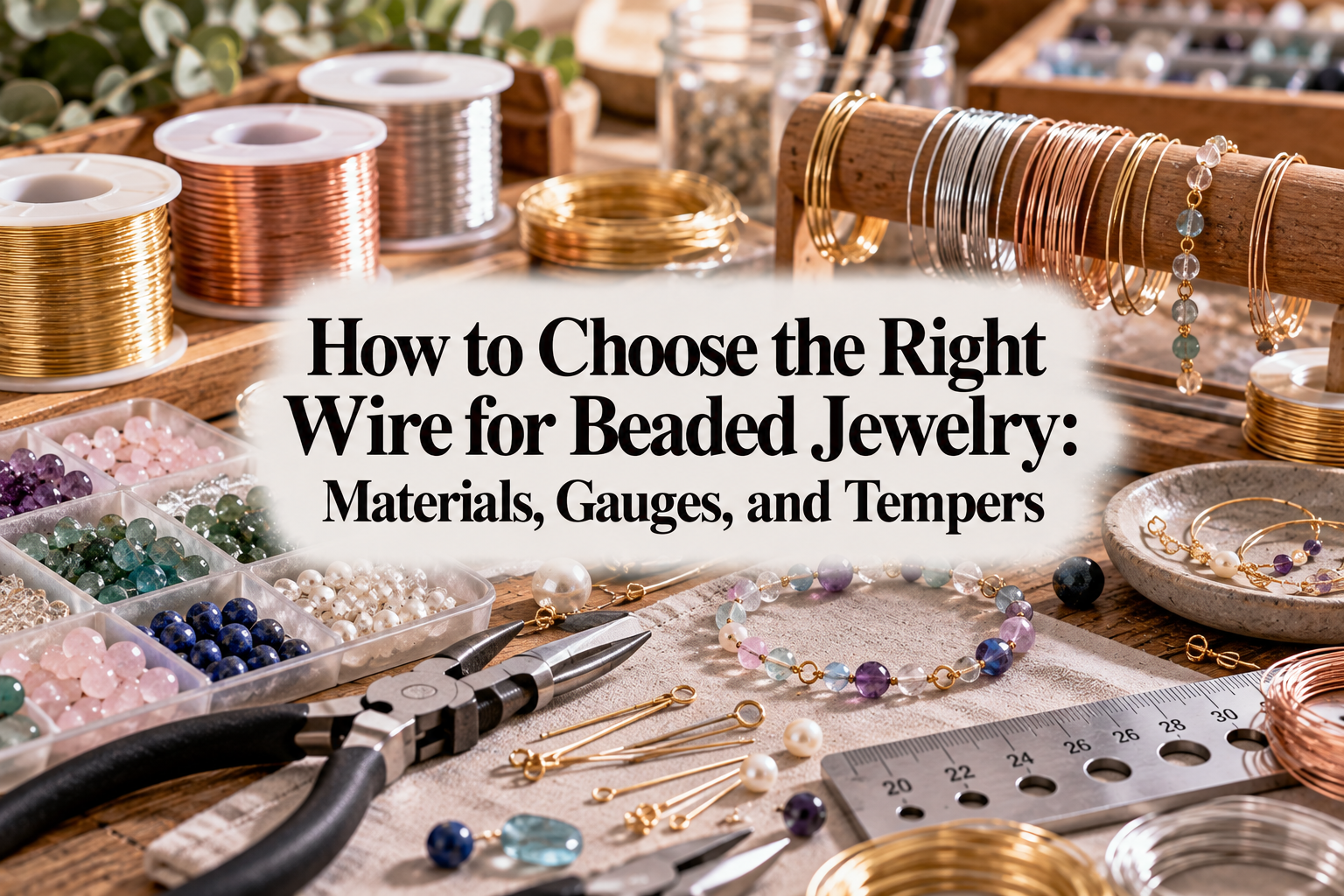
As someone who absolutely loves making, viewing, and shopping for all kinds of handmade crafts, today I want to share a thorough guide on an essential topic for beaded jewelry makers: how to choose the right wire.
When you start making beaded jewelry, one of the first obstacles you run into is the sheer variety of craft wire available. Walking into a craft store or browsing an online shop can be overwhelming when everything looks somewhat similar, yet the materials, thicknesses, and hardness levels are all completely different.
Unlike nylon monofilament (tegusu) or bead cord, craft wire holds its shape securely and brings an elegant metallic luster and high-end feel to your work. However, picking the wrong type can lead to frustrating problems—such as sore fingers from wire that is too stiff, finished pieces that bend out of shape immediately, or wire that simply will not fit through your bead holes.
In this guide, you will learn how to confidently pick the perfect wire for whatever beaded jewelry project you have in mind. Mastering these basics will help you bring your jewelry designs to life exactly as you envisioned.
Wire used in beaded jewelry generally falls into four main categories, each with very distinct structures and working properties. Using the wrong wire can make crafting difficult, so let’s look at how each type behaves.
Artistic Wire is hands down the most versatile and popular option in beadwork and wire jewelry. It features a copper core coated with color, followed by an enamel clear coat or non-tarnish treatment.
Its greatest advantages are rich coloration and resistance to tarnishing. Many brands feature hypoallergenic coatings, and this wire handles wire-wrapped loops (megane-dome), stone framing, and wire wrapping exceptionally well. It bends easily, making it the top choice for beginners and professionals alike.
It is also available in an extensive range of colors, including gold, silver, gunmetal, rose gold, and antique bronze. If you plan to do wire-manipulation work for beaded jewelry, building your collection around Artistic Wire is the best place to start.
Nylon-coated wire consists of multiple ultra-fine stainless steel strands twisted together and encased in a smooth nylon resin jacket. It offers both flexibility and tremendous tensile strength.
This wire is engineered specifically for stringing beads and securing ends with crimp beads (tsubushidama). It cannot be shaped with pliers into wrapped loops. For necklaces and bracelets that carry heavy beads or continuous strands of gemstones, nylon-coated wire is the undisputed choice.
It drapes gracefully like thread while being nearly impossible to snap under normal tension, ensuring your wearable pieces stay secure over time.
These are raw metal wires without protective coatings, commonly found at hardware stores at low prices.
However, I do not recommend using raw brass or raw copper wire for finished beaded jewelry. Contact with air, moisture, and skin oils quickly causes oxidation, leading to dark discoloration or greenish patina (rokushō).
Aluminum wire is extremely soft and easy to manipulate, but it lacks the structural strength needed for delicate beaded jewelry. Unless you are using it strictly for basic practice, always opt for coated wire designed specifically for accessories.
These are high-end materials intended for fine, jewelry-grade pieces. Because they are made from genuine precious metals or feature thick mechanical gold layers, they deliver genuine brilliance and exceptional durability.
While they are more of an investment, combining them with natural gemstones or premium glass beads instantly elevates your piece. They make a wonderful upgrade once you are comfortable working with standard craft wire.
After material, the next critical factor is thickness (wire diameter). Wire size is typically measured in millimeters (mm) or American Wire Gauge (AWG / G).
The most important detail to remember is that in the gauge system, a higher gauge number means a thinner wire. Here is a quick reference conversion:
For most beaded jewelry projects, you will primarily work within the 0.3 mm (28G) to 0.8 mm (20G) range. Sizes outside this window are reserved for specialized techniques.
If your wire is too thick for a bead’s hole, forcing it through can chip or crack the bead. Conversely, if the wire is too thin, the bead will wobble loosely along the wire, leading to misaligned lines.
A professional rule of thumb is to choose a wire that is approximately 0.1 mm to 0.2 mm smaller than the bead’s hole diameter. For example, if a bead has a 0.6 mm hole, a 0.4 mm or 0.5 mm wire will sit securely without excess slack.
Beyond material and gauge, wire also comes in different hardness levels, known as temper. Even with identical diameters and materials, wire behaves very differently depending on its temper.
Craft wire generally comes in three temper ratings:
Here are three practical wire pairings that I rely on regularly in my own studio:
For delicate drop earrings that sway gently, you need a balance of lightness and loop stability.
Wrapping larger beads (10 mm+) or undrilled cabochons requires both a sturdy backbone and pliable wrapping wire.
When stringing multiple beads into continuous strands that rest against the neckline or wrist, rigid solid-core wire will look stiff and unnatural.
Cause: Using wire that is too hard, or applying excessive force with bare metal pliers.Solution: Use half-hard or soft wire for tight bending. Protect your wire by using nylon-jaw pliers, or wrap masking tape around the tips of your flat-nose pliers before working.
Cause: Using wire that is too thin or using dead-soft temper for structural elements.Solution: Never use soft wire for ear wires, clasps, or load-bearing rings. Use at least 0.6 mm (22G) wire in a half-hard temper to ensure the findings keep their shape.
Cause: Repeatedly bending the wire back and forth in the exact same spot, causing metal fatigue.Solution: While quality craft wire is flexible, every metal fatigues when overworked. Plan your bends before applying pressure, and try not to re-bend a single section more than once or twice.
Cause: Sharp pinching or tight pulling during the stringing process.Solution: Because nylon-coated wire contains an inner core of stainless steel strands, a sharp bend causes permanent structural deformation. Store spools flat, unspool gently, and handle the wire in broad loops during stringing. If a sharp kink occurs, cut that segment away and start with fresh wire.
If you are assembling your wire toolkit from scratch, here is the exact progression I recommend to avoid buying unnecessary supplies:
Even high-quality wire can degrade over time if stored improperly. Humidity and ultraviolet light are wire's biggest enemies, leading to surface dullness and premature tarnish.
Always store your wire spools in airtight zipper bags with a small packet of silica gel desiccant. Additionally, keep the free end of the wire taped down with masking tape or tucked into the spool’s rim notch to keep it from uncoiling and developing accidental kinks.
Selecting the right wire directly impacts both the beauty and the durability of your beaded jewelry. Keep these essential points in mind:
Finding the right wire balance will make your crafting process smoother and your finished jewelry look clean, polished, and professional. Pick out the right wire for your current project and enjoy the process of handmade creation!
If you found this guide helpful, please feel free to share it with your fellow makers. See you in the next craft guide—this has been Yassy from Crafters!



For example, if you are looking for articles about mizuhiki, try searching for "mizuhiki"; if you are interested in tools, try keywords like "nippers" or "pliers."
