Beginner’s Guide to Sewing Small Fabric Goods: Zero-Failure Essentials, Fabrics, and Starter Kits
yassy
Crafters!
Hello! This is Yassy from Crafters! (・∀・)
I absolutely love everything about craft life—whether it's spending time crafting unique pieces, browsing beautiful shops for inspiration, or buying materials that spark my creativity! The joy of creating is wonderful, but nothing beats the incredible feeling a handmade artist gets when a treasured item reaches a happy customer.
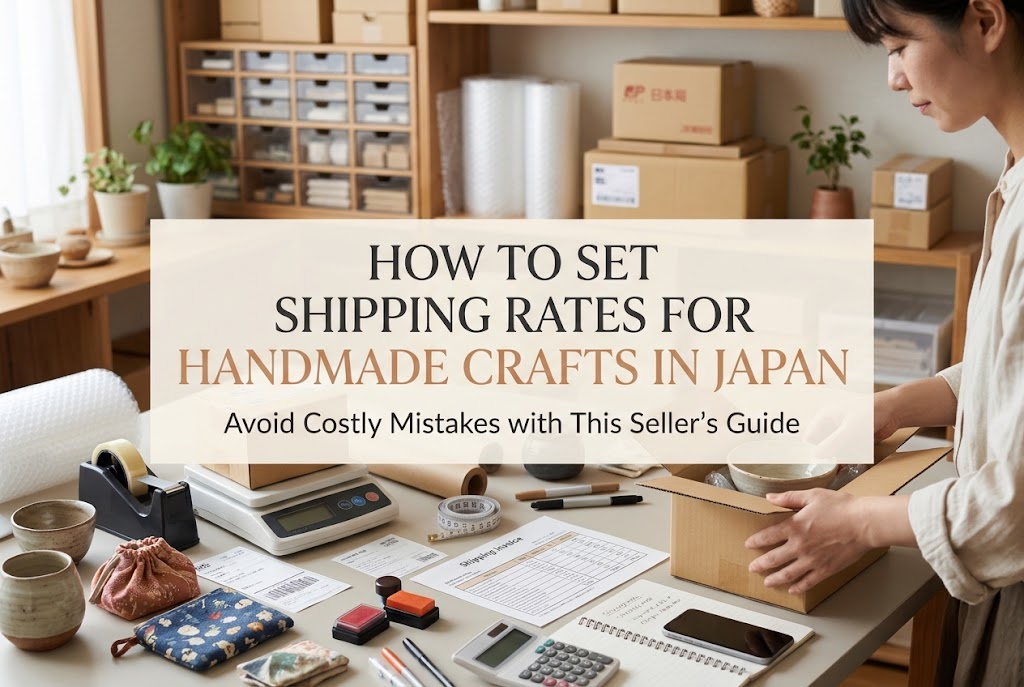
However, when starting to sell handmade items, almost every seller hits the same major wall: "How should I set my shipping rates and free shipping offers?"
If you leave these questions unanswered and set your shipping fees at random, you run the risk of falling into a nightmare scenario where the more you sell, the more money you lose. In my experience observing many creators, I've seen countless artists drain their profits—and lose their passion for crafting altogether—simply because of shipping calculation mistakes.
In this article, I'll thoroughly break down all the know-how you need to set shipping fees without failing! From the pros and cons of "Free Shipping" versus "Shipping Extra," to hidden costs beyond carrier postage, and the trap of combined shipping for multiple purchases, I've packed all my practical insights right here.
Read through to review your shop's shipping setup immediately and step up as a maker who keeps a solid profit!
Setting shipping rates isn't just a matter of quoting what the carrier charges. One wrong move, and your shop's operations can collapse surprisingly fast.
First, let's look closely at the three major traps that handmade beginners tend to fall into. Make sure to check whether you're caught in any of these!
If you're used to shopping on massive e-commerce platforms, it's easy to assume that offering free shipping will instantly boost your orders. However, in the handmade world, this is a very dangerous way of thinking.
Big corporations can offer free shipping because they negotiate massive volume discounts with courier services and work with extremely low item cost ratios. What happens if an individual handmade creator tries to cover shipping out of pocket without a strategy?
Every time an item sells, a few hundred yen disappears straight from your pocket, leaving you with an hourly wage of just a few dozen yen. Even if your revenue figures increase, if the cash in your hand drops, your business is failing.
Please remember: "Free shipping without a strategy" is simply a bad decision that suffocates your business.
"Postage via Non-Standard Post (Teikeigai) costs 120 yen, so I'll set my shipping fee to 120 yen."
If you are thinking this way, stop immediately! This calculation method is guaranteed to put you in the red.
To ship a crafted product, you don't just pay the postage fee to Japan Post or Kuroneko Yamato. You also incur mandatory "hidden costs" such as:
For instance, even if carrier postage is 120 yen, if the mailing box costs 60 yen and the OPP bag plus cards cost 20 yen, your actual expense per shipment is 200 yen. If you set your shipping fee to 120 yen, you are personally paying 80 yen out of your own pocket every time a product sells.
Setting shipping fees based solely on carrier postage is a clear mistake.
When a customer loves your store and orders two or three items at once, it feels fantastic! But if you haven't calculated combined shipping correctly, that happy moment turns into a loss trap.
A single item might fit into a small parcel under 3cm thick (such as Japan Post's Click Post or Yamato's Nekopos). However, bundling two items together often exceeds that 3cm limit, forcing you to switch to a larger shipping service like Yu-Pack or Takkyubin.
If you collected 200 yen for a small parcel, but actual shipping jumps to 800 yen for a door-to-door courier service, you'll have to cover the 600 yen difference yourself. To avoid losing profit on multi-item orders, establishing rules for combined shipping is essential.
"So, should I offer free shipping or charge shipping separately?" Here is my clear answer:
The right choice depends on the price range and category of your items.
You don't need to force all your items into one system. Understand the characteristics of both and choose what fits best for each creation.
"Shipping Extra" means charging the delivery fee as a separate item from the product price.
If your items meet the following criteria, set them to "Shipping Extra" without hesitation:
If you offer "Free Shipping (Shipping Included)" on low-priced items, the item's unit price appears higher, raising the psychological hurdle to purchase.
For example, instead of listing 1,000 yen earrings as "1,250 yen (Free Shipping)", displaying "1,000 yen (+ 250 yen shipping)" communicates the item's reasonable value much more intuitively.
Furthermore, separate shipping makes it much easier to offer customers a sense of savings when buying multiple items together.
"Free Shipping" in this context means building the estimated delivery cost into the product's list price while marking the listing as "Free Shipping" to the buyer.
Items meeting these conditions benefit tremendously from free shipping:
Customers purchasing high-value items over 8,000 or 10,000 yen care more about convenience and a premium shopping experience than calculating minor shipping fees. If they reach the checkout and suddenly see "+ 800 yen shipping," it creates a psychological brake (cart abandonment).
Pricing the item at "12,000 yen (Free Shipping)" from the start allows buyers to complete checkout smoothly. The higher the price tier, the stronger the psychological benefit of free shipping becomes.
Here is the exact framework I use for my own shop and recommend when consulting other makers:
To set proper rates, you must understand the key features of major Japanese delivery services commonly used in handmade selling.
For items under 3cm in thickness, these mailbox delivery services are standard:
This is my top recommended method. It offers a flat rate across Japan and handles up to 3cm thickness, making it ideal for shipping accessories safely in small box packaging. Tracking numbers give buyers peace of mind upon shipping notification.
Integrated shipping services provided by Japanese handmade platforms like minne and Creema (or Mercari) don't require manual address writing and include coverage for lost items. For valuable accessories or one-of-a-kind items, using integrated insured shipping is recommended.
While often chosen for low cost, the lack of tracking means sellers bear all the risk if a parcel goes missing. Considering the effort required for dispute handling, beginners should transition to tracked options like Click Post as soon as possible.
For items over 3cm thick or fragile goods, parcel courier services are necessary.
Use parcel couriers for fragile ceramics, glassware, or large bags. Because rates vary by region, make sure to enter detailed regional shipping tables in your marketplace shipping settings.
As long as items fit into the dedicated envelope, there is no thickness restriction. You can fold the envelope into a box shape for plushies, thick pouches, or small wooden crafts at a flat rate nationwide.
I follow these strict standards when selecting delivery methods:
If a delivery loss occurs without insurance, the costs of remaking, reshipping, or refunding fall entirely on you. Avoid untracked methods just because they're cheap.
Here is the exact formula to ensure you never run at a loss:
[Set Shipping Fee] = [Base Carrier Postage] + [Total Packaging Material Cost] + [Buffer Cost (5 to 10 yen)]
The "Buffer Cost" covers small consumables like tape, printer ink, label paper, and shop cards. Adding 5 to 10 yen prevents out-of-pocket leakage without complex math.
Assuming Click Post postage is 185 yen and shipping in a small box:
Total: 185 + 50 + 5 + 10 + 15 + 5 = 270 yen
In this scenario, your listed shipping fee should be 270 yen!
If you casually set it to 200 yen thinking postage is 185 yen, you lose 70 yen per order (7,000 yen across 100 shipments). Buyers won't mind a small difference when they see care put into secure packaging.
Assuming a size-80 box shipped from Kanto to Kansai with 1,000 yen carrier postage:
Total: 1,000 + 120 + 50 + 20 + 10 = 1,200 yen
Set the shipping fee to 1,200 yen. Fragile items require higher material expenses to prevent breakage during transit.
Japanese marketplaces like minne and Creema feature an "Additional Shipping Fee" (追加送料) setting for multi-item orders. Understanding how this works is critical.
When a buyer purchases multiple items, marketplace systems automatically apply the highest base shipping fee from the items in the cart for the 1st item, then add the additional shipping fee set for each remaining item.
For example:
The customer pays: 250 yen (Item A base) + 50 yen (Item B additional) = 300 yen.
Setting additional shipping to 0 yen is ONLY acceptable if multiple items are guaranteed to fit in the exact same box without exceeding weight or size limits!
For small items like rings or earrings where 2–3 pieces fit in one small box:
Since carriage fees don't change, setting additional shipping to around 50 yen compensates for extra inner packaging while offering the buyer a great deal on combined orders.
For bulky creations like bags, clothing, tableware, or flower arrangements, ordering two items may push parcel dimensions from Size-60 (800 yen postage) up to Size-80 (1,000 yen postage).
[Additional Shipping Fee] = [Up-sized Courier Rate & Materials] − [1st Item Base Shipping Fee]
If 1 item costs 800 yen shipping and 2 items cost 1,000 yen shipping, the difference is 200 yen. Therefore, set the additional shipping fee for that bulky item to 200 yen.
If a buyer orders a large bag (base shipping 1,000 yen) and small earrings (base shipping 250 yen), the system takes the higher base fee (1,000 yen). Fitting small earrings into a large bag box requires no extra box size increase. Thus, setting additional shipping on small accessories between 0 to 50 yen ensures smooth, fair calculations.
Shipping settings can act as a powerful marketing tool to increase your average order value!
Set your free shipping threshold to 1.5x to 2x your shop's average order value. If your average sale is 3,000 yen, set "Free Shipping on orders over 5,000 yen." Buyers carting a 2,500 yen item will often add another 2,000 yen piece just to reach free shipping, significantly increasing your net profit.
Clearly explain your shipping methods in your shop policies. For instance:
[Delivery Options]・Click Post (Nationwide 270 yen): Shipped in a small box with tracking for safety (Mailbox delivery / Uninsured).・Takkyubin / Registered Delivery (Nationwide 650 yen): Hand-delivered with full insurance coverage for loss/damage.
When buyers understand that their 270 yen fee covers box packaging and tracking, they gladly pay it.
Let's review the key takeaways:
Proper shipping rates are the protective wall of your handmade business. Charge fairly for your packaging effort so you can continue buying materials and crafting wonderful creations!
Review your shop's shipping setup today using these formulas. If you found this helpful, sharing it on social media or with maker friends would mean the world to me!
See you in the next article! This was Yassy from Crafters!
For example, if you are looking for articles about mizuhiki, try searching for "mizuhiki"; if you are interested in tools, try keywords like "nippers" or "pliers."