What Is Amigurumi? A Complete Guide to Japanese 3D Crochet: Projects, Care, Difficulty, and Budget
yassy
Crafters!
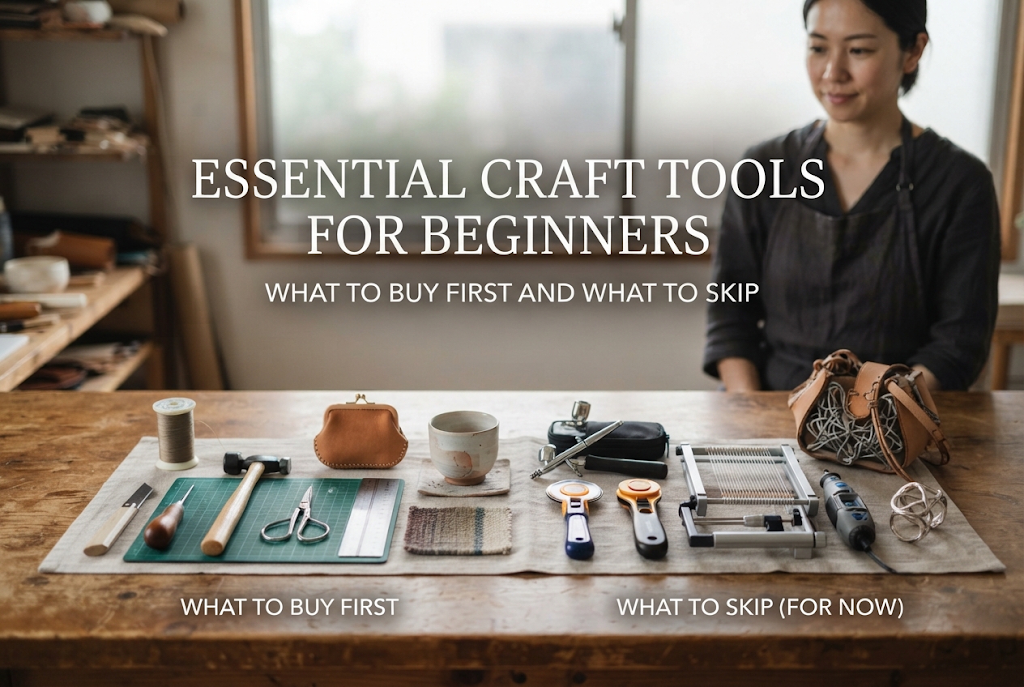

Hello, this is Yassy from Crafters! (・∀・)
I absolutely love making handmade pieces, admiring the work of wonderful artisans, and shopping for cute materials and tools! Just looking at all the shiny tools lined up on craft store shelves gets me excited, and whenever I bring home a new piece of equipment, I often find myself crafting late into the night.
However, there is a major trap that almost every beginner falls into: getting caught up in having all the "proper gear" and buying a mountain of tools you will never actually use.
When you walk into a craft supply aisle, every single item looks incredibly useful, and it is tempting to toss everything into your basket. But you do not need a complete, professional toolkit from day one. In reality, the essentials you truly need at the beginning are very few. Most specialized tools can easily wait until you have gained some experience.
Today, drawing from my own crafting journey—making countless projects, testing endless tools, and learning from plenty of mistakes—I will break down exactly which tools beginners should buy right away and which ones you can safely put off. Let's make sure you start your handmade journey comfortably and without wasting money!
The moment you decide to start crafting, your motivation is at an all-time high. Riding that surge of excitement, many people head straight to craft stores or 100-yen shops and practically sweep entire shelves into their carts. This, however, is a big mistake.
The biggest reason you shouldn't buy too many tools upfront is that until you establish your own crafting style and discover what you truly enjoy making, roughly 80% of what you buy will end up sitting idle.
For instance, imagine you decide you want to make jewelry and immediately purchase a starter kit with multiple pairs of pliers. Once you actually start working, you might realize, "Actually, rather than wrapping wire around beads, I enjoy making clear parts with UV resin much more." At that exact moment, those specialized metalworking pliers become paperweights.
Furthermore, buying expensive or overly specialized tools right away creates unnecessary psychological pressure: "I spent all this money on these tools, so I have to use them." Handcrafting is supposed to be fun; feeling obligated to work just to justify your purchases completely defeats the purpose.
The single best approach to choosing craft tools is this: start with the absolute minimum set of versatile essentials, and only add new tools one by one when you actually feel the need while working. There is no better way.
Whether you want to make jewelry, sew fabric goods, try papercrafts, or sculpt with clay, there are four versatile tools that I consider absolute staples. These items not only determine the quality of your finished work, but they also prevent injuries and drastically boost your efficiency.
For these four essentials, avoid cutting corners. Prioritize usability above all else. Here is what to look for and how to choose them.
Whether cutting paper, trimming thread, slicing ribbon, or trimming thin sheets, there is practically no crafting session without scissors. Instead of using standard household stationery scissors, be sure to get stainless steel craft or sewing scissors with fine, pointed tips.
A pair of scissors with slender, sharp tips allows you to make delicate cuts and trim right up to the edge with precision. If you try to save money by using dull scissors, your cut edges will look jagged, and the overall quality of your project will suffer immediately. Scissors are the most critical tool for clean, precise work.
For measuring and cutting straight lines, always choose a metal ruler (stainless steel). Never use a plastic ruler for cutting tasks.
The biggest flaw of a plastic ruler is that when you run a utility knife or craft blade along it, the blade will shave off the plastic edge. Once the edge is damaged, you can no longer draw or cut a straight line, and worse, the blade might slip over the edge and cut your fingers. A metal ruler withstands craft blades effortlessly, guaranteeing straight, crisp cuts every time. Choosing one with a rubber or non-slip backing will keep it securely in place while you cut.
A cutting mat protects your work surface, but it also defines your entire workspace. I strongly recommend choosing an A3 size over an A4 size.
While an A4 mat might seem compact and easy to store, in practice, setting down a ruler and a few materials completely fills the surface. An A3 cutting mat gives you plenty of breathing room to work without stress. If you choose one printed with grid guidelines, measuring materials on the fly becomes effortless.
Flat-nose pliers (known in Japan as hirayatatoko) act as an extension of your fingers for gripping, bending, holding, and opening/closing small findings. Be sure to pick a pair specifically sold for handcrafting.
Never use standard hardware-store DIY pliers from a home toolbox. General DIY pliers have serrated ridges on the inside of their jaws, which will instantly scratch and ruin delicate jewelry findings and craft materials. Craft-specific flat-nose pliers have completely smooth jaws inside, making them an indispensable staple for clean, scratch-free results.
Today, Japanese 100-yen shops offer an incredible range of craft supplies. You can find almost everything you need in a single visit, and I regularly use items from 100-yen shops myself. However, that does not mean every single tool should be bought there.
There is a clear dividing line between tools where 100-yen options are fantastic and tools where you should invest in reputable craft brands (or professional-grade tools) from the start. Getting this wrong can lead to frustration, broken tools, and wasted money.
Secondary accessories and consumable items that do not directly affect cutting precision or the structural integrity of your piece are smartest to buy at 100-yen shops.
For primary tools responsible for cutting, shaping, and bonding—actions that dictate how durable and polished your work looks—invest in quality products from established manufacturers right away. In the end, they save you substantial time and dramatically elevate the beauty of your finished projects.
Here, we will look at three popular beginner genres—jewelry making, fabric crafts, and clay crafting—and sort the tools into what you need immediately and what you can safely postpone.
Jewelry is one of the easiest crafts to enter, but it is also the category with the highest number of specialized small tools. Resist the urge to overbuy and keep it streamlined at first.
Tools You Need Right Now:
Tools That Can Wait:
It is easy to assume you can get by with regular household items for sewing, but having proper basic sewing tools is the quickest route to well-finished projects.
Tools You Need Right Now:
Tools That Can Wait:
Clay and miniature crafting feature a near-infinite variety of shaping tools. If you try to buy them all at once, you will quickly end up with an unmanageable collection.
Tools You Need Right Now:
Tools That Can Wait:
When starting a new craft, keeping your initial tool expenses under roughly 3,000 yen is the smartest approach. Rather than spending your entire budget on tools, save your funds to purchase beautiful, high-quality materials and findings.
Here are two realistic starter kits that keep costs minimal while setting you up for success:
This is all the tooling you need! Spend the remaining funds on beads, natural stones, or findings that you genuinely love. Working with quality components helps even a beginner's first project look polished and store-ready.
Just like with jewelry, prioritize your budget on a proper cutting tool, then cover the rest with simple essentials. Use your savings to choose fabrics and decorative woven labels that inspire you.
People who struggle with tool clutter usually fall into similar traps. I have fallen into every one of these myself in the past, winding up with piles of unused items. Keep these in mind so you don't repeat my mistakes!
Online marketplaces are filled with "30-Piece Ultimate Beginner Craft Kits! Everything you need to start today!" While they look like a bargain, I suggest passing on them.
To keep the price low, these kits often include low-grade tools. In particular, the wire cutters and scissors are usually dull, meaning you will end up having to replace them anyway. On top of that, out of 30 pieces, you might only ever use three or four; the rest will sit forgotten in the box. Selecting a few quality essentials individually is always the better route.
When you see admired artisans on social media using high-end, specialized tools or imported equipment, it is easy to think, "If I had that tool, maybe my work would look that good too." But tools are instruments, not magic wands.
Professional crafters get incredible results because of their foundational technique and hours of hands-on experience. If a beginner jumps straight to complex, high-end gear, the features often go unused, or the tool gets damaged due to improper handling. Always start with straightforward, easy-to-handle basics that match your current comfort level.
The craft world is packed with novelty gadgets designed for hyper-specific tasks—like gadgets to close jump rings with one hand or tools designed solely to fold a bow.
While they sound convenient, single-purpose gadgets have zero versatility. They do one job and take up drawer space. Build solid manual habits using basic tools first. Once you have built your fundamental skills and discover that a repetitive step is genuinely slowing you down, that is the right time to consider a specialized helper tool.
In the handmade world, your tools are your creative partners. But if you invite too many partners into the room at once, instructions get mixed up and your progress stalls.
As we've covered, the essentials you actually need at the start are very modest:
Follow these simple rules, and you will never regret your tool purchases. Instead of spending your budget on unnecessary gear, put it toward gorgeous materials or exploring the work of other makers to sharpen your creative eye.
Keeping your toolkit minimal means a tidy workspace, effortless cleanup, and the freedom to start crafting whenever inspiration strikes. Pick up a few trusted tools you feel confident using, and dive straight into making something special! Nothing beats the joy of watching something you imagined take shape in your own hands.
Until next time, happy crafting! This was Yassy from Crafters!

For example, if you are looking for articles about mizuhiki, try searching for "mizuhiki"; if you are interested in tools, try keywords like "nippers" or "pliers."
