Japanese Candle Maker’s Complete Guide to Wax Types: Master the Choice for Flawless Creations
yassy
Crafters!
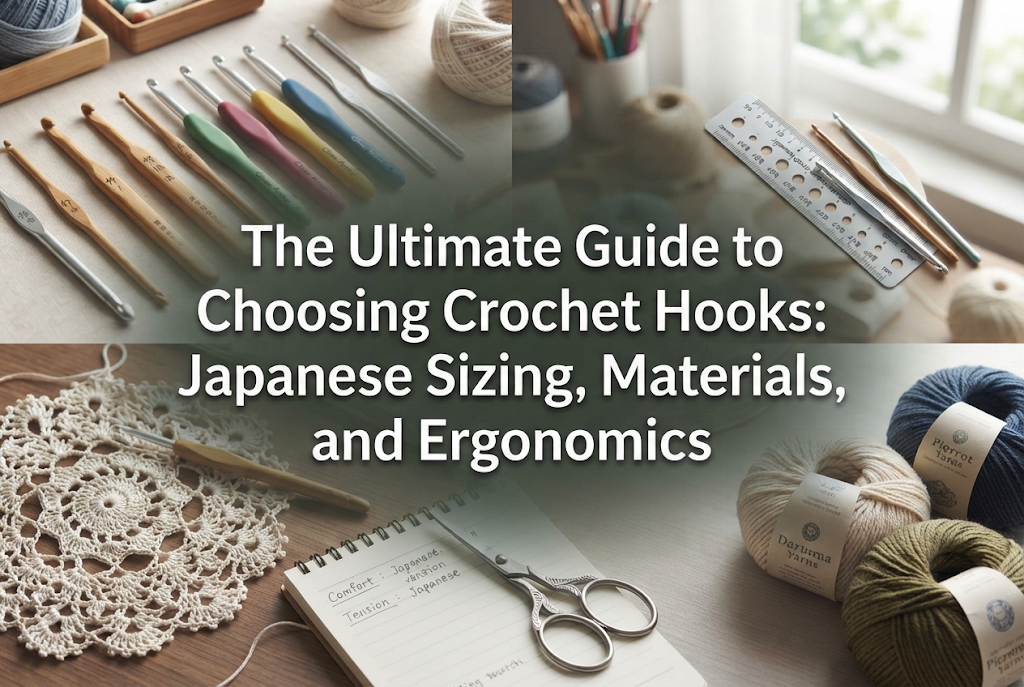

Hello, everyone! This is Yassy from Crafters! (・∀・)
When you decide to try crochet and look at the vast array of crochet hooks lined up in craft stores or online shops, have you ever felt completely lost about which one to choose?
From classic metal hooks to warm bamboo hooks and colorful ergonomic grips, the options vary wildly in appearance, feel, and price.
You might think, "Isn't every crochet hook essentially the same?" But that is a huge misconception!
If you use a crochet hook that doesn't fit your hand or style, your stitches can become uneven, your yarn might snag and cause constant frustration, or worst of all, your hand might start hurting—causing you to lose your passion for crochet altogether.
I love making, viewing, and shopping for all kinds of handmade crafts, and when it comes to crochet, I deeply appreciate the immense importance of choosing the right tools.
Simply using the perfect hook selected with the right knowledge will dramatically boost your stitching speed, the beauty of your finished work, and your overall crafting joy.
In this guide, I will thoroughly explain the absolute rules of selecting crochet hooks—covering materials, how to read Japanese size charts, hook tip shapes, grip variations, and the common pitfalls that beginners often encounter.
By reading this article to the end, you will know exactly which crochet hook you should buy right now. Let's eliminate all confusion and start your best crochet life!
Before selecting a hook, the first thing you need to understand is how sizing and numbers work. If you visit a Japanese craft shop without knowing these sizing rules, you might accidentally purchase the wrong thickness and struggle to even begin your project. Make sure to firmly grasp how Japanese hook sizes operate!
When browsing the crochet section in Japan, you will see two distinct types of hooks side by side: crochet hooks (かぎ針 – Kagibari) and lace hooks (レース針 – Race-bari). These are completely different tools, and their sizing systems run in opposite directions!
Japanese crochet hooks are written with a "/0" suffix, such as 2/0 (pronounced ni-slash-zero-go). For crochet hooks, the larger the number, the thicker the hook.
On the other hand, lace hooks are written simply as 0, 2, or 8. For lace hooks, the larger the number, the finer and thinner the hook. Lace hooks are designed for crafting delicate lace with ultra-fine thread, whereas crochet hooks are intended for standard yarns.
If you are a beginner starting out with standard yarn, make sure you choose a crochet hook labeled with the "/0" notation.
Crochet hooks sold in Japan use a unique numerical sizing system called Gosu (号数). The thickness is determined by the shaft diameter (the cylindrical body between the handle and the hook tip) measured in millimeters (mm).
Here is the reference table showing the main Japanese hook numbers and their exact millimeter equivalents:
Notice that slight variations like 7/0 (4.0mm) and 7.5/0 (4.5mm) exist; even a fraction of a millimeter makes a noticeable difference in your finished work. Yarn labels in Japan always specify a recommended hook size, such as "Hook Size 6/0–7/0". Using the recommended size is essential to ensure your project turns out in the correct dimensions and beauty.
Hooks thicker than 10/0 (6.0mm) are classified as Jumbo Crochet Hooks and are labeled directly in millimeters, such as 7mm, 8mm, 10mm, or 15mm. These jumbo hooks are used for super bulky yarns or T-shirt yarns.
More crafters today follow international crochet patterns and video tutorials. However, the Japanese "/0" notation is not used outside of Japan. Sizing standards differ completely across the US, UK, and Europe.
In the United States (US standard), sizes use a combination of letters and numbers, such as G-6 (4.0mm) or H-8 (5.0mm). In Europe, hooks are labeled simply by their millimeter measurement (4.0mm, 5.0mm, etc.).
When following an international pattern, do not look at the letter codes—always convert to millimeters (mm) to find the corresponding Japanese hook. Most Japanese crochet hooks display both the Japanese size number and the millimeter size (e.g., "7/0 – 4.0mm") on their packaging or handles, making it easy to match any global pattern seamlessly.
Crochet hooks are crafted from various materials including metal, bamboo/wood, plastic, and soft ergonomic resin. The material fundamental changes two major factors: how smoothly the yarn glides and how much fatigue your hands experience. Let's look at the characteristics of each material.
Metal hooks are the most traditional and classic option. Steel is primarily used for fine hooks, while lightweight aluminum is used for medium to thick hooks.
Pros: The biggest advantage is the ultra-smooth surface, allowing yarn to glide effortlessly without snagging. This makes metal ideal for crafters who want to stitch quickly. Furthermore, metal hooks virtually never bend or break, offering outstanding durability.
Cons: If your hands get sweaty, the metal can feel sticky, and it feels cold to the touch during winter. Additionally, basic metal hooks often feature flat, thin handles that can press uncomfortably into your fingers during long crafting sessions. If you have a tight grip or want to avoid finger pain, choosing a metal hook with an ergonomic grip handle is essential.
Currently the most popular choice in the handmade community—and the option I most strongly recommend—is the ergonomic gripped crochet hook. These feature a smooth metal hook tip paired with a soft resin or rubber handle.
Pros: The key advantage lies in the 3D ergonomic shape designed specifically to fit the human hand. It fits comfortably against your fingers, allowing you to hold the hook lightly without unnecessary strain. Hand fatigue and pain are drastically reduced during long projects. It truly combines the smooth glide of metal with the effortless comfort of resin.
Cons: They are slightly more expensive than plain metal hooks, but given the massive gain in comfort and stitch quality, they are well worth the investment. For beginners, a gripped hook is hands-down the best first purchase you can make.
Hooks made from bamboo or wood offer natural warmth and a pleasant, tactile feel.
Pros: Their main strength is moderate surface friction. When working with slippery yarns, a metal hook can cause loops to slide off too easily, ruining your tension. Bamboo and wood hold onto the yarn securely, allowing you to stitch at a controlled, comfortable pace. Complete beginners who frequently struggle with yarn slipping off the hook will find bamboo hooks very forgiving and stable.
Cons: Very thin bamboo hooks can snap under excessive pressure. Additionally, over years of use, the tips may wear down or become slightly rough, requiring periodic care or replacement. They are exceptionally suited for slick acrylic yarns or slippery summer cottons.
Plastic or acrylic crochet hooks are bright, colorful, and extremely lightweight. They are commonly used for jumbo sizes such as 8mm, 10mm, or larger.
Pros: Making large hooks out of metal would make them far too heavy and tiring to hold. Plastic provides substantial thickness while remaining exceptionally light. This lightness is a massive advantage when crocheting thick scarves, cowls, or T-shirt yarn bags with bulky yarns.
Cons: Plastic can generate static electricity, causing fine yarn fibers to cling to the hook. Furthermore, the surface is not quite as slick as polished metal, which can cause slight resistance when working with stiff fibers. Use plastic hooks as dedicated secondary tools for super bulky projects.
A crochet hook's performance isn't determined solely by its material. The specific shape of the hook tip (head & throat) and the design of the grip heavily impact your crafting experience. Let's break down these structural details.
The tip of a crochet hook consists of two main parts: the top (point) that pierces through stitches, and the hook/throat (indentation) that catches and pulls the yarn.
If the top point is moderately defined, it enters stitches smoothly. If the tip is too rounded, it won't push into tightly woven stitches easily, requiring extra force from your wrist.
Next is the depth of the throat. A throat that is too deep holds yarn securely but tends to catch on previous loops when pulling through. Conversely, a throat that is too shallow lets the yarn slip off mid-stitch, forcing you to redo movements repeatedly.
Yarn splitting (where the hook catches only some fibers of a multi-ply strand) occurs when the throat angle is too sharp or has unpolished edges. High-quality Japanese craft brands design their hook tips with a precise "golden balance" of curvature and depth. If you struggle with yarn splitting, upgrading to a high-precision Japanese brand hook can resolve the issue instantly!
There are two primary ways to hold a crochet hook: Pencil Hold (holding the hook like a pencil) and Knife Hold (gripping over the top like a kitchen knife). In Japan, the pencil hold is most common, whereas the knife hold is widely favored internationally.
The shape of grip you should choose depends entirely on how you hold your hook:
Observing your own natural holding style and picking a matching grip design is the secret rule for stress-free stitching!
Beginners often fall into predictable traps due to a lack of tool information. Recognizing these three common mistakes will save you time, money, and frustration!
100-yen shop (dollar store) hooks are budget-friendly and great for a quick test. However, attempting to complete a full project using basic budget metal hooks can easily lead to disappointment.
Mass-produced budget hooks sometimes have microscopic surface imperfections or burrs. These tiny rough spots snag yarn fibers, damaging the strand and creating friction that forces you to grip harder. As a result, your hands ache, making crafting feel like a chore.
Solution: Using a budget hook to practice a couple of rows is fine. But if you want to complete a real project—like a coaster, pouch, or scarf—invest in a quality hook from a recognized craft manufacturer. The price difference is small, but the incredible smoothness and comfort will transform your experience. Choosing a brand with a cushioned rubber grip keeps hand pain virtually at zero.
Another frequent mistake is using a 5/0 (3.0mm) hook simply because it's the only one on hand, even when working with bulky yarn.
What happens if your hook is too small for the yarn? The yarn won't fit into the hook throat, causing severe splitting. Furthermore, the stitches become extremely tight and dense, turning your project stiff like a wooden board.
Conversely, using a huge hook with thin yarn creates oversized, gaping loops that look loose and messy.
Solution: Always buy your yarn first, check the recommended hook size printed on the yarn label, and acquire the matching hook size. Matching your tools to your yarn is a fundamental rule of handmade crafts.
It is tempting to buy inexpensive multi-piece hook sets online that span from size 2/0 all the way to 10/0, thinking, "This covers everything for a low price!"
However, these sets often include sizes you may never use (like ultra-fine 2/0 or very thick sizes) or lower-quality finishes. In the end, crafters often end up using only one or two middle sizes (like 6/0 or 7/0), while the rest sit untouched in a drawer.
Solution: As a beginner, I strongly recommend buying individual hooks. Purchase high-quality single hooks in only the sizes required for your current project. As you complete more projects, you will naturally discover which sizes you use most. At that point, investing in a complete set from your favorite brand with a storage case becomes a truly satisfying purchase!
If you're wondering, "Which single hook should I buy first?" here are my direct recommendations based on what you plan to make!
If you haven't decided on a specific project yet but want to practice crochet, pick up an ergonomic gripped hook in size 7/0 (4.0mm) or 8/0 (5.0mm).
These two sizes perfectly match medium (worsted/DK) to aran weight yarns—the most common yarn weights in crafting. Tiny hooks make stitches hard to see, causing beginners to struggle, while overly large hooks require bigger hand motions that are harder to control. Sizes 7/0 and 8/0 offer the ideal golden balance: easy-to-see stitches and comfortable handling.
If you want to focus on small items like coasters, small pouches, or dish scrubbies, sizes 5/0 (3.0mm) to 6/0 (3.5mm) are ideal. Small accessories require neat, tight stitch definitions.
In fact, when crafting Amigurumi (crocheted stuffed plushies), a pro technique is to use a hook one size smaller than the yarn's recommended size (such as a 4/0 or 5/0). This creates a firm, tight weave that prevents the interior fiberfill stuffing from poking through the gaps!
For wearable items like scarves, cowls, blankets, or cardigans, choose sizes 8/0 (5.0mm) to 10/0 (6.0mm) or larger jumbo sizes. Wearables need a soft, supple drape. Using a slightly larger hook creates airy, gentle stitches that feel wonderful against the skin.
Large projects involve tens of thousands of stitches, making hand ergonomics your top priority. Choose a high-quality ergonomic hook with a soft rubber grip to absorb hand tension throughout your crafting journey.
To master crochet hook selection, you must understand personal stitch tension. Every crafter naturally holds yarn with a different level of tightness.
The recommended hook size on a yarn band is merely a standard baseline. Once you know your own tension tendencies, you can adjust your hook size like a professional!
If your stitches constantly shrink, making it difficult to push the hook tip into previous loops, you have tight tension. This is common among beginners who hold yarn tightly due to nervousness.
If you have tight tension and stick strictly to the label's hook size, your finished project will turn out significantly smaller and stiffer than expected.
Adjustment: Use a hook that is one size larger than the yarn label recommends. For example, if the yarn calls for a 6/0 (3.5mm) hook, use a 7/0 (4.0mm) hook instead. The slightly larger shaft compensates for your tight grip, restoring the correct size and soft texture.
If your stitches look loose, floppy, or uneven, you have loose tension. This happens when yarn is pulled too loosely or hand motions are wide.
Adjustment: Use a hook that is one size smaller than recommended. If the yarn specifies a 7/0 (4.0mm) hook, switch to a 6/0 (3.5mm) hook. Dropping down one size automatically tightens your stitches, producing clean, beautifully aligned rows.
Remember: recommended sizes are guidelines, not rigid laws. Adjusting your hook size to suit your hand is the secret to professional results!
Choosing a crochet hook isn't just about grabbing a tool—it's the single most important step in shaping your finished work and turning your crafting time into sheer bliss.
Let's quickly recap our key rules:
By following these simple guidelines, you will never make a mistake in selecting tools again. Once you hold a hook that fits your hand effortlessly, you'll love the feeling of yarn gliding smoothly through your fingers.
If you found this guide helpful, please share it with your crafting friends on social media or messaging apps! It means the world to me and inspires my writing.
Until next time, happy crafting! This was Yassy from Crafters!


For example, if you are looking for articles about mizuhiki, try searching for "mizuhiki"; if you are interested in tools, try keywords like "nippers" or "pliers."
