Beginner’s Guide to Candle & Aroma Wax Sachet Making: Start Today with a Starter Kit
yassy
Crafters!

Hello everyone, Yassy from Crafters here! (・∀・)
When you first start making candles, one of the biggest hurdles you encounter is figuring out which wax to choose from the overwhelming variety available. When you browse craft supply shops, you will see paraffin, soy, beeswax, gel, palm wax, and more lined up side by side.
Even though they might all look like similar white powders or pellets, their properties and characteristics are completely different. Picking the wrong wax can lead to frustrating failures: candles stuck frozen inside molds, unsightly surface cracks, or wicks that drown and extinguish halfway through burning.
Having crafted, collected, and tested countless candles over the years, I can confidently say that 90% of a candle's final quality and finish is decided by your wax selection. In this guide, I will thoroughly explain the properties, melting points, and surface finishes of essential wax types, along with golden blending rules to ensure zero failures. By the end of this article, you will know exactly which wax to pick for your dream project and be able to create store-quality candles consistently!
Candle wax is far more than just material that melts when lit. Every type of wax has specific parameters for its melting point, shrinkage rate when cooling, compatibility with dyes and fragrance oils, and surface texture.
For example, the wax ideal for container candles (poured into glasses or tins) is fundamentally different from the wax used for pillar candles (cast in molds and removed). If you pour a wax with a low shrinkage rate into a silicone mold, it will adhere tightly to the inner walls as it hardens, making it almost impossible to remove regardless of how much force you apply. Conversely, if you pour a wax with a high shrinkage rate into a glass jar, it will contract significantly while cooling, creating unsightly gaps between the wax and the glass walls.
These mistakes are not due to a lack of crafting technique; they happen simply because the wax was used outside its natural characteristics. Understanding and matching these properties is the absolute shortest path to failure-free candle making.
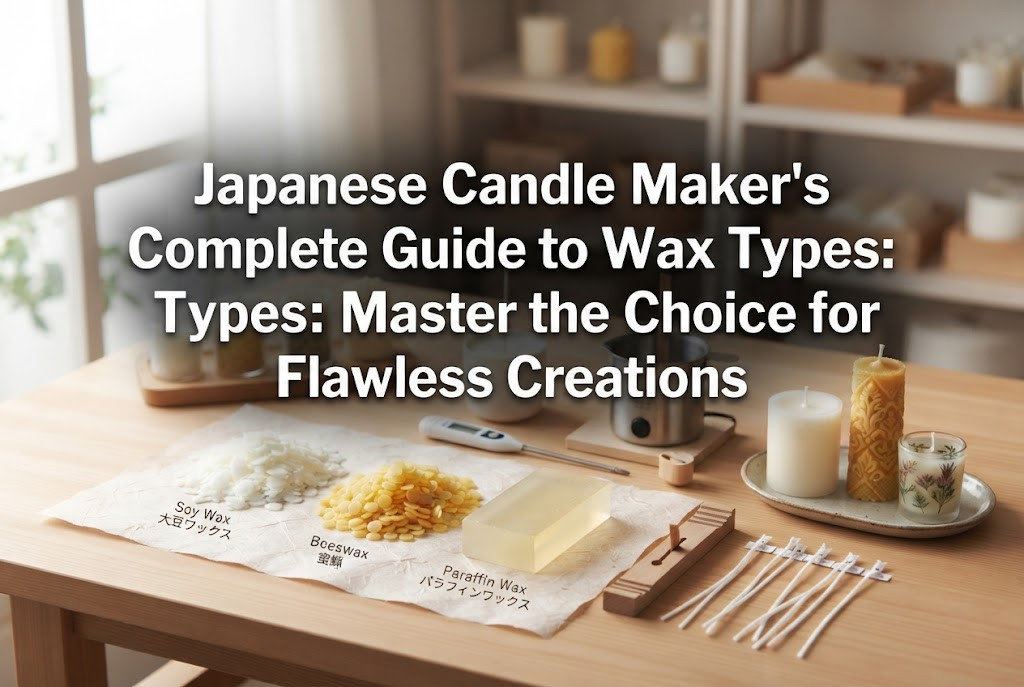
Here are the six main types of candle wax frequently used in handmade crafting, along with their raw materials, textures, melting points, pros, and cons.
Paraffin wax is a refined petroleum byproduct and the most standard wax in candle making. Most commercial candles produced worldwide use paraffin. Its standard melting point is around 58°C (136°F), offering great ease of use and exceptional cost performance.
It holds color beautifully, allowing you to achieve exact, vivid shades when mixing candle dyes or pigments. Because it contracts moderately as it cools, it releases smoothly from polycarbonate or silicone molds. It is an indispensable material for mold-based works like pillar candles, gradient candles, and sculpted motif candles.
However, paraffin has a strong tendency to form a crater or sinkhole in the center as it hardens. Because of this, a "second pour" or topping-off step is required during production to fill the depression. Additionally, it can produce soot if paired with an incorrect wick size.
Soy wax is derived from hydrogenated soybean oil. As a 100% plant-based wax, it is eco-friendly, clean-burning, and produces minimal soot, making it wildly popular among natural craft enthusiasts. Soy wax cures to a creamy, matte finish that gives off a cozy, high-end feel. Because it melts at a lower temperature and burns slowly, it diffuses fragrance oils gently into the air, making it the best choice for scented candles.
When purchasing soy wax, you must pay close attention to the difference between "Soft Type" and "Hard Type":
Using the wrong type will result in molded candles crumbling upon extraction or container candles melting into a liquid mess. Also, as a natural vegetable wax, soy wax is prone to "frosting" (a white crystalline powder forming on the surface) or micro-cracking. Careful temperature control during pouring is essential to prevent this.
Beeswax is a natural wax secreted by honeybees to construct their honeycombs. It comes in two varieties: unrefined natural Yellow Beeswax and refined, bleached White Beeswax. It features a high melting point between 62°C and 65°C (143°F–149°F), hardening into an extremely durable candle.
Yellow Beeswax emits a subtle, sweet honey scent and is believed to help purify the air when burned. Due to its sticky texture, rather than using it alone for molded candles, it is best blended at 10%–30% with paraffin or soy wax to increase structural strength. Its warm, natural golden glow cannot be replicated by any other wax. White Beeswax is odorless, making it perfect when you want to dye your candles or create elegant, pure-white pieces. Though more expensive than petroleum or plant waxes, its premium quality is well worth the investment.
Palm wax is a natural plant wax processed from oil palm fruit. Its most striking feature is the beautiful, shimmering crystalline patterns that emerge on the surface as it cools. Varieties include "Crystal Type" (glittery sparkle) and "Feather Type" (patterns resembling bird feathers).
With a high melting point between 55°C and 65°C (131°F–149°F), it hardens into a very solid texture, making it excellent for molded pillar candles. Its moderate shrinkage ensures clean mold release, leaving a unique, crisp surface finish with a low sheen. Adding dyes highlights these crystal patterns even further, creating a dreamy look unique to palm wax. It also holds scent well, balancing beauty and practicality. Keep in mind that air bubbles can easily get trapped, so slow cooling is necessary for optimal crystal formation.
Gel wax is made by combining mineral oil with polymer resins to form a jelly-like wax. Its greatest advantage is its stunning high transparency, allowing you to see right through the candle. Even at room temperature, it does not turn solid like traditional wax, retaining a soft, springy elasticity.
By arranging dried flowers, sea shells, glass figurines, or glitter inside a container and pouring in gel wax, you can craft mesmerizing botanical gel candles. Its melting point is high, exceeding 90°C–100°C (194°F–212°F+), requiring higher heat during preparation. Pouring too quickly can introduce air bubbles that reduce transparency, so slow pouring and gentle cooling are key. Practically, gel wax also boasts a significantly longer burn time than standard waxes.
Microcrystalline wax is produced during the petroleum refining process and consists of fine crystalline structures. It is rarely used as a standalone base wax; instead, it serves as an additive or modifier blended into paraffin wax in small amounts.
It has a high melting point between 60°C and 80°C (140°F–176°F) combined with remarkable pliability and stickiness. Adding just 5%–10% microcrystalline wax to paraffin eliminates the brittle nature of paraffin, preventing surface cracks. Furthermore, it reduces trapped air, smooths the surface, and prevents uneven dye dispersion. It is also an essential component when making pliable sheet wax for hand-sculpted clay-style candles.
The melting point—the temperature at which the wax begins to liquefy—is the single most important parameter when selecting candle wax. Understanding how melting points relate to candle construction is crucial for crafting success.
If you try to make a freestanding pillar candle using low-melting-point wax, it will either break upon mold removal or stick stubbornly inside the mold.
If you use high-melting-point wax in a container candle, the flame will melt only a narrow tunnel around the wick (tunneling), leaving a thick wall of unburned wax around the sides. Container candles strictly require low-melting-point waxes.
Here are three common issues beginners encounter during candle making, along with their causes and solutions. Almost every issue stems from selecting the wrong wax or mismanaging temperature.
Cause: You likely used soft soy wax or low-melting-point paraffin designed for containers. Because these waxes have very low shrinkage rates, they stick firmly to the inner mold walls.
Solution: Always use high-melting-point waxes with good shrinkage (100% paraffin, palm wax, or hard soy) for molded projects. If a candle is currently stuck, place the entire mold in the freezer for about 15 minutes. This temporarily contracts the wax, helping it release.
Cause: This is caused by the strong volumetric contraction inherent to paraffin wax. As the wax cools from the outside inward, the core shrinks last, pulling downward.
Solution: Sinkholes are a natural physical property of paraffin wax. To fix this, reserve a small portion of melted wax during your initial pour. Once the main body hardens, poke small holes around the wick with a bamboo skewer to release trapped air pockets, then perform a "second pour" with the reserved wax at the same temperature to level the surface.
Cause: Frosting is a natural phenomenon that occurs when 100% natural soy wax recrystallizes as it cools. While harmless, it affects the visual appearance.
Solution: Control your pouring temperature strictly. Allow soy wax to cool down to 50°C–55°C (122°F–131°F)—just before it starts to slush—before pouring slowly into containers or molds. Pouring at high temperatures extends cooling times, encouraging crystal growth. Alternatively, blending 5%–10% paraffin or microcrystalline wax into your soy wax will eliminate frosting completely while maintaining a natural look.
While using a single wax type works fine, mastering wax blends elevates your work to a professional standard. Here are two tried-and-tested golden recipes I frequently use in my studio:
Paraffin alone can be brittle and snap if dropped, or show white stress lines along color gradients. Adding 10% microcrystalline wax gives the candle a smooth texture and greatly increases its toughness while maintaining effortless mold release.
Aroma sachets made solely with soy wax can crack around embedded dried flowers or break when handled. Blending in 20% beeswax provides a tough, solid foundation, adding an elegant subtle sheen that makes your sachets look like luxury hotel amenities.
If you're wondering which wax to buy for a specific creation, use this quick reference guide before ordering supplies:
Proper melting techniques are just as vital as choosing the right wax. Follow these two mandatory rules for safety and quality:
Never heat candle wax directly over an open flame or direct heat source. Wax is flammable, and overheating can cause it to flash and ignite—especially if it reaches its smoke point (around 200°C / 392°F). Melt wax safely using a double boiler setup (a heat-safe pitcher set inside a pan of simmering water) or a temperature-controlled electric wax melter/IH plate.
Guesswork is the leading cause of candle failures. Always measure temperatures precisely with a digital thermometer: measure the melting point, the fragrance addition temperature (typically around 70°C / 158°F), and the exact pouring temperature recommended for your specific wax. Strict temperature control eliminates up to 80% of common surface flaws, cracks, and bubbles.
We have covered everything from wax properties and melting points to golden blending ratios and project recommendations. Let's recap the key takeaways:
Understanding these unique characteristics allows you to transform simple wax into gorgeous, high-quality candles that look completely professional. Pick a project you want to try, grab the right wax, and enjoy the magical craft of candle making!
If you found this guide helpful, please share it with your fellow crafters! Until next time, this was Yassy from Crafters!

For example, if you are looking for articles about mizuhiki, try searching for "mizuhiki"; if you are interested in tools, try keywords like "nippers" or "pliers."
