Level Up Your Leathercraft: How to Choose and Use Rubber Boards and Setting Anvils
yassy
Crafters!
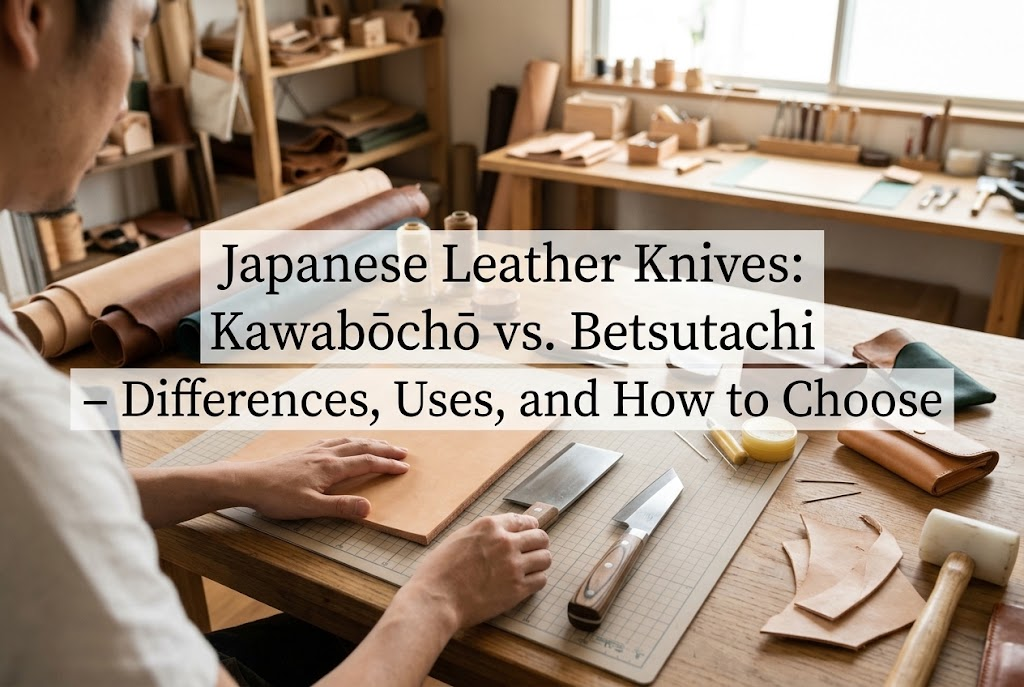

Hello, everyone! This is Yassy from Crafters! (・∀・)
I love making, looking at, and buying all kinds of handmade crafts. When I first stepped into the world of leathercraft, the very first major hurdle I faced was choosing the right cutting tool.
Standard utility knives or scissors meant for paper and fabric simply cannot cut genuine leather—with all its thickness and density—in clean, straight lines. The cut edges often end up slanted, distorted, or frayed, which drastically lowers the overall quality of your finished project.
To cut genuine leather exactly as you intend and achieve impeccably clean edges, two dedicated tools are indispensable: the traditional Kawabōchō (Japanese leather knife) and the Betsutachi. Both are specialized cutting tools designed specifically for cutting leather and for kawasuki (leather skiving—shaving down the thickness of leather edges).
However, beginners often wonder: "Should I buy a traditional Japanese leather knife, or a utility-style Betsutachi?" and "How do these actually differ from a regular box cutter?"
In this guide, I will draw upon my hands-on experience and craft knowledge to clearly explain their functions, how to use them, their structural characteristics, how they differ from everyday cutting tools, and how to choose the right one without mistakes. By the end of this article, you will know exactly which blade fits your projects and workspace, eliminating any hesitation about cutting leather!
Both the kawabōchō and the betsutachi were created with the specific purposes of cutting leather cleanly in straight lines and skiving down edges. However, their construction and maintenance requirements are quite different. Let's look at what defines each tool.
A kawabōchō is a traditional Japanese leathercraft blade consisting of a rectangular forged metal blade fitted into a wooden handle. The cutting edge is flat and straight, and options range from handmade hand-forged artisan blades to affordable, mass-produced versions.
Its defining characteristics are the thickness of the steel and its bevel structure. A kawabōchō has a thick blade that never flexes during a cut. Because of this rigidity, you can apply downward pressure vertically without the tip wandering, even on thick, dense leather.
When the edge dulls, you resharpen it yourself using whetstones. With proper maintenance, a good kawabōchō can be cared for and used for decades, making it a true lifelong companion. The balance of the wooden handle in your palm and the smooth sensation as the heavy metal blade glides through leather is deeply satisfying once you experience it.
The betsutachi is a replaceable-blade leathercraft knife manufactured and popularized by Japanese blade makers such as OLFA. It is a highly rational tool that blends the convenience of a utility knife with the cutting power and blade geometry of a traditional leather knife.
Structurally, a flat, rectangular blade is clamped firmly into a metal or plastic handle using a screw-tightening mechanism.
Its greatest feature is that it uses disposable replacement blades, meaning you never need to sharpen it. When the edge dulls, you simply swap in a fresh blade to instantly restore razor-sharp performance. Because you do not need whetstones or sharpening skills, it dramatically lowers the barrier to entry for leatherworking. It is also very affordable and widely available in home centers, craft stores, and online.
Both kawabōchō and betsutachi share two structural advantages that standard craft knives and scissors lack: a single-bevel (chisel edge) structure and a broad blade width.
A single bevel means only one side of the blade is ground at an angle, while the back face remains flat (often featuring a subtle hollow grind called urasuki). By placing this flat side flush against a cutting ruler, the cutting edge does not wander outward, producing an edge cut that is perfectly perpendicular to the leather surface.
Furthermore, because the blade itself is wide, your line of sight along the cut is unobstructed, allowing you to clearly see where you are cutting. The broad steel also resists turning or bending against the tough grain of the leather. This unique geometry is precisely why both tools produce the clean, pristine edges (known in Japanese craft as koba) that define fine leatherwork.
Neither tool is meant solely for trimming leather sheets; they play vital roles across multiple leathercraft processes. Understanding these three main techniques will dramatically improve your work efficiency and finish quality.
Cutting straight lines for rectangular panels—such as wallet pockets, key cases, and bag components—is the most frequent cutting task in leathercraft.
To execute a straight cut, place a metal ruler on the leather and set the flat side of the kawabōchō or betsutachi directly against the ruler's edge. Because you can apply downward body weight through the blade, even firm vegetable-tanned leather over 3 mm thick can be cut cleanly in one or a few smooth passes without slipping.
Unlike thin craft blades, there is no blade deflection and no danger of the blade slipping underneath the ruler. Cutting parts with zero deviation ensures your panels align flawlessly during assembly.
When cutting along curved pattern lines, both tools are remarkably effective using a technique called "push-cutting" (oshikiri), rather than cutting in one continuous slicing motion like scissors.
You pierce the leather with the corner of the blade, then gently rock or press the blade downward, moving forward increment by increment along the curve. While a wide blade might look unsuited for curves at first glance, mastering this push-cut technique allows you to produce smooth, accurate radiuses with clean vertical edges.
As you progress in leathercraft, you will inevitably confront the challenge of leather bulk. Folding over leather edges or stacking multiple card pockets can create an awkward, bulky finished product if the material is left at full thickness.
To prevent this, you shave down the thickness along the edges—a process known as leather skiving (edge skiving or step skiving). Kawabōchō and betsutachi are indispensable here.
By resting the blade against the flesh side of the leather at a shallow angle of roughly 15 to 30 degrees and gliding it forward or toward you, you smoothly pare away the fibrous underside. The rigid, flat blade ensures uniform material removal, resulting in slim, refined edges that fold neatly without bulk.
Beginners often ask whether standard stationery box cutters or tailor's shears can do the job. In my view, using them as your primary leather cutting tools is definitely not recommended for genuine leather.
Everyday snap-off utility knives are designed primarily for paper. Their blades are extremely thin and scored with snap lines, making them vulnerable to lateral pressure. When pushed into tough leather, the blade flexes sideways against the grain. Even if you hold the knife against a ruler, the cut face slants, resulting in a wobbly, uneven cross-section. Excessive force can also snap the blade unexpectedly, which is dangerous.
In contrast, kawabōchō and betsutachi blades are rigid and over 1 mm thick. They do not flex, ensuring that the force you apply travels straight down into a clean, safe cut.
Rotary cutters are convenient for long, straight cuts on soft, chrome-tanned leathers, but the wheel axle can drift when pressed hard against a ruler, and they lack the power needed for thick vegetable-tanned hides. Moreover, skiving is structurally impossible with a rotary cutter.
Precision pen knives are great for tiny details, but their narrow tips lack the stability and strength needed for long straight cuts. Kawabōchō and betsutachi stand out as versatile all-rounders capable of handling straight cuts, curves, and skiving at a professional level.
Shears cut by shearing material between two opposing blades. When clamped down on thick, firm leather, the resistance forces the blades slightly apart. This crushes the leather cross-section at an angle rather than slicing it cleanly. Hand tremors also translate directly into wavy lines. The fundamental rule of leather cutting is to slice and push down against a cutting mat, never to snip in mid-air.
When searching for either tool, you will notice different shapes, blade widths, and steels. Understanding these specifications will help you make an informed choice.
Kawabōchō come in two primary blade shapes:
Common blade steels include:
Common blade widths are 24mm, 30mm, 36mm, 39mm, and 45mm. Wider blades offer greater stability on straight lines, while narrower blades are more nimble for tight curves and delicate skiving.
The betsutachi typically features a standardized blade width around 39mm. While straight blades are standard, the blades can often be flipped depending on your dominant hand or preference. Replacement blade packs (5-pack or 10-pack) are very inexpensive. The moment an edge feels dull or chips, you loosen the screw, insert a fresh blade, and instantly regain peak sharpness without any sharpening gear.
If you are deciding between the two, here is my clear recommendation based on your current setup and maintenance preference.
For those just starting leathercraft, I confidently recommend starting with a Betsutachi.
The primary reason is simple: it eliminates the burden of sharpening. Any blade dulls with use. Cutting leather with a dull blade requires extra force, leading to ruler slippage, distorted cuts, and increased risk of injury. With a kawabōchō, you must learn whetstone sharpening right away. Trying to learn leather stitching and hand sharpening at the same time increases the risk of feeling overwhelmed.
With a betsutachi, replacing the blade takes only seconds. You can focus purely on learning proper cutting technique with a reliably sharp edge, building confidence right from the start.
If you prefer caring for your tools, enjoy the ritual of maintenance, and want an authentic Japanese craft experience, start with a straight-blade (suguha) kawabōchō with a 36mm blade width.
A 36mm width is comfortable even for smaller hands, offering the perfect balance between stability on straight cuts and maneuverability for curves and skiving. Look for Shirogami (White Paper Steel) or High-Speed Steel from reputable leathercraft suppliers.
Even the finest tool cannot perform well without proper technique. Here are practical tips to achieve professional results.
Avoid cutting while slouching in a chair using only wrist strength. Always stand at your workbench so you can look directly down over your cut line.
Grip the handle firmly from above, resting your index finger along the spine of the blade. This posture channels your upper-body weight directly through the cutting edge. Rather than pulling the blade with just your arm, pull backward slightly with your core, letting your body movement guide the blade smoothly toward you.
On thick leather, never force the cut in a single pass. Make an initial light score mark, then make a second or third pass along the groove to complete the cut cleanly without shifting.
If the blade digs too deeply and cuts through, the angle is too steep. Lower the blade angle and slice forward smoothly.
Because these are heavy-duty, razor-sharp blades, proper safety and maintenance routines are essential.
Always work on a thick leathercraft cutting mat. Cutting over thin cardboard or newspapers can allow the blade to strike the tabletop underneath, chipping the edge instantly. Never place your holding hand in the path of the blade; keep your fingers safely behind or to the side of the cutting line on the ruler.
If leather begins to snag, pull, or leave fuzzy edges, or if the blade digs uncontrollably during skiving, the blade is dull. Replace it immediately. Wrap used blades securely in heavy cardboard or tape and dispose of them safely according to local waste regulations.
You do not need to use a whetstone every session. For regular maintenance, use a leather strop (a wooden board mounted with leather, dressed with polishing compound like green chromium oxide). Stropping the bevel and back a few times before and during work realigns microscopic edge roll and restores peak cutting performance.
Traditional high-carbon steels rust easily. After finishing work, wipe away hand oils and moisture with a dry cloth, and apply a light coat of blade oil or anti-rust spray before storing.
In leathercraft, your edge finish reflects the quality of your cutting tool. Clean, perpendicular edges make beveling, burnishing, and stitching vastly easier and far more attractive.
If you want effortless maintenance and guaranteed sharpness right away, pick up a Betsutachi. If you want a traditional tool to hone and cherish as a lifelong companion, choose a 36mm straight-blade Kawabōchō. Whichever path you choose, adopting these specialized Japanese leather knives will transform your leathercraft journey.
I hope this guide helps you find your ideal cutting companion. If you found this helpful, please share it with your fellow makers. See you in the next article! This was Yassy from Crafters!




For example, if you are looking for articles about mizuhiki, try searching for "mizuhiki"; if you are interested in tools, try keywords like "nippers" or "pliers."
