Rubber Stamps vs. Clear Stamps: Complete Guide to Feel, Durability, and Flawless Stamping
yassy
Crafters!

Hello, this is Yassy from Crafters! (・∀・)
As someone who loves making, looking at, and buying all kinds of handmade crafts, today I want to talk about crucial tools that directly affect the quality of your finished work.
When working on handmade projects, situations where you think, "I want to measure just a tiny amount of material" or "I want to mix liquids evenly" occur very frequently. That is where measuring spoons and measuring cups come in handy.
Many people have the impression that these are kitchen tools for cooking, but they are also indispensable, essential tools in handmade crafting.
You might think, "Isn't a digital scale for measuring weight enough?" But that is a big misconception. Measuring spoons and measuring cups, which measure by volume, have their own unique advantages and uses that digital scales cannot replace.
In this article, I will thoroughly explain the roles of measuring spoons and cups in crafting, differences based on types and materials, how to use them differently from similar tools, how to choose them without making mistakes, and precautions during use.
In the world of crafting, accurately controlling the quantities of your materials directly leads to the success of your project. Proceeding by guesswork can cause decisive failures, such as materials failing to cure, poor color payoff, or lack of fragrance.
Measuring spoons and measuring cups are tools for quickly and easily measuring the volume of liquids and powders.
Their main uses include the following tasks:
Taking out a digital scale every single time, turning on the power, placing a container, and taring it to zero significantly disrupts your work rhythm when you frequently use small amounts of materials.
By using a measuring spoon, you can accurately add the exact same amount every time just by scooping and leveling it off. This speed and ease of operation are precisely why it dramatically increases crafting efficiency.
However, please never reuse kitchen measuring spoons or cups that you use for cooking directly in your crafts.
Reusing tools contaminated with chemicals, essential oils, or colorants for cooking creates serious hygiene hazards. Furthermore, if moisture or food oils get mixed into your craft materials, it can hinder chemical reactions and ruin your project. Be sure to prepare dedicated tools exclusively for crafting and keep them strictly separate.
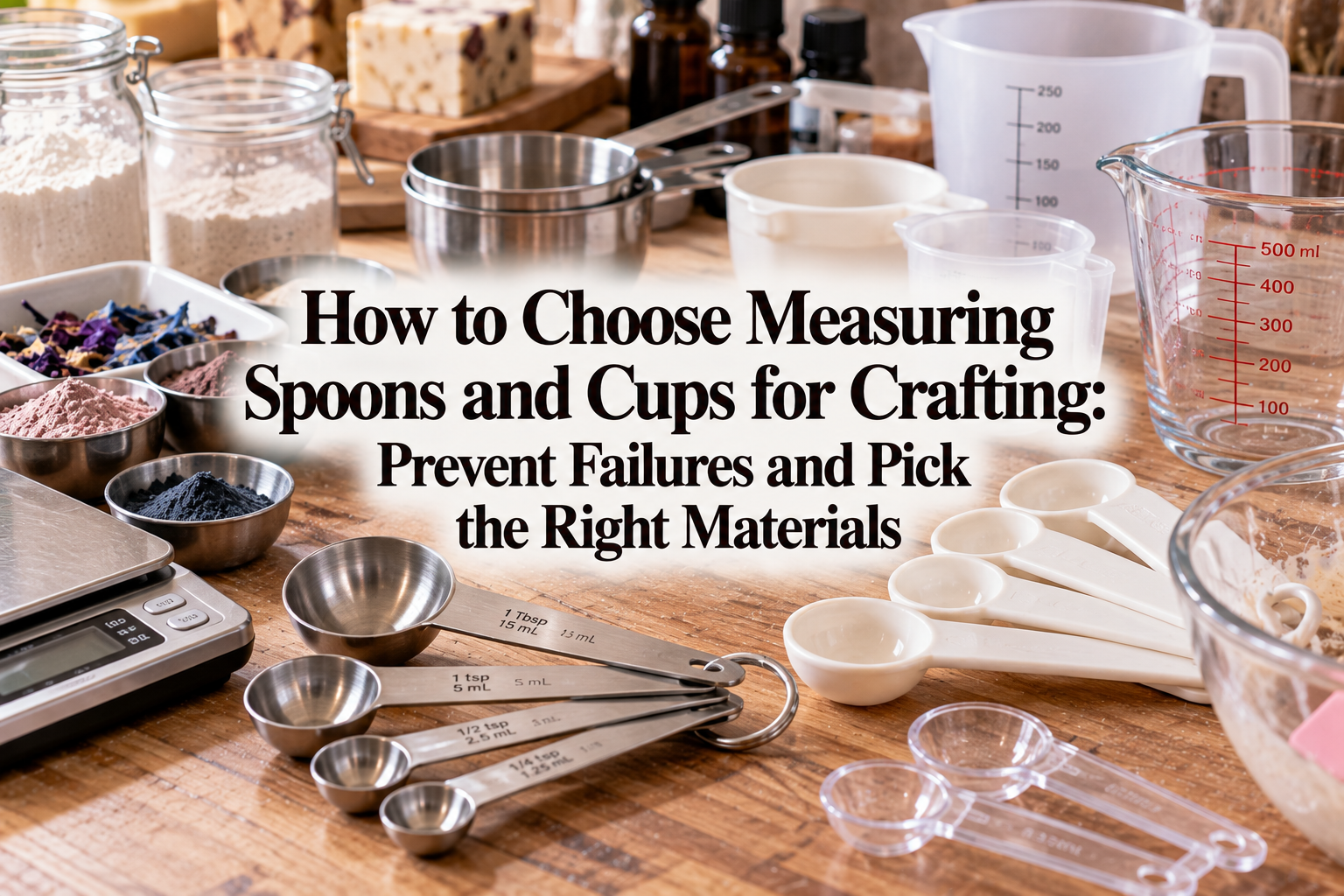
Measuring spoons and cups come in products made from various materials. It is essential to select the right material according to the properties of the craft materials you use, such as chemical resistance, viscosity, and heat tolerance.
Understand the pros and cons of each material and select the best one for the projects you create.
Plastic products are characterized by being inexpensive, easy to get, lightweight, and easy to handle. Many are transparent or translucent, making it easy to see the liquid level and read graduations smoothly.
However, if you put essential oils, high-concentration alcohol, or organic solvents in them, there is a risk that the plastic may turn cloudy or the surface may dissolve.
They are extremely effective when used as disposable mini measuring spoons or as disposable portion cups for epoxy resin.
The greatest appeal of silicone measuring spoons and cups is their excellent flexibility. By squeezing the rim of the cup, you can narrow the spout and pour liquids precisely into target spots.
Not only are they heat-resistant, but even after resin liquid or candle wax hardens, you can easily pop out the cured material.
Because they dramatically reduce the effort of cleaning, they are the top priority material to get for resin crafts and candle making.
Stainless steel is the top-tier material for chemical resistance, heat resistance, and durability. There is zero concern about deterioration even if it comes into contact with essential oils, strong paints, or various solvents.
Because the surface is smooth and the edges are sharp, it exhibits outstanding accuracy when leveling off powder materials.
It is resistant to impacts and can be used for years without deforming, making a set invaluable across all types of craft work.
Heat-resistant glass measuring cups feature exceptionally easy-to-read markings and overwhelming strength against chemicals and high heat.
They can be used safely even under harsh conditions, such as double-boiling in candle making or mixing strong alkaline solutions for handmade soap.
While care is needed to prevent breakage from drops, they suffer no color staining or odor transfer at all, making them the ideal choice for tasks involving fragrances or strong dyes.
In addition to measuring spoons and cups, other tools used for measuring and portioning include digital scales, droppers, and syringes. To improve project accuracy, do not confuse these and use them properly according to your needs.
Digital scales measure weight (in grams), whereas measuring spoons and cups measure volume (in ml or cc). Do not confuse the two.
In the case of water, 1 ml is approximately 1 g, but because oils, resin liquids, and powder materials have different specific gravities, 1 ml will never equal 1 g.
For example, 1 spoon of baking soda and 1 spoon of essential oil have completely different weights.
As a strict rule, if a recipe specifies grams, use a digital scale. If it specifies ml, tablespoons, or teaspoons, use measuring spoons or cups. For materials that require strict weight ratios, such as two-part epoxy resin, a digital scale is essential.
Droppers and syringes are tools used for micro-amounts of liquid under 1 ml, or when you want to dispense drop by drop.
On the other hand, measuring spoons are suitable for small to medium volumes from about 1 ml to 15 ml, and measuring cups are suited for measuring larger volumes of 30 ml or more.
Differentiate clearly by volume scale: use droppers for ultra-tiny controls like 1 to 2 drops, and use measuring spoons for small combined amounts like 1 teaspoon (5 ml).
Let's dive specifically into how to utilize measuring spoons and cups in actual craft genres, based on the approach I practice in my own work.
In candle making, fragrance (essential oils or aroma oils) is added to melted wax at a specific ratio.
When adding 3% fragrance (about 3 ml) to 100 g of wax, tiny stainless steel measuring spoons or small graduated glass cups are extremely useful.
When double-boiling and pouring the wax itself, using a heat-resistant metal or glass measuring cup with a spout allows for safe and quick pouring into molds.
In bath bomb making, large quantities of powdered materials such as baking soda, citric acid, and cornstarch are mixed together. Here, stainless steel or rigid plastic measuring spoons are used to perform accurate leveled measurements.
If the ratio of powders falls apart, the fizzing reaction in hot water weakens or the bomb loses its shape.
In addition, soap making involves mixing caustic soda into purified water. To withstand the heat of this chemical reaction, heat-resistant glass measuring cups or highly chemical-resistant polypropylene cups are indispensable.
In resin crafting, mini silicone measuring cups and ultra-mini stainless steel measuring spoons demonstrate great power.
When mixing powder colorants or pearlescent pigments into resin liquid, using a delicate measuring spoon to scoop tiny, consistent amounts—like a few earpick scoops or 0.5 ml—allows you to reproduce the exact same color shade every time.
Silicone cups used for color mixing can be bent at the rim to create a narrow stream, enabling you to pour resin liquid into fine gaps in molds without creating air bubbles.
When adjusting the firmness of resin clay or oven-bake clay, or diluting acrylic paint to a workable viscosity, adding water directly from the tap often leads to overwatering and failure.
By scooping precisely 1 ml (or a few drops worth) with a measuring spoon and adding it bit by bit, you can perfectly control the moisture level of clay or paint.
Having a benchmark like "one spoon amount" dramatically improves the reproducibility of your craft work.
To keep you from getting lost when stocking up on tools, here are the selection criteria beginners should focus on, along with the best combination I recommend.
When purchasing measuring spoons or cups, always check these three points:
If you are unsure about what to get first, I recommend preparing the following 3-piece set. This is the most versatile and foolproof combination:
Having these three types will cover the vast majority of main craft genres. It prevents wasteful repurchases and lets you work in a professional environment right from the start.
Because these tools are easy to acquire, people tend to treat them carelessly, but absolute rules exist to maintain measurement accuracy and prevent defects in your work.
When measuring powder materials with a measuring spoon, always scoop a heaped amount first, then use a flat board like a spatula or ruler to level it off smoothly. If you level it with your finger, unevenness occurs and changes the volume.
When measuring liquids with spoons or cups, be mindful of surface tension (meniscus).
Liquids curve up or down at the edges of a container. Scientifically correct measurement requires bringing your eye level horizontal with the liquid surface and measuring where the bottom of the curved liquid surface perfectly overlaps the graduation line. Looking down diagonally from above will always cause discrepancies.
When handling different materials, never reuse the same unwashed measuring spoon for another material.
For example, if you scoop yellow pigment with a spoon that was used for red pigment, the entire container of material will be contaminated. The same goes for essential oils; fragrances will mix and ruin the raw materials.
The cardinal rule is to use one spoon per material, or completely wipe away dirt and moisture with ethanol or cleaning solution before using it on another material.
How you clean tools after use also varies by material.
For silicone cups with resin attached, wipe them thoroughly with paper towels and rubbing alcohol before the resin cures. Flushing uncured resin down the drain clogs pipes and negatively impacts the environment. After wiping, cure any remaining residue under a UV light and throw it in the trash.
For stainless steel or glass tools with essential oils or fats, wash away oil completely with warm water and neutral detergent, wipe off moisture, and dry them.
If dust adheres to tools, it will get mixed into your next project as debris. After drying, store them in sealed containers or drawers to shut out dust.
In crafting, measuring spoons and measuring cups are not merely background tools. They are key control tools that keep your finished work consistent and allow you to create the exact colors, textures, and scents you envision.
Once you understand how they differ from digital scales and choose the right tools suited to material properties, common failures like "for some reason it won't harden" or "the color is different every time" will drop dramatically.
By handling tools correctly and turning accurate measurement into your ally, your crafting journey will become far more enjoyable and your finished pieces will reliably step up in quality. Pick up your favorite easy-to-use measuring tools and enjoy making wonderful crafts!
I would be so happy and encouraged if you share this article with your friends on social media or messaging apps! Well then, see you in the next article! This was Yassy from Crafters!

For example, if you are looking for articles about mizuhiki, try searching for "mizuhiki"; if you are interested in tools, try keywords like "nippers" or "pliers."
