How to Choose Label Stickers That Elevate Handmade Products: Materials, Adhesive Strength, and Printing Methods
yassy
Crafters!

Hello, this is Yassy from Crafters! (・∀・)
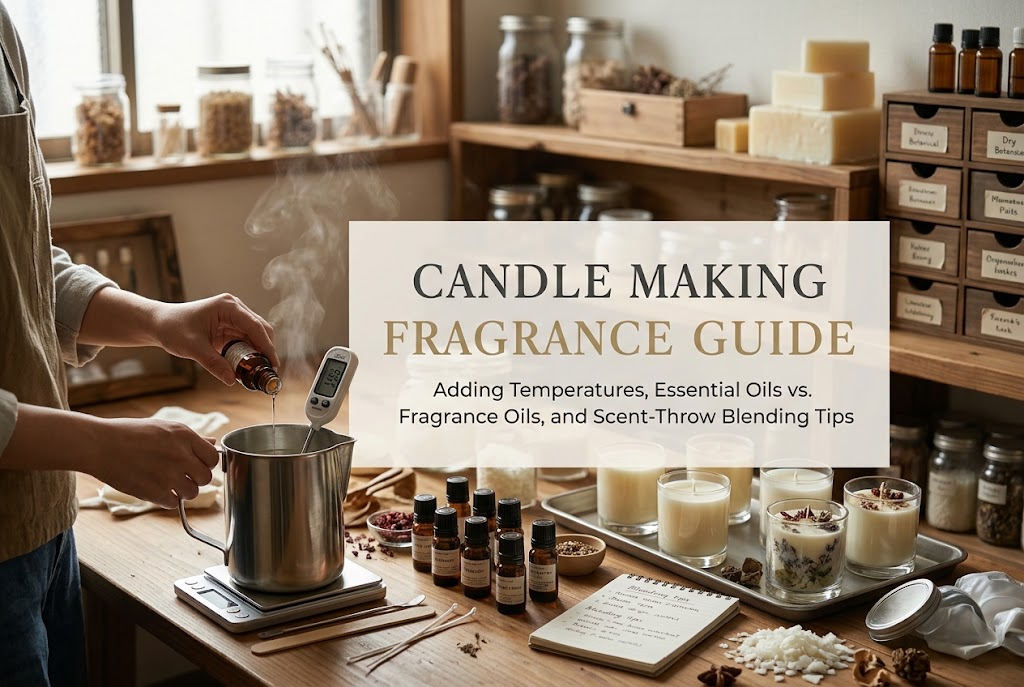
When making candles, the element most makers want to obsess over is the scent. Spending relaxing candle moments enveloped in your favorite aroma is absolute bliss, and scented candles are immensely popular as gifts and for sale.
However, you cannot simply buy any aromatic oil you like and stir it into melted wax. If you choose the wrong type of oil or handle temperatures incorrectly, your candle may emit zero scent when lit, leak oil and turn sticky on the surface, or, in the worst-case scenario, produce foul odors and hazardous smoke during burning.
I personally love making, observing, and collecting handmade crafts. I have made countless candle test batches and collected many candles over the years. Through that hands-on experience, I have become convinced of one clear fact: the aromatic quality of a candle is 100% determined by selecting the right fragrance and maintaining strict temperature control.
In this guide, I will share all the know-how I personally practice—from fragrance basics and the core differences between essential oils and fragrance oils, to wax compatibility, foolproof adding temperatures, precise calculation formulas, and curing techniques.
With the right knowledge, anyone can craft professional-grade scented candles worthy of a boutique shelf. Let's eliminate all doubts and missteps, and start building your ideal scent profile!
Fragrance materials suitable for candles broadly fall into two categories: natural botanicals (pure essential oils) and synthetic compounds (candle fragrance oils). These two differ entirely in both source materials and physical properties.
First, here is the most crucial safety warning to remember: never use water-soluble oils formulated for diffusers or humidifiers, or potpourri aroma oils sold at 100-yen shops and variety stores, for candle making.
If you mix fragrance products containing alcohol or water-soluble bases into candle wax—which is an oil base—they will separate instead of dissolving cleanly. When cooled, pockets of water or trapped oil form inside the candle body. When lit, this can cause dangerous spitting, crackling, and unpleasant, acrid smoke.
The only fragrance choices permitted in candle making are 100% pure natural essential oils or oil-soluble, heat-resistant candle fragrance oils. Please etch this fundamental rule firmly into your memory.
Essential oils are 100% natural aromatic compounds extracted from plant blossoms, foliage, rinds, bark, and roots. They feature gentle, authentic botanic aromas. If you are seeking genuine aromatherapy and soothing relaxation benefits, pure essential oils are the indisputable choice.
However, essential oils have distinct weaknesses: they are highly volatile and extremely sensitive to heat. Adding them directly to excessively hot molten wax causes their delicate aromatic molecules to flash off and evaporate immediately.
Moreover, compared to synthetic fragrances, their scent throw is subtle. When the candle is lit, essential oils provide a mild, close-range diffusion rather than filling an entire room. They are best suited for those who appreciate delicate, natural scents.
Fragrance oils are synthetic aromatic compounds carefully formulated by perfumers. Oils manufactured specifically for candles are engineered to bond smoothly with melted wax and endure elevated pouring temperatures.
Their greatest advantage is exceptional scent throw and unmatched versatility. They can reproduce aromas impossible to find in natural botanicals, such as freshly baked bread, combinations like rosemary with sweet mandarin, or refined powdery scents reminiscent of luxury hotels.
Because they release rich, robust fragrance throughout a room when lit, specialized fragrance oils serve as the primary standard for commercial luxury candle brands and handmade artisans crafting candles for sale.
You might wonder, "Which one should I actually use?" In short, the answer depends entirely on what you want from your finished candle.
I choose between the two deliberately based on the concept of the project and how I want to enjoy the finished piece. Choosing with clear intent rather than ambiguity is your fastest route to success.
Select pure essential oils if you are crafting candles for your personal pre-sleep wind-down routine, making thoughtful gifts for people sensitive to synthetic chemicals, or designing all-natural botanical candles.
Candles made with essential oils such as lavender, sweet orange, or bergamot release a serene, soothing scent the moment the wick catches flame, offering deep relaxation. When using essential oils, you must strictly manage wax temperatures to prevent the scent from boiling off. While it requires care, you gain the profound, grounding comfort that only authentic plant extracts provide.
If you want a rich aroma to fill an entire living space, or if you plan to sell your creations on craft marketplaces and handmade shops, choose candle fragrance oils without hesitation.
When customers purchase scented candles, their highest expectation is a perceptible, robust hot throw when burning. To customers accustomed to commercial candles, candles made purely with essential oils can often feel underwhelmingly faint.
With dedicated fragrance oils, you can deliver dependable, rich scent diffusion during burn time. For consistent reproduction and high customer satisfaction, candle fragrance oils are the reliable choice.
The type of wax you pour also dictates how well scent disperses and which aromatic oils pair best. Choosing a fragrance without considering your wax's unique properties will not yield satisfying results.
Here is an overview of how four major candle waxes interact with fragrance materials.
Derived from petroleum refining, paraffin wax is one of the most widely used and forgiving materials in candle making. It excels at both binding fragrance load and throwing strong scent into the air when heated.
Paraffin pairs exceptionally well with candle fragrance oils, maximizing their aromatic potential. When your goal is a bold, room-filling hot throw, paraffin wax is a dependable foundation.
Made from soybean oil, 100% plant-based soy wax pairs beautifully with natural essential oils. Because soy wax has a lower melting point and burns slowly at lower temperatures, it disperses fragrance gently without destroying fragile botanical components.
The naturally smooth, creamy profile of soy wax works in synergy with pure botanical oils. For crafting eco-friendly, natural aromatherapy candles, the combination of soy wax and essential oils is ideal.
Harvested from honeycombs, natural beeswax possesses its own distinct, subtly sweet honey aroma.
Because of this inherent character, fragile scents or clean, light citrus oils can easily be overpowered by the wax itself. When scenting beeswax, choose robust profiles that harmonize with its sweet warmth—such as vanilla, warm woods, or earthy spices.
Gel wax is loved for its crystal-clear, jelly-like aesthetic, but it requires the greatest care regarding fragrance selection.
Introducing incompatible fragrance oils—especially natural essential oils or regular liquid scents—can trigger a chemical reaction that turns transparent gel completely cloudy and opaque. This ruins the crisp transparency that defines gel candles.
When working with gel wax, you must use specialized fragrance oils explicitly verified by the supplier as "gel-compatible (non-clouding)." Treat this as an absolute rule.
Adding a massive amount of oil in an attempt to make a candle smell stronger is the most common mistake beginners make. Every wax has a strict saturation limit for how much fragrance it can hold.
Exceeding this threshold disrupts the molecular structure of the wax. Once cured, excess oil leaches to the surface in an oily, sticky film known as "sweating." Furthermore, an oversaturated wick draws too much fuel, causing oversized, dangerous flames or sputtering burn failures.
The optimal fragrance ratio for candle making is 5% to 8% of the total weight of your wax blend. You should never exceed 10% under any circumstance.
Here is an exact calculation example when aiming for a 100g finished candle:
A crucial distinction here: do not simply take 100g of wax and dump 6g of oil on top. Calculate your components so that the finished 100g candle contains exactly 6g of fragrance. Adhering to this precise ratio elevates your consistency and finished quality.
In general aromatherapy, people often calculate "1 drop = approx. 0.05 ml," but counting drops is strictly unacceptable in quality candle making. The weight of a single drop varies drastically depending on the liquid's viscosity, room temperature, and dropper opening.
Always use a digital scale capable of reading in 0.1g increments. Place your heatproof measuring beaker on the scale, tare it to zero, and measure your fragrance purely in grams.
Relying on exact weight rather than intuition or visual estimation is the true professional secret to consistent candle quality.
The exact temperature at which you incorporate fragrance into molten wax is the decisive factor between success and failure. Adding fragrance too hot burns off the delicate notes; adding it too cold causes the fragrance to separate from the wax matrix.
While different waxes possess distinct melting points, the universal target range for adding fragrance is strictly 70°C to 75°C (158°F to 167°F).
Always keep a reliable thermometer in your melting pitcher. The moment the cooling wax reaches 75°C, smoothly add your measured fragrance. Never guess the temperature by eye.
Once you pour your fragrance into the wax, immediately begin stirring with a glass rod or stainless steel spoon.
The secret is to stir calmly and steadily for two full minutes without aerating the wax. Whisking rapidly whips air into the mixture, resulting in unsightly internal air pockets and surface pinholes once cooled.
Stir in steady circular motions, lifting gently from the bottom of the pitcher for a full two minutes. This dedicated mixing time allows the wax and fragrance molecules to form a stable physical bond, preventing separation down the road.
Just because your poured candle has hardened does not mean it is ready to be lit. In freshly poured candles, the wax crystals and fragrance oils have not yet fully integrated.
Resting a finished candle in a well-ventilated, dim space for a set period is known as "curing." Allowing this resting phase dramatically transforms the intensity and richness of your hot throw.
Wax requires time for its crystalline structure to settle and lock in fragrance molecules:
Soy wax in particular takes significant time for its plant-based crystal lattice to stabilize. Give it at least one full week—ideally two weeks—to cure. A properly cured soy candle displays an infinitely smoother, more luxurious fragrance diffusion when lit.
Resist the urge to burn your creations immediately. Cover them with a lid or dust cover and let them rest undisturbed at a steady room temperature.
Here are quick solutions for common fragrance-related problems that makers often face.
Cause: You added too much fragrance oil, or added it at too low a temperature with insufficient stirring. The wax could not hold the excess oil, expelling it during cooling.
Solution: Gently wipe away surface oil using a paper towel. On your next attempt, reduce your fragrance load by 1%, ensure the wax is at 75°C (167°F), and stir continuously for two full minutes.
Cause: The fragrance was added at an excessively high temperature, burning off the aromatic compounds; too little fragrance was used; or the candle was burned without curing. Additionally, relying solely on subtle essential oils to fill an oversized room can make the scent seem imperceptible.
Solution: Strictly adhere to the 70°C–75°C (158°F–167°F) window and allow a full week of curing. If you need strong diffusion in large spaces, switch from pure essential oils to formulated candle fragrance oils.
Cause: Incompatible fragrance oils—such as water-soluble scents, certain essential oils, or unverified fragrance blends—were mixed into the gel wax.
Solution: Once gel turns cloudy, you cannot reverse the reaction. You must restart using fragrance oils explicitly marked as compatible with gel candle making.
While single-note candles are wonderful, mastering the art of blending multiple fragrances unlocks limitless creative possibilities.
Understanding the standard three-tier fragrance note structure helps you design balanced, professional-grade scent profiles.
Fragrance components evaporate at different rates, grouped into three primary tiers:
A proven blending ratio to start with is Top 3 : Middle 5 : Base 2. This proportion yields a cohesive, well-rounded aroma with evolving depth.
If you are unsure where to start, here are two personal recipes from my workshop that have yielded fantastic results:
Relaxing Night Blend (For Pure Essential Oils):Lavender (Middle) 5 : Bergamot (Top) 3 : Cedarwood (Base) 2Classic lavender paired with uplifting bergamot citrus and calming cedarwood makes an exceptional bedtime companion.
Luxury Hotel Suite Blend (For Fragrance Oils):Rose (Middle) 4 : White Musk (Base) 4 : Peach (Top) 2Velvety rose and enveloping clean musk diffuse across the room, accented by a hint of sweet peach, instantly creating a lavish atmosphere.
Fragrance oils and essential oils are delicate liquids susceptible to oxidation and degradation from exposure to light, oxygen, and heat. Using degraded, oxidized oils introduces sour, rancid undertones that diminish candle quality.
Follow these storage guidelines to protect your materials:
Always store oils in UV-protective amber or cobalt blue glass bottles. Prolonged storage in soft plastics can cause volatile compounds to degrade or even dissolve container walls.
Keep your bottles in a cool, dark place with stable temperatures around 15°C to 20°C (59°F to 68°F). If your workspace becomes extremely hot during summer months, keeping sealed bottles inside a dark cooler box or wine fridge is an effective option.
Oxidation begins the moment an oil bottle is opened. Always cap bottles tightly right after pouring to limit air exposure.
As a general rule, use opened essential oils and fragrance oils within roughly one year. Citrus essential oils oxidize particularly quickly, so aim to use them within six months of opening.
Choosing the right fragrance materials and mastering precise handling elevates simple wax into an extraordinary sensory craft.
Keep these vital takeaways in mind:
Fragrance is what breathes life and personality into handmade candles. With careful temperature control and quality ingredients, your handmade candles will rival those of high-end brands.
Blend your own signature scents, light the wick, and enjoy your soothing candle space!
If you found this guide helpful, please share it with your craft friends on social media. It means the world to me and keeps me motivated! See you in the next post—Yassy from Crafters signing off!





For example, if you are looking for articles about mizuhiki, try searching for "mizuhiki"; if you are interested in tools, try keywords like "nippers" or "pliers."
