8 Techniques for Lettering and Decorating Japanese Pottery: Clay States & Pro Rules for Success
yassy
Crafters!

Hello, everyone! It’s Yassy from Crafters! (・∀・)
As someone who loves crafting, admiring wonderful pieces made by artisans all over Japan, and collecting my favorite handmade items, pottery holds a very special place in my heart. Shaping raw clay with your hands, where every touch directly influences the form of the finished piece, is truly the ultimate craft.
However, when beginners dive into the world of ceramics, the concept that causes the most confusion—and wonder—is firing temperature.
When you place shaped clay into a kiln, the temperature at which you fire it completely alters its appearance, tactile texture, and structural strength. Even if you use the exact same clay and glaze, a difference of just 50°C (approx. 90°F) can change the outcome so dramatically that it looks like an entirely different piece.
In this guide, I will thoroughly explain the relationship between firing temperatures and finished results in Japanese pottery from a maker's perspective. Once you master how different temperature zones work, you will be able to turn your creative vision into reality without unexpected failures!
Firing temperature is the single most important factor determining the quality, durability, and function of your ceramic work.
Clay is not merely a lump of mud; it is a complex mixture of minerals, water, and organic matter. When exposed to extreme heat inside a kiln, these elements undergo chemical reactions and physical transformations. In Japanese ceramics, these processes are referred to as yakishime (vitrification/firing to hardness) and glass formation.
If the temperature is too low, the particles within the clay will not fuse together properly, leaving the piece brittle and porous. On the other hand, if you heat the clay beyond its maximum heat tolerance, it will melt, deform, or even fuse to the kiln shelf, ruining both your piece and your equipment.
In short, studio pottery is a chemical experiment where you heat clay and glaze to find the exact temperature sweet spot where beauty and strength peak. Understanding these physical changes is what makes or breaks your work, whether you are creating delicate ceramic accessories or everyday tableware.
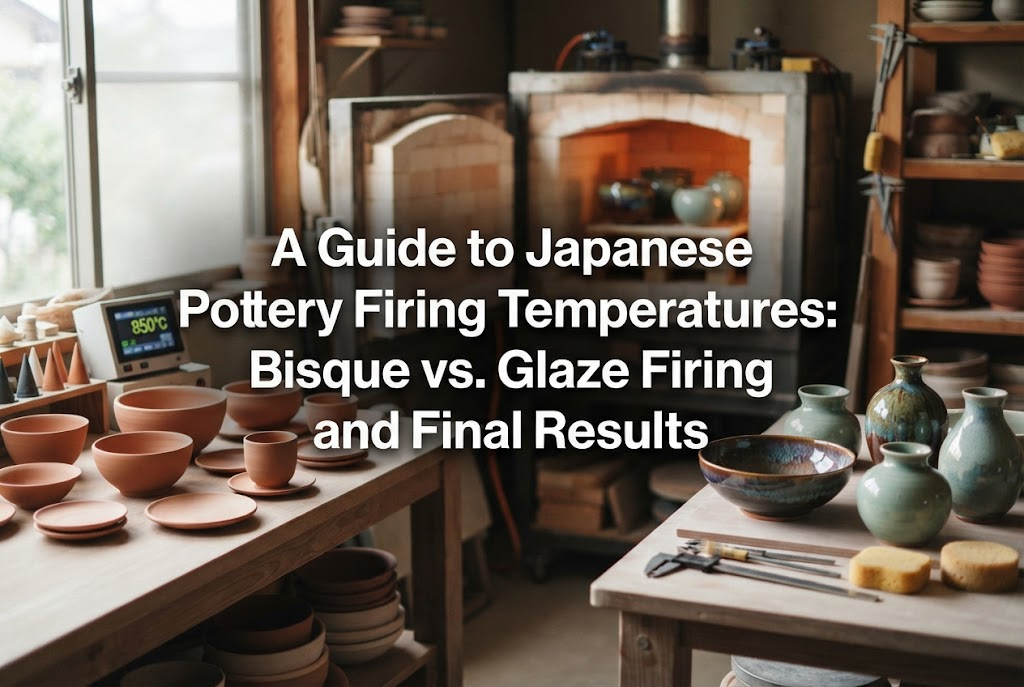
Pottery firing is broadly divided into two main stages: Suyaki (bisque firing) and Honyaki (glaze firing). Each stage serves a completely different purpose and requires different temperature ranges.
After your shaped clay has completely air-dried, it undergoes its first fire, known as Suyaki. The standard temperature range for bisque firing in Japanese workshops is between 700°C and 800°C.
The primary purpose of this stage is to drive out all remaining physical and chemically bound moisture, as well as burn off organic impurities embedded in the clay. Once bisque-fired, the piece becomes sturdy enough to handle without crumbling easily.
Visually, the clay transforms into a light pinkish-tan, terra-cotta, or pale beige hue with a rough, earthy texture. Crucially, bisque ware becomes highly porous. This porosity is essential for the next step: sekyu (glazing). The porous surface absorbs the water from liquid glaze, allowing raw glaze ingredients to adhere evenly to the clay surface.
If you skip bisque firing and apply liquid glaze directly to raw, un-fired clay, the piece will absorb too much moisture, dissolve, or burst inside the kiln. Suyaki is an indispensable step for achieving a stable, reliable finish.
After applying glaze to the bisque-fired ware, the piece undergoes Honyaki, the high-temperature main firing stage. This typically ranges from 1100°C to 1300°C (or higher depending on the clay).
At these intense temperatures, feldspar and other mineral components within the clay begin to melt, fusing the surrounding particles into a dense mass. This is the yakishime phenomenon. Simultaneously, the raw glaze on the surface—composed of glass-formers and metal oxides—melts into a liquid layer, encapsulating the clay body in a protective coat of glass.
Once cooled, a glaze-fired piece achieves high mechanical strength, becomes waterproof, and is safe for daily food use. The appearance shifts dramatically from the dull bisque state to vibrant glossy finishes or deep, subtle matte textures unique to ceramic art.
Glaze firing temperatures vary significantly depending on the clay, glazes, and artistic style you aim to achieve. Here is a comparison of the three primary temperature zones used in ceramics.
This category involves firing below 1000°C. A famous Japanese example of this technique is Raku-yaki (Raku ware), a traditional style long cherished in Japanese tea ceremony culture.
Pieces fired at low temperatures retain the natural warmth and softness of raw earth. They feel gentle to the touch and offer excellent thermal insulation. Low temperatures also preserve vibrant red and rich black glaze pigments exceptionally well.
However, because the clay particles do not fully vitrify at this level, the finished ware has lower mechanical strength and remains porous. If left filled with water for extended periods, moisture may slowly seep through. Thus, low-temperature ware is best suited for artistic tea vessels or decorative objects rather than heavy-duty kitchenware.
This mid-range zone is widely popular among craft makers, handmade jewelry artists, and community ceramic studios.
The greatest advantage of mid-range firing is its balance between bright glaze color development and practical strength. Vibrant glaze colors—such as bright yellows, soft pinks, and sky blues—tend to burn off or volatilize if fired at extreme temperatures. Mid-range temperatures lock in these vivid colors while hardening the clay enough for functional use.
If you want to make colorful Western-style mugs, cute ceramic brooches, or decorative homewares, mid-range firing is an ideal choice. Shrinkage is also less severe than in high-temperature firings, making dimensional control much easier.
Firing steadily at 1230°C or higher is the standard for authentic Japanese tableware and hard porcelain. At this level, clay particles fuse together completely, resulting in full vitrification.
When struck gently, high-fired stoneware or porcelain emits a clear, metallic ringing sound. Water absorption drops practically to zero percent, making pieces durable enough for daily use, microwave heating, and dishwashers.
Furthermore, high heat causes the glaze and clay body to melt together at their boundary, producing deep, rich color expressions and natural kiln mutations known in Japan as yohen. If you want to create unglazed, fired-clay work (traditional yakishime), reaching 1230°C to 1300°C is essential.
Temperature numbers alone do not dictate the final look. The atmosphere—the balance of gases inside the kiln—interacts with temperature to create dramatic variations.
In an oxidation firing, plenty of oxygen is supplied throughout the process. Electric kilns naturally operate in an oxidation environment. Because oxygen is abundant, metallic oxides in the clay and glaze oxidize straightforwardly.
This method produces reliable, predictable colors with minimal variations. For example, a copper-bearing glaze fired at 1230°C in oxidation yields a bright green color, while iron-bearing clays turn cream or warm red-brown. For beginners who want exact control over their color palette, oxidation firing is the safest path.
Reduction firing involves intentionally starving the kiln chamber of oxygen, causing incomplete combustion. This is typically done in gas, oil, or wood kilns. Seeking oxygen to fuel the flame, the fire draws oxygen atoms directly out of the chemical compounds within the clay and glazes.
This chemical extraction alters colors drastically. The exact same copper glaze that turns green in oxidation shifts to a brilliant, deep crimson red (known as Shinsha or oxblood) when fired to 1230°C in reduction. Similarly, iron clear glazes transform into delicate pale blue-greens (Seiji or celadon).
The higher the temperature, the stronger these reduction effects become. Combining high temperatures with reduction firing is the classic approach for crafting rustic, deeply textured Japanese tea bowls and artistic vessels.
Here are three common temperature-related mistakes that beginner potters often encounter, along with tips on how to avoid them.
It is easy to assume that higher heat equals stronger work. However, every clay body has a specific maximum heat tolerance (refractory limit).
If you take a clay rated for 1200°C maximum (such as certain Shigaraki earthen clays) and fire it to 1300°C, the clay will lose its structure, slump, or melt entirely. In Japanese ceramics, this failure is called hetari (slumping) or over-firing. Melted clay can ruin kiln shelves and heating elements, so always respect your clay's recommended limit.
Commercial ceramic glazes come with recommended temperature ranges (e.g., 1200°C–1250°C). Ignoring these guidelines leads to defects. Under-firing leaves the glaze milky, rough, or covered in pinholes because the raw glass ingredients failed to melt completely. Over-firing turns the glaze overly fluid, causing it to run down the piece and fuse to the kiln shelf.
Small studio or home electric kilns often list a maximum rating like 1270°C. Pushing a kiln to its absolute top limit repeatedly puts immense stress on the heating elements, significantly shortening their lifespan. Furthermore, reaching a peak temperature briefly without a proper heat soak (called nerashi in Japanese) may leave thick ceramic walls under-fired at their core. It is best to work with a safety buffer of 20°C to 30°C below your kiln's rated limit.
When planning a pottery project, how should you select your clay, glaze, and target temperature? Here is my practical decision-making process based on the intended use of the piece.
My Choice: High-Temperature Oxidation Firing at 1230°C to 1250°CTableware requires durability, stain resistance, and dishwasher safety. I select semi-porcelain clay or white stoneware rated for high firings. At 1230°C, the clay body becomes fully vitrified and non-porous, preventing odors or moisture retention over time.
My Choice: Mid-Temperature Oxidation Firing at 1150°C to 1180°CFor wearable accessories, vibrant color and lightweight forms are more important than extreme thermal shock resistance. Mid-range firing preserves pastel pinks, vivid yellows, and bright blues without burning out glaze pigments. Smooth white stoneware or porcelain clay bodies keep delicate details crisp.
My Choice: High-Temperature Reduction Firing (Unglazed / Yakishime) at 1250°CWhen I want to highlight raw clay texture, I leave the exterior unglazed and fire dark red clay or coarse, specked dark clay in a reduction atmosphere to 1250°C. The heat draws iron specks out to the surface, creating rich, rustic dark-brown mottling. If the piece needs to hold water, applying a clear glaze inside is my favorite trick to blend functionality with earthy aesthetics.
If you use a shared studio or firing service, follow these three simple steps to guarantee success:
Matching these three factors—studio temperature, clay rating, and glaze rating—eliminates almost all firing failures!
Firing temperature is far more than just applying heat to harden clay. It is the defining factor that shapes the texture, strength, color, and functionality of your ceramic art.
To recap:
Understanding these principles makes opening the kiln door infinitely more exciting! I hope this guide helps you choose the perfect temperature for your next ceramic creation.
If you found this helpful, feel free to share it with fellow craft lovers. Until next time, happy making—this was Yassy!



For example, if you are looking for articles about mizuhiki, try searching for "mizuhiki"; if you are interested in tools, try keywords like "nippers" or "pliers."
