A Guide to Jewelry Pliers: Round Nose, Flat Nose, and Slim Needle Nose Differences Explained
yassy
Crafters!

Hello, this is Yassy from Crafters! (・∀・)
When making handmade crafts, everyone has likely experienced frustration when materials slip while cutting, when holding an item with one hand makes delicate work difficult, or when hands get exhausted during drilling and sanding.
Personally, I love making all kinds of handmade crafts, looking at wonderful creations, and purchasing items from talented crafters. Having experienced crafting across various genres, there is one fact I can state with absolute confidence: introducing a proper craft vise, holding base, or workbench will dramatically improve both the quality of your work and your crafting speed.
Beginners tend to focus almost entirely on direct tools like scissors, cutters, and pliers. However, the foundational "holding tools" are actually the most crucial equipment for determining the final finish of your project.
In this guide, I will thoroughly explain the types, uses, selection criteria, and safe operation of craft vises and workbenches in an easy-to-understand way for beginners. By the end of this article, you'll definitely find the ideal item for your creative workspace!
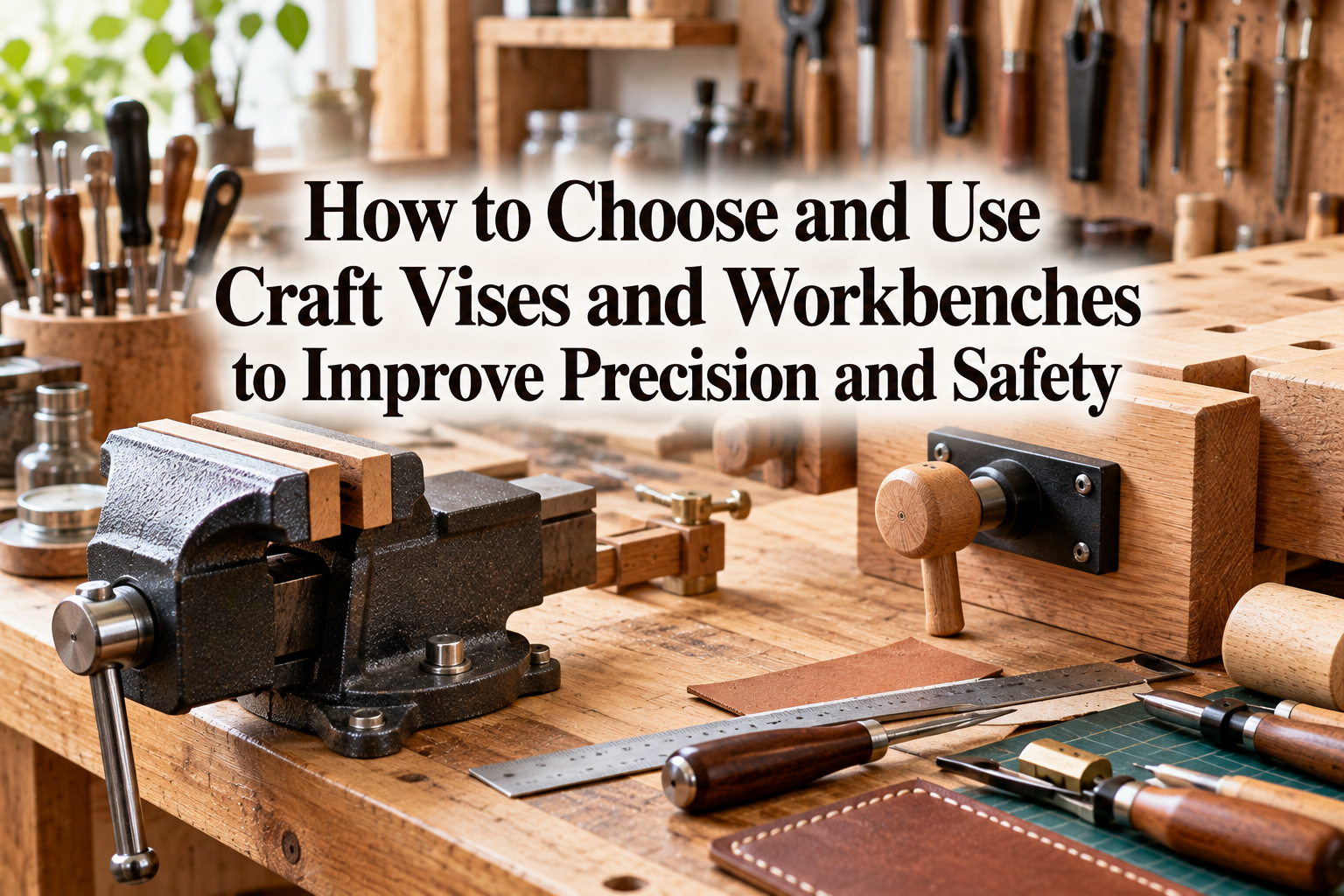
In handmade crafting, a holding base or workbench is far more than just a surface to rest your materials on. It is a powerful partner designed to maximize precision and protect your hands from injury.
When you hold materials directly with your hand, tiny, involuntary micro-shakes occur. These subtle movements cause crooked straight cuts, misaligned drill holes, and uneven sanding texture.
By securing your material firmly with a holding base, both of your hands become completely free. Without needing one hand to hold the workpiece, you can devote 100% of your concentration to manipulating your tools.
Furthermore, safety is a major benefit when working with sharp blades or power tools. Using utility knives or hand drills while holding materials in your hand carries a high risk of serious injury if the blade slips.
To guarantee safety and execute the exact shapes you imagine, building an environment where materials are solidly secured is indispensable.
From compact tabletop models to full-fledged folding workbenches, various types exist. Understanding their structures and features will help you pick the right one.
These are small clamping tools secured to the edge of a table with a clamp or placed directly on a flat work surface. They are best suited for firmly holding small metal, resin, or wooden items. Featuring two jaws operated by a screw mechanism, they deliver strong holding force—perfect for drilling beads, shaping resin components, or temporarily holding small parts during gluing.
Equipped with a large suction pad at the bottom, these vises lock firmly onto smooth worktops with the simple flick of a lever. They are ideal if you lack edge-clamping space or want to avoid scratching fine furniture. Setup and removal take only seconds, making them wonderfully convenient for crafters who want to pull out a tool only when needed. While they require a smooth surface like glass or a polished desk, their portability is outstanding.
These advanced holding bases allow you to rotate and tilt the clamped item 360 degrees freely. Thanks to the built-in ball joint mechanism, working at angled positions or turning items upside down becomes effortless. They excel in detailed work such as miniature painting, delicate clay carving, and assembling 3D parts.
These are standalone worktables with built-in legs, where the top itself opens and closes like a large vise. Because they can be folded and stowed away in tight spaces, they are ideal for crafters without a dedicated craft room. They provide unyielding stability during heavy-duty tasks like woodworking, working on large craft band projects, or sawing.
These heavy, bag-like bases are used in leathercraft and metalworking. During leather stamping or metal hammering, they absorb shock and impact sound while preventing the material from twisting or warping.
When searching for holding tools, it is easy to confuse them with tools used for similar purposes, such as cutting mats or temporary mounting tapes. Here are the key distinctions to remember:
A cutting mat is a protective pad meant to shield desk surfaces and prevent cutter blades from dulling. It has no mechanism to clamp materials in place. Using a craft vise on top of a cutting mat is actually the ideal setup for a crafting station.
Adhesive sheets and masking tape temporarily stick small, light items flat against a surface. While effective against horizontal slipping, they peel right off when strong physical forces (sanding, hammering, drilling) are applied. For three-dimensional objects or force-heavy tasks, mechanical clamping is essential.
Regular desks are designed for writing and placing objects. Applying force while sawing or drilling on a regular table causes wobbling that ruins accuracy. Workbenches designed specifically for crafting feature high load capacities and wobble-resistant structural designs.
The necessary clamping power and shape depend entirely on the type of craft you create. Choose the right style according to your main craft focus:
Since the materials are small (a few millimeters to a few centimeters), a compact suction base vise or a ball-joint base is best. Choosing a model that allows flexible angle adjustments near eye level reduces neck and shoulder strain during long crafting sessions.
These activities involve vigorous movements such as hammering, sawing, or firm sanding. For these, a heavy, high-rigidity portable workbench or a heavy-duty clamp-mounted vise is the only real choice. Avoid lightweight plastic bases, as they will slide around during work and pose safety hazards.
When working with fabrics and threads, standing embroidery hoops or frames act as your holding bases. Using a hands-free standing frame dramatically improves the uniformity and beauty of your stitches.
To avoid choosing the wrong tool, be sure to check these four key points before purchasing:
Clamping delicate resin or soft wood directly into metal vise jaws will inevitably leave dents and scratches. Choose a model that comes with rubber covers or soft nylon jaw covers. If none are included, you must use silicone sheets or thick fabric padding.
This specification determines the maximum size of the object the vise can hold. Purchasing a vise that cannot fit your workpiece renders it useless. Beginners should look for a model with a jaw opening capacity of at least 50 mm (about 2 inches) to cover most small craft items.
If you choose a clamp-on model, measure your table's thickness with a ruler beforehand. It is common to encounter tables that are too thick or have reinforcement frames underneath that prevent clamps from fitting. Suction types or freestanding units are safer choices if your desk structure is complex.
Tabletop bases require a reasonable amount of weight. If the base itself is too light, the force of sanding or drilling will slide the vise right across your desk. Look for solid metal construction or strong suction mechanisms.
Even a high-end holding base won't deliver results if used incorrectly. Here are proper operational steps and tips to elevate your finish:
Even with protective covers, extra care is needed when clamping soft wood or drying clay. Place small wooden scraps (wood padding) or leather remnants between the vise jaws and your workpiece. This distributes pressure evenly across the surface, preventing localized indentation.
Clamping a material high above the jaws causes it to flex and vibrate during work. Position the area you want to process as close to the vise jaws as possible to keep the center of gravity low and eliminate wobble.
The more you turn a vise handle, the stronger the pressure becomes. Over-tightening out of an eagerness to secure the item can crack delicate materials. Aim to tighten just enough so that a light tap does not move the material.
While vises are extremely helpful, improper handling can ruin workpieces or cause accidents. Follow these safety rules:
Be extra careful when holding hollow resin parts, thin metal tubing, or thin plastic containers. Exceeding safe pressure can cause them to crush instantly. Insert a fitting wooden dowel inside to support the walls, or switch back to holding the item carefully by hand.
Debris such as wood shavings, dust, and resin powder on screw threads or suction cups severely impairs functionality. Suction bases lose grip completely when dirty. Always wipe surfaces clean with a damp cloth after use, and apply a drop of machine oil to moving screw threads periodically.
On swivel-arm bases, applying heavy downward force when the arm is tilted extremely sideways can damage the joint or overturn the base. When performing high-pressure tasks, position the arm vertically or switch to a rigid fixed vise.
Here are representative crafting scenarios where introducing a holding base makes work infinitely easier:
When drilling pilot holes for screw eyes in natural stones or resin components, holding the piece by hand often causes the drill bit to slip, enlarging the hole or drilling through at an angle. Securing the part vertically in a vise lets you apply straight downward pressure for clean, accurate holes every single time.
When smoothing the cut edges of wood or acrylic sheets with sandpaper, securing the material in a vise lets you use both hands to sand with consistent pressure. This prevents edges from becoming rounded by hand movement, resulting in sharp, professional edges.
When applying edge finish and burnishing the edges of leather wallets or key cases, a shifting material prevents a clean shine. Using a leather stitching pony or a desktop craft vise holds the leather taut, allowing speedy, uniform, and high-gloss burnishing.
In this guide, we explored how craft vises and workbenches can dramatically raise the precision and safety of your handmade projects.
Beginners often hesitate, thinking these tools are too advanced for them. However, crafters with developing skills benefit the most from letting proper tools hold their work securely.
Eliminating hand tremors and slipping materials makes once-difficult processing tasks surprisingly effortless. Start by trying a compact desktop mini vise or a suction-based holding tool tailored to your workspace and project size. Once you experience the comfort and precision, you'll wonder how you ever crafted without one!
Find the perfect tool companion for your style, and make your daily crafting time even more enjoyable and comfortable.
If you found this helpful, sharing this article with your crafting friends on social media would mean the world to me!
Until next time, happy crafting! This was Yassy from Crafters!



For example, if you are looking for articles about mizuhiki, try searching for "mizuhiki"; if you are interested in tools, try keywords like "nippers" or "pliers."