Moving Beyond the Beginner Stage in Japanese Shrink Plastic Crafts: The Golden Order for Upgrading Your Tools
yassy
Crafters!
Hello, everyone! It’s Yassy from Crafters! (・∀・)
Whether I am making handmade crafts, looking at them, or buying them, there is one category of tools in my studio that I simply cannot live without: pointed tools used for piercing, guiding, and detailed auxiliary work.
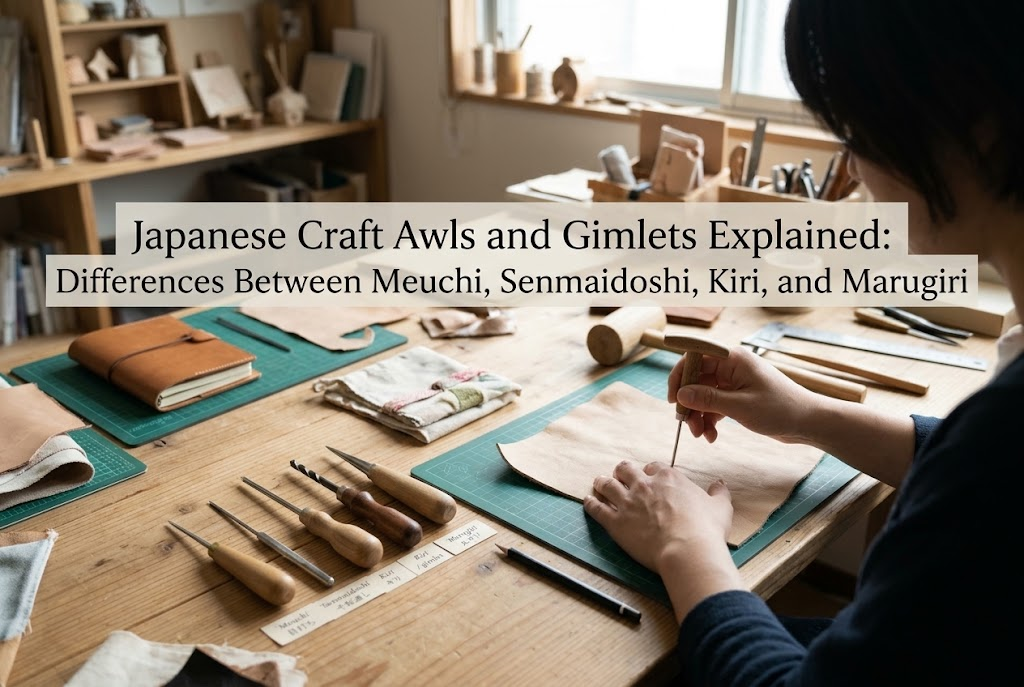
When you visit craft shops or home improvement stores in Japan, you will see a wide variety of tools lined up—each with a slender metal shaft and a handle. They go by names such as meuchi (sewing awl), senmaidoshi (piercing/bookbinding awl), kiri (Japanese gimlet), and marugiri (round leather awl). At a glance, they look almost identical.
If you have ever thought, "They all punch holes, so wouldn't any of them work?"—please think twice! These tools feature entirely different tip shapes, edge configurations, and primary purposes. Picking the wrong one can tear delicate fabric, split fine wood, or significantly lower the overall quality of your finished piece.
In this guide, I will thoroughly explain the differences and characteristics of meuchi, senmaidoshi, kiri, and marugiri, along with how to choose and use the right one for your specific craft. Mastering the unique traits of these tools will help elevate your crafting results to the next level.
While meuchi, senmaidoshi, kiri, and marugiri all consist of a slender metal pin set into a handle, their structural details and intended uses are completely distinct. Here is a quick reference table comparing their features:
As you can see, even though they appear similar on the surface, their core mechanisms—shaving away material, gently pushing fibers apart, or piercing straight through—are entirely different. Understanding this distinction is essential for mastering handmade crafts.
The meuchi is an indispensable staple in sewing and fabric crafts. You will find one on practically every textile crafter's workbench in Japan.
Its hallmark feature is a smoothly finished conical tip. While it looks sharp, the point is deliberately polished to be slightly rounded so that it will not easily puncture paper or sever threads.
The name meuchi comes from the Japanese action of separating or widening the "me" (the weave or mesh of fabric). Rather than slicing through fibers like a pair of scissors or a craft knife, a meuchi works by slipping between the woven threads and easing them apart.
A hole created with a meuchi will often close back up on its own over time or after light ironing, as the woven threads naturally spring back into position. This makes it ideal for making temporary openings—such as drawstring channels, or pilot holes for rivets and eyelets—without compromising the inherent strength of the fabric.
If you have ever turned a pouch, collar, or coaster right-side out only to find rounded, sloppy corners, you know how frustrating that can be. This is where a meuchi shines. By inserting the tip just beneath the inner seam and gently coaxing the fabric outward thread by thread, you can produce clean, precise right angles. Because the tip is rounded rather than razor-sharp, the risk of poking an accidental hole through your fabric is kept to a minimum.
When feeding fabric through a sewing machine, the edges can slip, or fabric may bunch up right in front of the presser foot. Placing your fingers near the moving needle is dangerous, but the slender tip of a meuchi allows you to hold down edges and feed layers smoothly into place. For thick seams, matched patterns, or bias tape bindings, a meuchi acts as a precise extension of your fingers.
The word senmaidoshi literally translates to "passing through a thousand sheets." True to its name, this tool was designed to pierce cleanly through dense stacks of paper. Often categorized under stationery and bookbinding supplies, its point is constructed very differently from a meuchi.
The tip of a senmaidoshi is honed to an extremely fine, needle-like point. The shaft retains a solid thickness from the base nearly all the way to the tip, providing the rigidity needed to withstand firm downward pressure without bending. It is built to plunge straight into paper, thin leather, or film with minimal resistance.
For papercrafts, cartonnage, handmade sketchbooks, and traditional Japanese stab binding (watoji), the senmaidoshi is exceptional. Pressing it vertically through stacked sheets cleanly severs the paper fibers, creating straight, neat through-holes without deforming the surrounding paper.
However, you should avoid using a senmaidoshi on woven fabric. Its razor-sharp tip will slice through the woven yarns, resulting in fraying, permanent punctures, or torn fabric.
The kiri (traditional Japanese gimlet) is a fundamental woodworking tool. While its silhouette resembles an awl, it possesses one crucial difference: it features functional cutting edges.
Examining the blade of a kiri reveals that its cross-section is not a smooth cylinder; it is typically square (yobogiri) or triangular (mitsugiri). The ridges along the shaft act as sharp cutting edges. When you twirl the handle, these edges shave away wood fibers, cutting a clean cavity while ejecting tiny wood shavings.
Unlike an awl that merely pushes material aside, a kiri removes mass. This prevents the outward pressure that causes hard or brittle wood to crack.
In wooden crafts and DIY projects, attempting to drive a screw or screw eye straight into timber will often split the grain. By drilling a proper pilot hole beforehand with a kiri, you can prevent splitting entirely and ensure fasteners go in straight and secure.
A four-sided kiri (yobogiri) excels at cutting deep, straight holes, whereas a three-sided kiri (mitsugiri) is handy for reaming holes wider or setting shallow starting marks. Whenever your project involves timber, always reach for a bladed kiri rather than a sewing awl.
The marugiri (round awl) is a specialized tool widely used in leathercraft. While frequently mistaken for a generic awl, its proportions are tailored specifically to working with hide.
The tip of a marugiri is finely pointed like a senmaidoshi, but right behind the tip, the shaft tapers gently into a consistent cylinder. This controlled taper makes it easier to keep hole sizes consistent based on how deep you insert the tool. Furthermore, the shaft is polished to a smooth, mirror finish so it glides across the grain of leather without catching or gouging.
In leatherworking, drawing pattern lines with a standard pen can leave permanent marks that ruin the finished piece. Instead, leathercrafters use the tip of a marugiri to lightly trace along the edge of a pattern template, scratching a faint, crisp guideline into the leather’s surface—a technique known in Japan as kegaki.
A marugiri is also used to mark guide points before punching with pricking irons (diamond chisels) or drive punches, to widen tight stitching holes, and to adjust edge alignments. It is an all-around staple for leather goods.
To avoid damaging your materials, match your tool directly to your chosen craft:
Here are four typical mistakes crafters encounter when first using these tools, along with practical solutions:
In an effort to get a sharp point, pushing the awl too forcefully into the corner can cause the tip to burst through the fabric, leaving an unsightly hole.
Solution: Rather than stabbing directly outward, gently tuck the tip of the meuchi into the inside seam and gently stroke the fabric threads outward from within. If you struggle with this, try a curved-tip meuchi (kyokusen meuchi). The curved blade significantly reduces the chance of piercing through the outer fabric.
Using a senmaidoshi to make a hole for a snap or rivet can slice crosswise threads. Over time, the fastener may tear right out of the weakened fabric.
Solution: Always use a rounded meuchi for textiles. Rotate the tool back and forth as you gently push it into the weave. This pushes the threads aside rather than severing them. When you insert the hardware through the opened gap, the intact fibers grip around the post securely.
Trying to screw a small eyelet into a wooden base or piece of driftwood by forcing a sewing awl in can bend the tool's slender tip.
Solution: Sewing awls lack cutting edges and cannot withstand strong lateral torque against hard grain. For wood, always rotate a four-sided kiri (yobogiri) back and forth to shave a proper pilot hole before installing hardware.
Punching holes through paper or leather without a backing surface can cause the sharp tip to plunge into and scratch your cutting table or desk.
Solution: Always place a heavy self-healing cutting mat or a dedicated leathercraft rubber pounding block underneath your work. Because senmaidoshi and marugiri pierce through materials easily, a protective mat is essential.
Keep these three points in mind when selecting your tools:
Because these tools have sharp points, handling them with care is critical for your safety and the longevity of the tool.
Never hold your fingers directly behind the material you are piercing. If the tool breaks through suddenly, you risk a painful puncture wound. Keep your supporting hand to the side or behind the direction of travel, and always back your piece with a thick mat or rubber block.
Always replace the protective safety cap after each session. Storing unprotected awls in a tool box can bend the fine tips when they collide with other items, and it creates a hazard when reaching inside. If you lose the safety cap, pushing the tip into a wine cork or small eraser makes an effective temporary guard.
Over time, skin oils and moisture can cause fine surface rust, reducing how smoothly the tool slides through materials. Occasionally wipe the metal shaft with a drop of camellia oil or anti-rust machine oil using a soft cloth. Polishing it lightly with a metal polishing cloth will restore its smooth shine, making fabric work noticeably easier and more pleasant.
Here is a quick recap of the four tools:
Each tool’s shape was developed to solve a specific challenge in crafting. Choosing the correct one for your material will prevent common headaches and make your crafting smoother, faster, and far more enjoyable!
If you found this guide helpful, please feel free to share it with your fellow crafting friends! See you in the next article—this was Yassy from Crafters! (・∀・)

For example, if you are looking for articles about mizuhiki, try searching for "mizuhiki"; if you are interested in tools, try keywords like "nippers" or "pliers."