Power Drill and Drill Bit Basics for Crafters: Choosing, Using, and Mastering Step Drills
yassy
Crafters!

Hello, this is Yassy from Crafters! (・∀・)
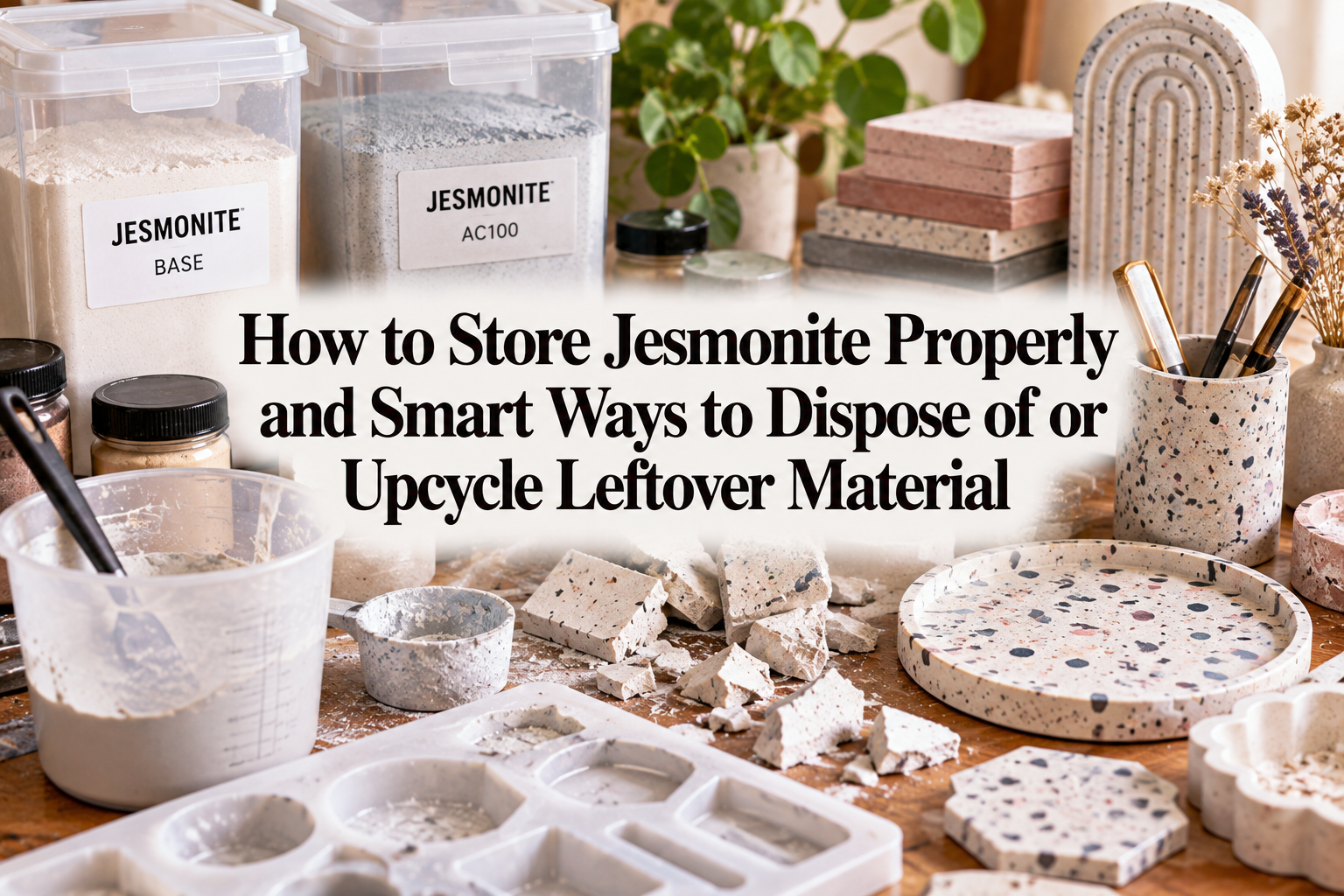
I absolutely love making, looking at, and buying all kinds of handmade crafts, but recently I've fallen completely in love with water-based resin: Jesmonite. It yields a smooth, high-end stone-like finish, and because it contains no organic solvents, you can safely create with it indoors without harsh fumes—which is one of its biggest appeals.
However, many makers who dive into Jesmonite quickly run into two major hurdles: how to store the materials properly, and how to deal with leftover mixture. Jesmonite is a unique two-part composite made by mixing a liquid acrylic polymer with a reactive mineral powder base. Because of this, it requires very different care and storage compared to conventional epoxy resins or clays.
"I hadn't cast anything in a while, and my powder turned into hard clumps!" or "I don't know how to dispose of the leftover liquid!"—these common headaches can be 100% prevented with the right knowledge. In this guide, I will share all the practical techniques I use in my own studio, covering everything from strict storage rules to keep your Jesmonite in peak condition, to creative upcycling hacks that turn leftovers into stunning terrazzo pieces instead of trash.
To get the absolute best performance out of Jesmonite, maintaining ideal storage conditions is essential. If your raw materials degrade, no matter how precisely you measure or mix them, you will end up with curing failures, rough surfaces, or brittle casts.
To understand why storage makes such a huge difference, let's look at how both the liquid and base components degrade over time.
The liquid component is a water-based acrylic emulsion—essentially microscopic acrylic resin particles suspended in water. If water evaporates from this liquid, the resin particles fuse together and create a thick, rubbery skin on top. Once this acrylic film forms, it cannot be reconstituted by adding water or fresh liquid.
Temperature is another critical factor. Because it contains water, if the liquid freezes during cold winters, the delicate emulsion structure is permanently ruined. Even after thawing, the resin stays separated, losing its bonding strength and structural integrity. Conversely, exposing the liquid to excessive heat accelerates chemical breakdown and water evaporation, turning it into an unusable, thick sludge.
The base component consists of a specialized reactive mineral powder (an alkaline mineral base). These particles are ultra-fine and naturally hygroscopic, meaning they rapidly absorb moisture from the surrounding air.
If kept in high humidity, the powder absorbs ambient water vapor—even inside a closed container—and slowly starts a micro-level chemical reaction. This results in hard lumps (clumping). When you eventually try to mix clumped powder with the liquid, it will not fully dissolve or blend smoothly. Pouring a mixture containing tiny clumps leads to internal voids, white speckles on the surface, and significantly weaker finished pieces.
To keep your liquid in top condition until the very last drop, controlling temperature and preventing air exposure are everything. Here are the specific steps and conditions you should follow.
The safest temperature range for storing Jesmonite liquid is between 5°C and 25°C (41°F to 77°F). Storing it on sunny windowsills, in non-air-conditioned rooms during hot summers, or inside a car can easily push temperatures past 30°C (86°F), which ruins the liquid. Always choose a cool, dark place inside your home—such as a storage closet, lower shelf, or shaded cupboard.
Winter demands extra caution. Leaving bottles in freezing hallways, entryways, or near uninsulated spots can cause the liquid to freeze. Keep two golden rules in mind: never let it freeze, and never expose it to temperatures above 25°C.
When screwing the cap back on after pouring, any residual liquid left around the threads or spout will cure into solid resin, gluing the cap shut. Worse, it creates microscopic air gaps that allow air to seep in continuously, drying out the rest of the bottle.
Always wipe down the neck and nozzle with a damp paper towel or wet wipe after every pour. Then, tighten the cap firmly to ensure an airtight seal. If there is substantial empty headspace in your bottle, transferring the remaining liquid into a smaller airtight polyethylene container helps minimize contact with air.
If you don't use your liquid for several months, the active components can settle, causing uneven density between the top and bottom. Whether your bottle is opened or unopened, give it a gentle shake once a month to keep the emulsion uniform. This simple habit prevents separation and ensures your liquid is always ready to go.
Moisture is the ultimate enemy of Jesmonite base powder. Even unopened bags begin absorbing humidity once the seal is broken. Here is how to keep it perfectly dry.
The original paper or thin plastic bags that Jesmonite base comes in cannot keep moisture out over time, even if closed with clips. Once opened, transfer the powder into an airtight plastic container with a rubber gasket (lock-style container) or double-bag it using heavy-duty zip-top storage bags.
When sealing bags, gently press out excess air without kicking up dust, then seal tightly. If using containers, ensure the lid features a solid silicone or rubber gasket for an airtight seal.
Toss a few food-grade or camera-grade silica gel packs directly inside your airtight container or zip bag. The silica gel actively absorbs any residual moisture trapped inside, keeping the base free-flowing and dry for much longer.
Inspect your desiccant packs periodically, and replace them when the indicator beads change color. For every 1 kg (2.2 lbs) of base, I like to keep two to three large silica gel packs inside the container.
Room floors are prone to condensation from temperature changes and tend to accumulate cool, humid air. Placing bags or containers of powder directly onto flooring or tatami mats causes the base to draw up moisture from underneath, leading to hard lumps at the bottom.
Always store your base on a shelf or elevated pallet at least 30 cm (about 12 inches) off the floor. This single adjustment drastically cuts the risk of moisture degradation.
No matter how carefully you measure, you will inevitably end up with a little bit of mixed liquid Jesmonite left over in your mixing cup. Mishandling this leftover mixture can cause serious and costly damage to your home plumbing. Here are the critical mistakes to avoid and how to dispose of waste safely.
The most important rule in Jesmonite crafting is: never rinse leftover liquid down the sink, and never wash mixing cups or spatulas covered in wet resin under running water.
While Jesmonite is water-based, it does not dissolve or wash away in water. In fact, it reacts and hardens underwater. If it enters your drains and plumbing, it will cure inside the pipes and create rock-solid blockages. Once hardened inside domestic plumbing, chemical drain cleaners and power jetting cannot clear it; replacing the pipes entirely can cost thousands of dollars.
Never pour leftover mixture down the sink, and never rinse wash-water containing wet Jesmonite into your drains.
The only correct way to dispose of excess liquid Jesmonite is to leave it to cure fully before throwing it away.
Keep disposable paper cups, empty milk cartons, or scrap silicone cups near your workstation. Pour all excess liquid into these containers. After 15 to 30 minutes, the mixture will cure into a completely solid, hard block.
Once fully cured, Jesmonite can be treated like inert plastic or plaster waste. Dispose of it in your standard trash according to your local waste management guidelines. Throwing liquid Jesmonite into the trash risks bag punctures and leaks, so solidifying it first is an absolute rule.
Instead of washing your silicone cups, stirrers, and measuring tools with water, you should either wipe them off before they set, or peel the resin off after it cures.
If you absolutely need to rinse tools, do so in a dedicated water bucket. Let the rinse bucket sit undisturbed overnight so the suspended particles settle and cure at the bottom. The next day, gently pour off the clear water on top, scrape up the sediment sludge at the bottom with paper towels, and discard it in the trash.
Letting leftover Jesmonite harden just to throw it in the trash is such a waste! Jesmonite remains incredibly useful even after it cures. Here are professional techniques to turn leftover mixture into premium design elements that elevate your next projects.
One of the most popular Jesmonite styles is terrazzo—a technique where colorful cured chips are cast into a contrasting base. Leftover Jesmonite is the perfect raw material for making your own custom terrazzo chips.
The process is remarkably simple. Pour your leftover colored mixture onto baking parchment or a silicone craft mat, and spread it out ultra-thin (under 1 mm) using a spatula. Let it cure for about 20 minutes.
Once hard, peel the sheet off and crush it between your fingers into tiny, irregular flakes. Store chips from different projects in labeled zip-top bags organized by color. When you're ready to cast a larger tray or vase, fold these chips into your fresh pour for a stunning, high-end terrazzo effect.
Keep a few small silicone molds on the corner of your workbench at all times. Mini letter molds, tiny stars, button molds, or small cabochon shapes are ideal.
Whenever you finish filling your main project mold and have a spoonful of mixture left in your cup, quickly pour it into these mini molds. These tiny cured pieces are fantastic for:
By keeping mini molds nearby, you bring your material waste down to virtually zero, saving money while expanding your creative inventory.
During the post-processing stage—trimming flashing after demolding or wet-sanding surfaces—you will naturally produce hardened scraps and fine dust. Don't discard these either!
Edge trim trimmed off molds, or test casts that didn't go quite right, can be crushed with a hammer or broken down with pliers. Sift and sort these fragments into small clear jars by grit size (large, medium, fine).
Chunky fragments create dramatic, stone-like mosaic effects, while fine crumbs produce an elegant, sand-cast granite texture. Mixing and matching colors opens up endless design possibilities.
The fine powder collected when sanding pieces with wet/dry sandpaper can also be dried and saved. Mixing small amounts of white or gray sanding dust into a future base mix adds a subtle matte quality, or slightly thickens the mixture to create dimensional, sculptural surface textures.
Even with careful storage, Jesmonite components eventually reach the end of their shelf life. Attempting to cast with degraded materials will ruin your work, so it is vital to spot the warning signs early.
Jesmonite liquid generally has a shelf life of around 6 to 12 months once opened. Even unopened, poor storage can spoil it within 1 to 2 years. Do not use your liquid if you observe any of the following:
Degraded liquid cannot undergo proper cross-linking and curing. When this happens, it is best to dispose of it properly rather than risk ruined casts.
The base powder also has a typical shelf life of about 6 to 12 months after opening. Look for these signs of expiration:
Once mineral base absorbs ambient humidity and cures partially, it cannot be reverted to a fine, smooth powder.
If your liquid or base is no longer usable, dispose of it safely using these steps:
Here is the storage system I use in my own workspace to prevent waste, avoid expired batches, and dramatically boost workflow efficiency.
First, whenever I open a new container of liquid or base, I grab a roll of masking tape and a permanent marker and write the opening date clearly on the front. Because fresh and aged Jesmonite can look identical at a glance, labeling dates is the most foolproof way to monitor shelf life.
Second, I clearly label all storage containers—"Liquid," "Base," "Terrazzo Chips (Sorted by Color)," and "Crushed Stone Fragments"—and keep them together on the same designated shelf inside a closed cabinet. Grouping them along my natural work path means I can grab what I need immediately while keeping everything safely shielded from humidity and direct sunlight.
If you find yourself running low on one component faster than the other, you can purchase liquid and base separately to rebalance your stock. Approaching your work with fresh, well-cared-for materials is the ultimate secret to achieving that signature silky-smooth finish and rock-solid strength in every cast.
In this guide, we covered everything you need to know about storing Jesmonite and handling leftover material safely and sustainably.
Here is a quick recap of the key takeaways:
Once you understand its unique material properties, working with Jesmonite is an absolute joy. Storing your supplies thoughtfully and turning every leftover drop into creative new assets makes your handmade journey more economical, eco-friendly, and inspiring.
Equipped with fresh, well-maintained materials, go ahead and create your own breathtaking Jesmonite pieces! I'm cheering you on!
If you found this guide helpful, please share it with your craft friends on social media—it means the world to me! Until next time, this was Yassy from Crafters!







For example, if you are looking for articles about mizuhiki, try searching for "mizuhiki"; if you are interested in tools, try keywords like "nippers" or "pliers."
