Beyond the Starter Kit: The Golden Order for Upgrading Your Japanese UV & LED Resin Tools
yassy
Crafters!

Hello everyone, it's Yassy from Crafters! (・∀・)
When crafting handmade jewelry like earrings and necklaces, there is one set of hand tools you simply cannot do without: jewelry pliers—known in Japan as yattoko.
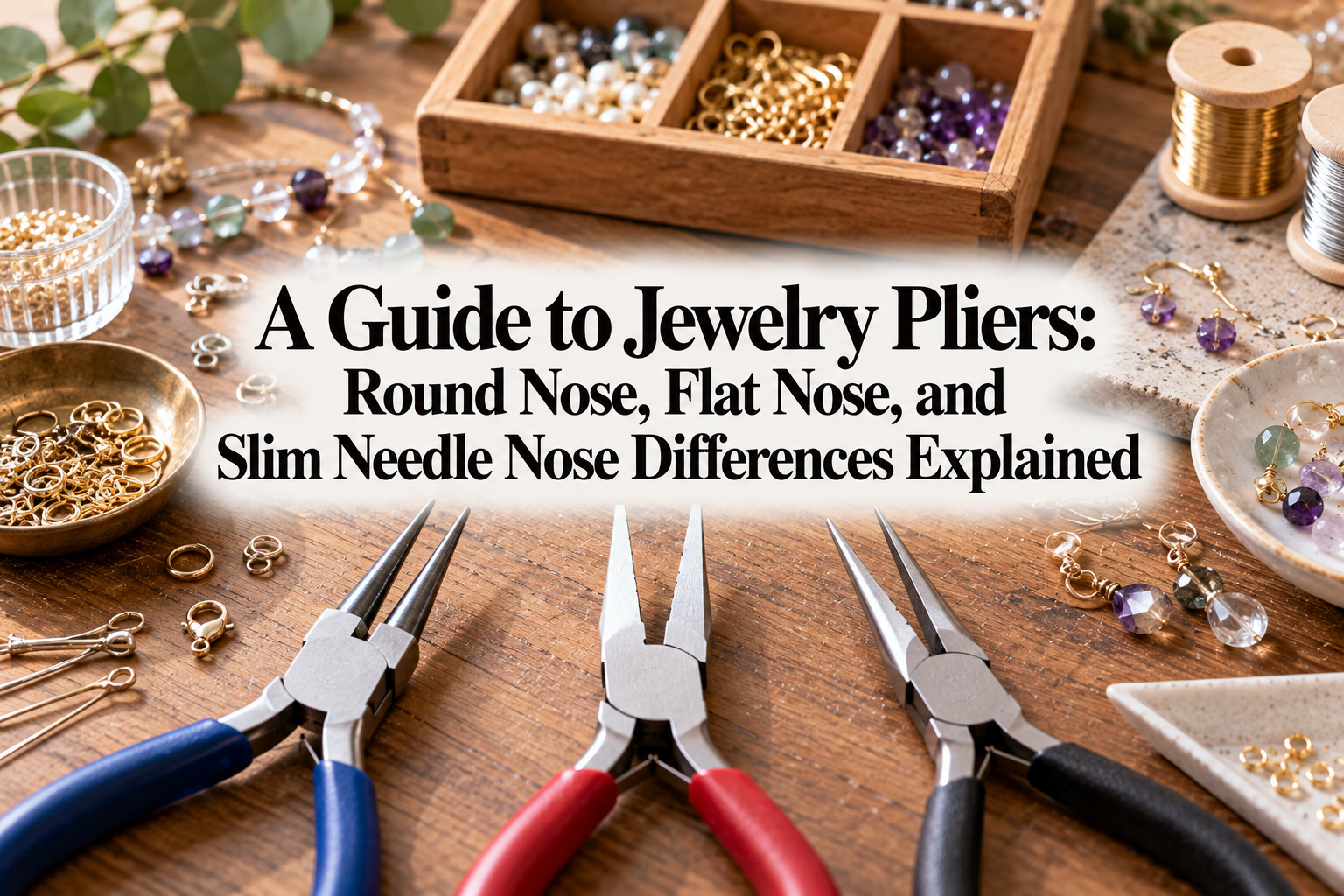
Browse online craft shops or tool aisles, and you will see an array of options: round nose pliers, flat nose pliers, slim needle nose pliers, and more. Because they all look like similar metal hand tools at first glance, beginners often wonder which one to buy first and how to use each type effectively.
Besides making my own jewelry, I truly love admiring and purchasing the gorgeous creations of other handmade artisans. Having handled countless pieces, I can say with confidence that the clean finish and overall quality of handmade jewelry come down to the precision of your pliers and how well you alternate between them.
By choosing the right tool and mastering its proper use, you can bend wire and connect findings with a professional finish—without leaving a single scratch on delicate metal parts. In this guide, drawing from my hands-on crafting experience, I will explain the characteristics, uses, and differences of round nose, flat nose, and slim needle nose pliers, along with practical tips for choosing the right pair.
In Japanese jewelry making, the dedicated pliers used to grip, bend, open, close, and hold metal components are called yattoko. While they share a similar basic mechanism with regular household pliers, jewelry pliers have one crucial feature that sets them apart: their inner jaws are completely smooth, without serrations or grooves.
Standard utility pliers feature serrated, grooved teeth designed to grip bolts or heavy wire with firm friction. However, if you grip delicate jewelry findings with serrated jaws, those teeth will leave deep gouges on the metal surface and strip away the plating. Jewelry pliers are precision hand tools designed specifically for crafting, built to handle components cleanly without scratching their finish.
Round nose pliers (maru-yattoko) feature conical, round jaws that taper smoothly toward the tips. Whether viewed from the side or above, the cross-section of both jaws is perfectly circular.
When it comes to rolling wire or headpins into clean, rounded loops, round nose pliers are absolutely essential.
The jaws taper into a cone so you can easily adjust the size of the loop you form based on where you position the wire along the jaws. Clamping near the slender tips produces tiny loops, while gripping further back toward the thicker base creates larger loops.
They excel at pin work—such as turning eye pins and headpins into uniform loops—as well as creating circular wire loops. Because the jaws have no flat surfaces, they are not suited for holding flat components firmly in place. However, when it comes to forming neat curves and circles, nothing replaces them.
Forming a neat, circular loop at the end of a pin requires a specific hand movement and angle:
Keeping the wire positioned at the exact same spot along the tapered jaw throughout the turn is the secret to producing a balanced, symmetrical circle.
Flat nose pliers (hira-yattoko) have completely smooth, flat surfaces on the inner faces of both jaws. While the outer profile may be slightly rounded, the wide, flat gripping area provides a secure, stable hold on components.
In jewelry making, flat nose pliers are the most frequently used tool and serve as the foundation for virtually every project.
The greatest strength of flat nose pliers lies in their ability to clamp components across a flat plane. They are ideal for opening and closing jump rings (round and oval), flattening crimp beads, and bending sheet metal or flat findings.
Because pressure is applied evenly across the surface, components are far less likely to slip or dent unevenly. If you are starting jewelry making, flat nose pliers are an indispensable staple.
When opening jump rings, you should never pull the ends directly outward to the left and right. Pulling them sideways deforms the circular shape, making it nearly impossible to restore a clean, flush circle.
The correct technique uses two pairs of pliers to twist the ring open front-to-back:
Sticking to this front-to-back twist preserves both the structural strength and the aesthetic shape of your jump rings.
Slim needle nose pliers (sakiboso-yattoko) share the same smooth, flat inner jaw structure as flat nose pliers, but their tips taper down to an exceptionally fine, sharp point. They show their true strength in tight spaces and when handling minuscule components where standard flat jaws cannot reach.
While standard flat nose pliers often have tip widths around 1.5 mm to 2 mm, slim needle nose pliers are ground down to tip widths under 1 mm. This slender profile allows you to slip between closely spaced beads easily.
They are particularly useful for picking up delicate chain links, adjusting tiny jump rings, or executing intricate wire-wrapping techniques. Because the fine tips do not block your line of sight, you can clearly see your work area and place your tools with pinpoint accuracy.
When using slim needle nose pliers, be mindful not to apply excessive force. Because the tips are extremely thin, trying to bend heavy-gauge craft wire or crush tough metal findings can bend or distort the tool tips themselves.
Keep a clear division of tasks: use sturdy flat nose pliers when firm leverage is needed, and reserve slim needle nose pliers for detailed, delicate tasks where precision matters most.
A common mistake among craft beginners is reaching for standard DIY tools from a home repair kit. Understanding why dedicated crafting pliers are necessary will save your materials and time.
General DIY pliers and hardware needle-nose pliers have deep grooves or serrations cut into their jaws to prevent heavy wire or bolts from slipping. Gripping gold- or silver-plated jewelry findings with serrated jaws will immediately gouge the metal. Once plated surfaces are scratched, they cannot be repaired and become vulnerable to peeling and tarnishing. Always use smooth-jawed jewelry pliers for delicate craft work.
Another frequent misunderstanding is attempting to cut wire or pins using jewelry pliers. Round nose, flat nose, and slim needle nose pliers have no cutting edges whatsoever. Cutting metal wire is exclusively the job of side cutters (nippers). Pliers are designed to grip, bend, and hold; cutters are designed to cut. Forcing wire between plier jaws to sever it can misalign the jaws and ruin the tool.
Jewelry pliers range widely in price, from budget options to premium precision tools. Keep the following checkpoints in mind to find a dependable pair you can enjoy using for a long time.
Always verify whether the pliers feature an internal spring between the handles. A spring-loaded tool automatically opens its jaws when you release your hand pressure. This mechanism drastically reduces hand strain during repetitive opening and closing tasks. Pliers without springs require your fingers to push the handles open every time, which slows your work and quickly fatigues your hand and wrist.
Jewelry making involves holding tools for extended periods. Plain metal handles or bare, hard plastic grips can cause hand pain over time. Look for comfortable handles coated with non-slip elastomer resin or soft-grip material. An appropriately sized grip that fits comfortably within your palm ensures delicate control without requiring excess grip strength.
The most common issue with overly cheap tools is poor tip alignment. If the tips do not meet flush and leave an uneven gap when closed, fine wire or tiny jump rings will simply slip through. Check that the jaws close seamlessly and accurately at the very tip. Furthermore, pliers made from stainless steel or high-carbon steel offer high durability and resist bending or rust over long-term use.
Beginners often ask whether they need to purchase all three types right away. Here is a practical sequence based on common crafting needs.
If you can only buy one pair at the start, choose flat nose pliers without hesitation. In basic jewelry making, attaching jump rings to readymade charms and connecting earring findings makes up a large portion of the work. Flat nose pliers handle these opening, closing, and holding tasks immediately, making them the most fundamental tool in your kit.
Once you have flat nose pliers and find yourself wanting to thread beads onto headpins to create loops, add round nose pliers as your second purchase. They open the door to headpin and eye pin work, vastly expanding your creative range. With one flat nose and one round nose pair, you can complete most basic jewelry projects.
After getting comfortable with your first two pairs, add slim needle nose pliers when you want to work with smaller beads, delicate chains, or intricate wirework. They also pair wonderfully with flat nose pliers when opening jump rings; having a slim tip alongside a flat jaw gives you an unobstructed view when handling micro-sized rings.
Starter sets featuring flat nose pliers, round nose pliers, and side cutters from reputable craft brands are widely available and offer great value for beginners. Sets also have matching handle sizes and weights, making tool changes feel natural. I started with a basic craft set myself, eventually investing in individual precision tools once I discovered my personal preferences. Starting with a reliable craft set is a great, accessible way to begin.
Improper handling can damage both your jewelry components and your tools. Keep these common mistakes and maintenance tips in mind.
In an effort to keep components secure, beginners sometimes squeeze the handles with excessive force. Because pliers function through leverage, high hand pressure transfers significant crushing force to the tips. Soft metals like aluminum, raw brass, or thin plated findings can easily dent. Use just enough pressure to keep the part from slipping. When working with delicate surfaces, wrapping a layer of masking tape over the plier jaws is an effective trick to prevent surface marks.
Scratches frequently happen when the plier tips slip off a jump ring during closing. This usually occurs because only the very edge of the ring was caught in the shallow tips. To prevent slipping, seat the component deeper along the flat jaw surface so the plier can grip a larger contact area. Keeping the jaws clean and wiping away finger oils or dust with a dry cloth also helps maintain a secure grip.
Because jewelry pliers are precision tools, applying excessive sideways strain—such as prying hard steel wire—or dropping them onto hard floors can misalign the pivot joint. Furthermore, moisture and skin oils can cause rust. After working, wipe down your tools with a soft, dry cloth. If storing them for an extended period, applying a tiny drop of mineral or machine oil to the joint and placing them in a case with a desiccant will keep them in peak condition for years.
To recap the roles of these three essential jewelry pliers:
Each shape is designed with a specific purpose in mind. Alternating between them according to your task will dramatically improve both your workflow and the finished quality of your pieces. Unlike standard utility pliers, smooth-jawed jewelry tools act as natural extensions of your fingertips.
Start with a reliable pair of flat nose pliers, enjoy the clean handling of your findings, and bring your creative designs to life with ease! Until next time, this is Yassy from Crafters!


For example, if you are looking for articles about mizuhiki, try searching for "mizuhiki"; if you are interested in tools, try keywords like "nippers" or "pliers."
