7 Essential Embroidery Tools and Their Roles: A Beginner’s Guide to Flawless Stitching
yassy
Crafters!
Hello, everyone! It’s Yassy from Crafters! (・∀・)
When making handmade items, have you ever encountered frustrating problems like asymmetrical shapes, parts that are off by a millimeter during assembly, or components that just won’t fit neatly together? We have all been there!
I personally love making all kinds of handmade crafts, browsing beautiful handmade shops, and purchasing items crafted with great care by makers. Through that journey, there is one thing I am absolutely certain of: the single most decisive factor that determines the quality of a craft is how accurately you measure and mark your positions.
No matter how high-end your materials are, if you rely on guesswork or eye-balling, the beauty of the finished piece will be cut in half. Conversely, if you use the right measuring tools suited to your task and measure accurately down to the millimeter or tenth of a gram, even beginners can achieve polished, professional-grade results.
In this guide, I will introduce essential measuring and positioning tools used in handmade crafting, grouped by their specific purpose. You will clearly understand what tools exist and which ones are truly necessary for your craft. Read through to find the perfect measuring partners for your workspace!
In crafting, measuring and positioning are not mere prep steps. They form the foundational backbone that supports the beauty, durability, and usability of the entire finished piece.
While human eyes are remarkably sharp, they are also easily fooled. A piece built solely on the intuition of “this looks about straight” will almost always show tilt or distortion when viewed from a distance. With everyday items such as accessories, leather goods, or fabric bags, a single millimeter of error creates an unmistakable, cheap appearance.
Furthermore, with materials like resin, handmade soap, or scented candles, errors in weight or volume—rather than length—make completing the project virtually impossible. Over 90% of failures, such as uncured sticky resin or soaps that refuse to release from molds, are caused by inaccurate measuring.
In short, moving away from relying on intuition and trusting precise tools is the shortest route to zero crafting mistakes. Building the habit of preparing thoroughly with the right tools for your specific medium and step is the key to elevating your work.
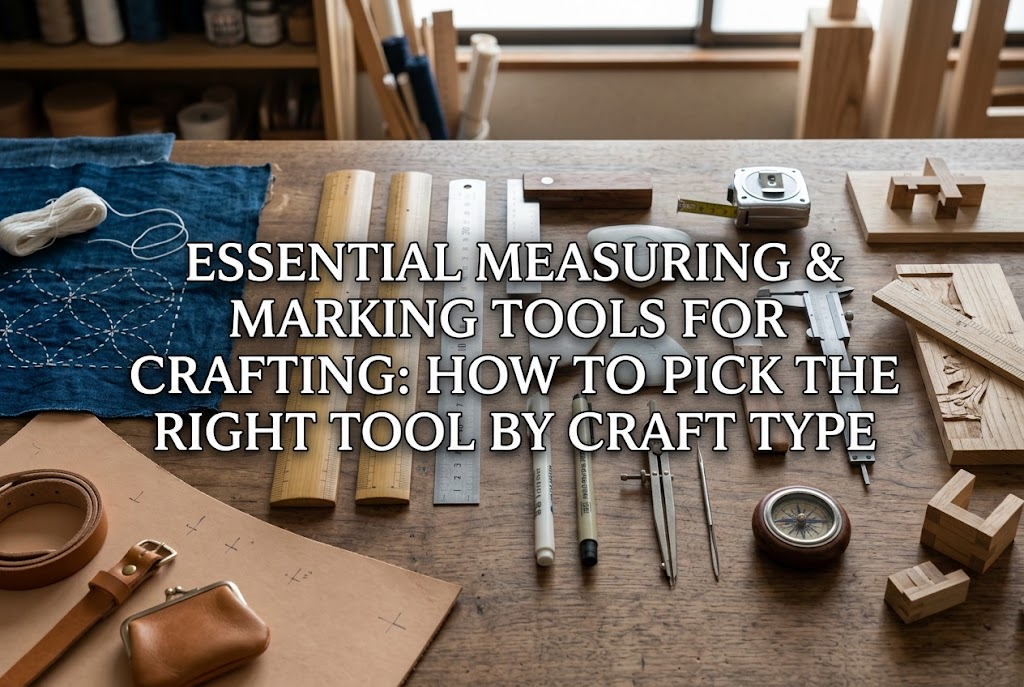
Let’s start with tools for measuring straight lines and drawing guides, which form the basics of paper crafts, sewing, leatherwork, and beyond. While they may appear similar at first glance, the proper tool depends entirely on your material and purpose.
The most accessible and basic tool is the straight ruler made from transparent acrylic or clear plastic.
Primary Uses and Features:Used for measuring paper and thin sheets, or drawing straight lines with pencils and pens. Because it is completely transparent, the biggest advantage is being able to align measurements while clearly seeing underlying sketches or blueprints through the ruler.
A Common Beginner Mistake:Using a craft knife directly against a clear acrylic ruler to cut paper or fabric. The blade will shave into the soft acrylic edge, making it wavy and ruining its ability to draw a straight line forever. Furthermore, the blade can slip over the ruler and cause serious hand injuries.
Yassy’s Insight:Think of the clear acrylic ruler strictly as a tool for drawing lines and checking alignment through transparency. Keep one specifically reserved for use with pencils and pens only.
These are transparent rulers printed with a precise square grid pattern, typically in 5 mm or 10 mm increments across the entire surface.
Primary Uses and Features:Used for adding seam allowances in sewing, drawing parallel or perpendicular lines in paper crafts, and positioning stamps or components at regular intervals. You can draw a line that is an exact distance parallel from an edge in one stroke, without having to mark multiple measurement points.
Difference from Standard Rulers:While a standard ruler only measures the distance between two points, a grid ruler allows you to align the printed grid over an existing baseline to instantly produce perfect right angles and parallel lines. Both speed and precision increase dramatically.
Yassy’s Insight:If you plan to work with fabric or paper, you should buy a grid ruler even before a standard ruler. Choosing a wide model with high-visibility dual-color markings ensures lines stay clearly readable even against darker backgrounds, boosting your efficiency immensely.
Takeshaku are traditional Japanese rulers made of natural bamboo, cherished for generations in Japanese sewing (wasai) and western tailoring (yosai).
Primary Uses and Features:Used for measuring fabric dimensions before cutting and checking hem folds while pressing with an iron. Because bamboo is a natural material, it is lightweight, naturally supple, and carries zero risk of scratching or snagging delicate fabrics.
Decisive Advantages Over Plastic:Bamboo rulers are remarkably heat-resistant. Even if you press a hot iron directly over the ruler while holding down folded fabric, it will never melt or warp. In addition, unlike plastic, bamboo does not generate static electricity, eliminating the frustration of fabric clinging and shifting out of place.
Yassy’s Insight:If you enjoy sewing or Japanese textile crafts, a longer bamboo ruler around 50 cm is an essential tool. It molds comfortably to your hand the more you use it, stays steady on fabric without slipping excessively, and elevates the precision of your textile projects.
These are extremely durable straightedge rulers constructed from metals like stainless steel.
Primary Uses and Features:Used as a cutting guide with utility knives or rotary cutters, as well as in leathercraft and cutting heavy cardstock or wood. Because it is metal, the blade will not shave into the edge, allowing for perfectly straight, crisp cuts.
Safety and Accuracy:When cutting through thick leather or cardboard, using a plastic ruler invites the danger of the knife blade climbing over the edge and causing injury. A metal ruler forms a solid barrier against the blade, enabling safe and firm cuts.
Yassy’s Insight:If your work involves blades, introducing a metal ruler is non-negotiable. Selecting one with an anti-slip foam or rubber backing will completely prevent the ruler from sliding during cutting.
Beyond flat lengths, measuring thickness, hole diameters, circular curves, and uniform spacing requires specialized tools. These tools elevate the precision of your crafts to a professional level.
Featuring a triangular cross-section, this specialized measuring rod carries different scale ratios across its edges.
Primary Uses and Features:Used for miniature crafting, dollhouse building, and drafting 3D designs. When creating realistic miniatures at ratios like 1:12 or 1:6, you can determine miniature dimensions straight from actual measurements without tedious manual math.
Difference from Standard Rulers:Calculating scale reductions on a regular ruler frequently leads to calculation errors and dimensional discrepancies. A triangular scale lets you read values directly, eliminating immense stress during miniature projects.
Yassy’s Insight:If you want to seriously pursue miniatures, models, or dollhouse furniture, a triangular scale is an indispensable tool. Choosing a solid, weighted aluminum model will also keep your line-drawing work remarkably stable.
Calipers clamp around an object to measure thickness, outer diameter, inner diameter, and depth down to tenths of a millimeter (0.1 mm) or finer.
Primary Uses and Features:Measuring the hole diameter of beads, checking the thickness of resin or clay parts, and gauging the outer and inner diameters of jump rings and bezels. Instead of holding a part over a ruler scale and guessing, you get an exact reading just by clamping the part.
Analog vs. Digital:Calipers come in manual dial/vernier types and digital models with LCD screens. For beginners, I strongly recommend a digital caliper, as it completely eliminates misreading mistakes.
Yassy’s Insight:When making bead jewelry, many crafters run into issues where needles won't pass through because they guessed the hole diameter or wire gauge. A single pair of calipers prevents part mismatches 100% of the time. Even an affordable, lightweight plastic digital caliper is extremely useful.
A two-legged drafting tool that anchors a center point while swinging open to draw clean circles.
Primary Uses and Features:Drawing circular backing bases for tsumami zaiku (traditional folded fabric flower craft), creating round pattern templates, and drafting bases for rosettes and candle pedestals. It allows you to draw true circles at exact target radii that are impossible to execute freehand.
Crafting Tips:If you want to avoid leaving a needle hole in delicate materials, apply a small piece of masking tape beforehand or use a compass with a blunt safety point. Some models also allow swapping out pencil lead for pens or cutter blades.
Yassy’s Insight:When making circular projects, some people trace around nearby cans or cups, but I advise against this. You cannot control the exact diameter. Always use a proper compass with measurements to achieve precise, beautiful circles.
While similar in appearance to a drafting compass, both legs of a divider terminate in sharp metal points, serving as a layout and measuring tool.
Primary Uses and Features:Used for setting uniform stitch spacing in leathercraft, transferring exact dimensions from one area to another, and scribing repeated equidistant markers. Once adjusted and locked, you can mark the exact same distance repeatedly without reaching for a ruler.
Difference from a Compass:While a compass is meant for drawing lines, a divider is designed to hold and transfer dimensions, or scribe fine guide marks onto material surfaces. It marks lines directly into materials like firm leather or wood where pencil graphite will not adhere.
Yassy’s Insight:When setting a neat stitching line parallel to the edge of leather, nothing beats a divider. It is a mandatory tool for achieving tidy, evenly spaced stitches.
A semicircular or circular clear plate inscribed with angular degrees from 0 to 180 (or 360) degrees.
Primary Uses and Features:Setting angles for evenly positioning tsumami zaiku petals, cutting precise angles in paper crafts and geometric embroidery, and drafting patterns for polygonal projects.
Impact on Finished Quality:For instance, if you want to make a flower with six balanced petals, dividing the circle evenly by 60-degree increments from the center is critical; otherwise, petal spacing will end up uneven. Laying down a precise base sheet using a protractor enables anyone to achieve professional-looking symmetry.
Yassy’s Insight:You might wonder, “A protractor for handmade crafts?” But it is an unsung hero for geometric patterns and radial designs. Preparing a highly transparent full-circle (360-degree) protractor makes alignment dramatically easier.
Here is an indispensable tool for measuring curved surfaces and human body measurements that rigid rulers cannot handle.
A flexible, bendable measuring strip made of soft cloth, vinyl, or fiberglass.
Primary Uses and Features:Body measurements for garment making and tailoring, measuring the circumference of completed bags or hats, and determining dimensions on three-dimensional curved items like candles and pottery. It wraps snugly against any curved contour with no gaps.
A Critical Buying Note:Inexpensive vinyl tape measures from 100-yen discount shops can stretch over long-term use or when pulled firmly, causing the scale to lose accuracy. When buying one, always choose a soft tape measure made of fiberglass, which resists stretching and maintains its length.
Yassy’s Insight:Having a retractable soft tape measure that snaps back inside a case at the push of a button keeps your workspace tidy and comfortable. Choosing one with a sturdy, flat metal end tab also makes measuring solo much easier and more accurate.
In many crafting genres, measuring weight or volume—rather than length—governs the entire outcome. These tools are critical for crafts that depend on chemical reactions or exact mixing ratios.
A measuring device that displays the weight of an item placed on its platform in digital numbers.
Primary Uses and Features:Mixing two-part epoxy resin base and hardener, dividing clay into equal portions, measuring candle wax and fragrance oils, and weighing ingredients for handmade soap.
Why 0.1g Precision Matters:If you use a basic kitchen scale that only reads in 1-gram increments for resin or scents, slight discrepancies can cause curing failures or volatile fragrance loss. For crafts, always prepare a digital scale capable of reading down to 0.1 g (or 0.01 g).
Yassy’s Insight:99% of curing failures with two-part resin happen because the maker measured by volume using marked plastic cups or used a rough 1-gram kitchen scale. Weighing on a 0.1g precision scale while using the tare (zero-display) function is the absolute rule for success.
A set of small spoons designed to scoop exact mini-volumes (such as 5 ml, 2.5 ml, 1 ml, 0.25 ml, etc.).
Primary Uses and Features:Measuring tiny amounts of pigment powders, liquid dyes, glitter, mica, bath bomb ingredients, and dried herbs.
Ensuring Consistency:If you want to recreate the exact same resin tint or candle scent intensity every time, eye-balling powder amounts will make reproduction impossible. By recording your formula using micro measuring spoons—such as “one level scoop of the mini spoon”—you can duplicate identical quality every time.
Yassy’s Insight:Instead of large kitchen measuring spoons, invest in ultra-fine mini craft measuring spoons that measure down to 0.1 ml. They give you complete control over powder additions.
Containers with volumetric markings printed along the side, used for measuring liquids and mixed compounds.
Primary Uses and Features:Blending water-based acrylic resins (like Jesmonite) or plaster with water, portioning larger volumes of melted candle wax, and mixing liquid silicone for mold-making.
Choosing Materials:Choose between disposable clear plastic cups and reusable silicone measuring cups, which allow cured materials to be peeled right off. Pick based on the properties of your resin, wax, or paint.
Yassy’s Insight:When checking liquid volume in a measuring cup, always place the cup on a flat work surface and bring your eye line level with the markings. Looking down from above at an angle creates substantial reading errors.
Now that we have covered 13 types of measuring and marking tools, you might wonder: “Which ones should I actually buy first?” Here is my guiding framework to ensure you never regret your purchases.
First, remember the fundamental rule: in measuring tools, bigger is not better. If you try to measure a tiny bead of a few millimeters with a 30 cm ruler, the wide margins at the end will get in the way and ruin accuracy. Conversely, if you try to measure a long stretch of fabric with a short ruler, shifting the ruler repeatedly accumulates errors. Always select a tool scaled to the dimensions of the project you make.
Second, when deciding whether you can make do with everyday household items, draw a clear line:
For tools involving safety and precision, investing in dedicated gear prevents ruined materials and ultimately saves you money in the long run.
Here is a quick reference list of the essential measuring kit for your chosen craft discipline:
You do not need to buy everything at once. Secure the essential set for your primary craft first, and add new tools as your creative projects expand!
In this guide, we explored 13 essential measuring and layout tools that dramatically transform the quality of handmade crafts, along with tips on how to choose them.
When crafting, it is easy to focus only on the exciting steps like cutting, painting, stitching, and curing. Yet the quiet, foundational step that guarantees those actions succeed is always accurate measuring and deliberate positioning.
Set aside guesswork and pick up the right measuring tools tailored to your craft. That single shift will reward you with parts that fit together seamlessly, perfectly balanced symmetry, and a clean finish that rivals store-bought goods.
I hope you experience the excitement of watching your beloved crafts evolve with the help of the right tools in your workspace!
If you found this guide helpful, sharing it with your crafting friends on social media means the world to me. See you in the next article! This was Yassy from Crafters!

For example, if you are looking for articles about mizuhiki, try searching for "mizuhiki"; if you are interested in tools, try keywords like "nippers" or "pliers."