A Japanese Crafter’s Guide to Jesmonite Sanding Tools: How to Choose Waterproof Sandpaper, Power Tools, and Grits for a Pro Finish
yassy
Crafters!

Hello, this is Yassy from Crafters! (・∀・)
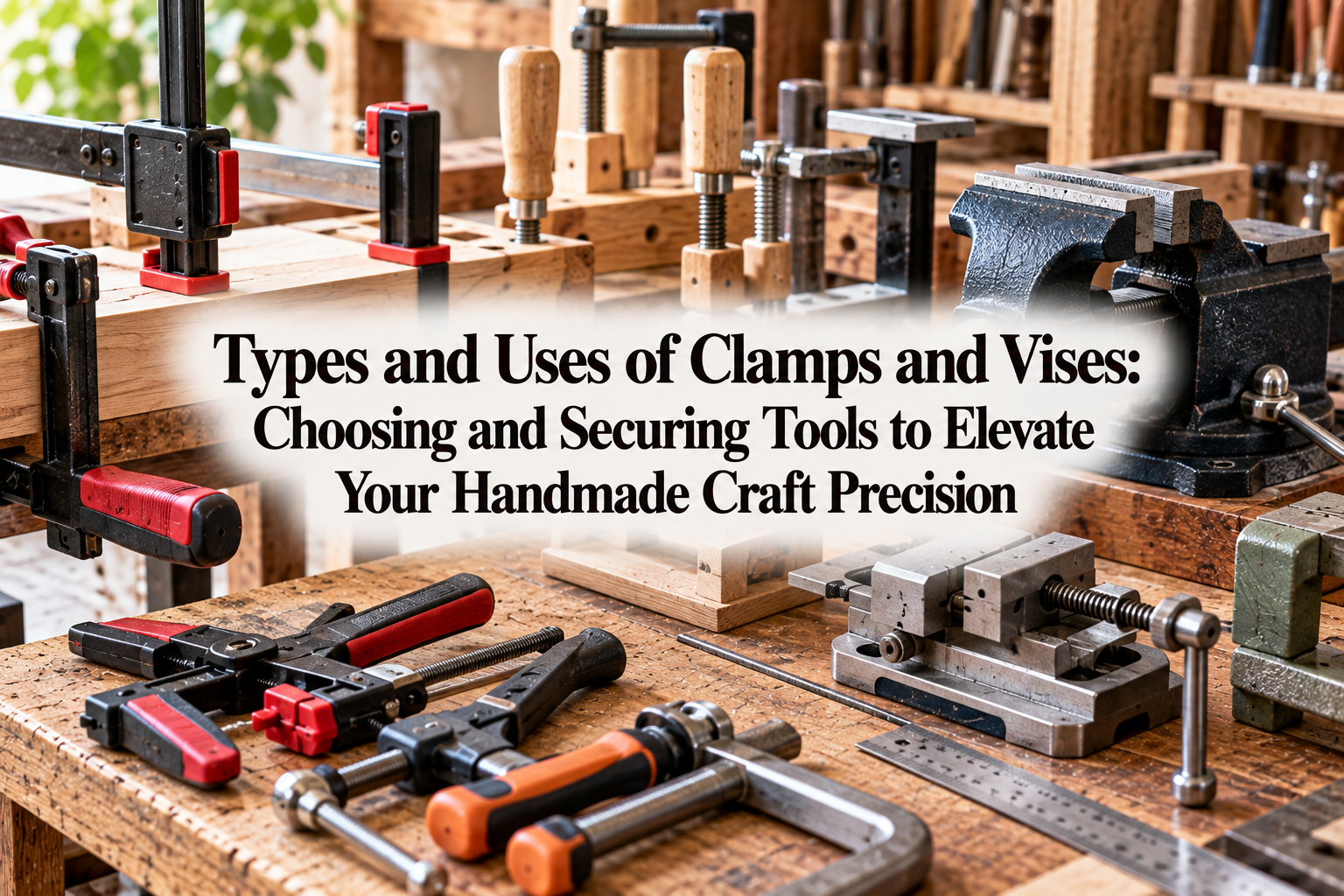
I love making, viewing, and buying all kinds of handmade crafts. However, one hidden yet essential item I always rely on to determine the final finish of a piece is the combination of clamps and vises.
When starting out in handmade crafting, it is common to hold materials by hand while waiting for glue to dry, or struggle to file parts that wobble around. But holding things manually has its limits. It causes subtle misalignments and makes your hands tired, leading to a loss of focus.
That is where clamps and vises come in to securely hold your workbench or materials together. Introducing securing tools properly will dramatically improve the precision of your creations. In this guide, I will thoroughly explain the basics, selection criteria, and practical application techniques of clamps and vises so beginners will never feel lost.
In handmade crafting, clamps and vises act as "an extra pair of hands." Their primary role is to free up both of your hands when you want to glue materials seamlessly or cut and sand safely.
No matter how focused you are, holding parts by hand creates micro-vibrations and slight looseness. Especially while waiting for glue to dry, hand tremors causing a shift of just a few millimeters can distort the entire piece. Using securing tools keeps constant pressure on the glued surface, achieving a strong and beautiful finish.
Additionally, ensuring safety during drilling, sawing, and filing cannot be overlooked. If materials move while using bladed tools, it can lead to injury or damage to your project. Securing materials is an essential process not only for boosting quality but also for protecting yourself.
Clamps and vises show incredible effectiveness across all craft genres—from woodworking and leathercraft to miniatures, polishing resin accessories, and stabilizing foundations for clay work.
While both clamps and vises are tools that grip and hold objects, they have clear differences in structure and purpose. Choosing between them according to your work size and process is key to success.
Clamps are portable tools designed to clamp materials directly together or secure materials onto a workbench. A key feature is that the tool itself is lightweight, easy to carry, and can be used in almost any clamping spot.
They are designed to clamp across a wide range of materials, coming in a rich variety of sizes and shapes. They adapt flexibly to broad scenarios, from gluing large boards to temporarily holding small parts.
In Japan, a vise is called manriki (万力), and it is a stationary, heavy-duty holding tool generally attached to a workbench or desk. Made of metal, the body is very solid and boasts exceptionally high holding power.
You securely mount the vise itself onto a workbench and clamp your project or material between its jaws. It is suited for processing tasks that apply strong force to the piece, such as filing metal, drilling holes with an electric drill, or deburring.
The criteria for choosing are simple. Select a clamp for joining materials together or securing materials to a workbench across a wide area. Select a vise for firmly securing small parts to intensely file, cut, or drill.
Remember it this way: use clamps when you need portability or are assembling box-like structures, and use vises when you want to perform heavy processing using both hands without moving the work position at all.
Even among clamps, usability varies significantly by structure. Here are representative clamps frequently used in crafting:
These clamps are shaped like the letter "F". They feature a wide opening capacity, allowing even large materials to be clamped firmly.
The "one-handed quick bar clamp" is especially recommended because you can tighten it with one hand just by squeezing the trigger. Beginners find it extremely easy to handle, as you can adjust your work position with one hand while effortlessly securing it with the other.
These are sturdy metal clamps shaped like the letter "C". Operating by turning a screw to tighten, they generate overwhelming pressing force.
They show their power when gluing thick wooden boards or when you need to apply very strong pressure. Because the body is slim, they can also handle clamping in tight spaces.
These clamps feature a structure similar to giant clothespins. Clamping solely by spring force, they allow quick one-touch securing without the hassle of turning screws.
Although holding power is modest compared to screw types, they are extremely convenient for temporarily holding fabrics, thin leather, or light drying parts. Since they are so easy to use, keeping several on hand is very helpful.
Specialized clamps designed to hold materials at a precise 90-degree right angle. They shine when making picture frames, wooden boxes, or dollhouse room frames.
Since you can let glue dry or insert screws while maintaining a perfect right angle, they are essential tools for preventing distortion in box-shaped creations.
Vises also come in several types depending on application and environment. There are types that won't damage your desk, so pick one that fits your workspace.
These desktop vises feature a strong suction cup on the base, allowing them to attach to smooth tables with a single lever. Since there is no need to drill holes or clamp them to the desk, you can easily use them on a living room table.
Small and lightweight, they are ideal for filing metal accessory parts, working on resin pieces, or shaping miniature components.
In this type, the base of the vise has a clamp structure that mounts onto the edge of a workbench. They offer higher holding power than suction types and won't wobble even during tasks that require a bit of force.
They excel in crafts requiring more serious processing, such as sanding woodwork, wire crafts, or cutting metal.
A high-end type where the mounting base for the jaws is a sphere (ball), allowing you to freely secure work at any angle or tilt.
They demonstrate overwhelming power when you want to perform high-precision work while catching light from any angle, such as gemstone wire wrapping, metal engraving, or painting detailed figures.
In securing tasks, some try to substitute tools with stationery paperclips, clothespins, or paperweights. However, there is a decisive performance gap compared to dedicated clamps and vises.
Clips have extremely weak gripping force, and their contact area is limited to small points or lines. Therefore, clamping thick or slippery materials will cause them to pop right off.
Furthermore, because they cannot maintain constant uniform pressure, glue jobs in woodworking will leave gaps and fail. Clamps differ decisively in that they are designed to apply uniform pressure across an entire surface.
Weights can only apply pressure vertically downward due to gravity. Securing from the sides, diagonally, or pulling against a workbench is impossible.
Moreover, the moment you place a weight, there is a high risk of the material sliding sideways, making them unsuitable for accurate positioning. Clamps allow you to control clamping direction freely, completely preventing slippage.
Pliers only hold materials while you squeeze them with your own hands. During work, one hand is always occupied, and continuous grip strength fatigues your hands.
Clamps and vises maintain holding power even when you let go, creating an environment where both hands are completely free to focus on precise craftsmanship.
Here are key points beginners should check when buying for the first time. Choosing based solely on appearance leads to mistakes, so verify these criteria carefully:
The last thing you want on a handmade piece is dents or scratches caused by clamping pressure. Using tools with exposed metal jaws will instantly dent wood, resin, or leather.
Beginners should always choose products with soft resin or rubber protective pads attached to the jaws. If using a product without pads, you will need to insert scrap wood or felt yourself.
Opening capacity refers to how many centimeters or inches of thickness can be clamped. Choose a capacity one size larger than the maximum size of the piece you want to create.
Also, throat depth is the distance from the edge of the material to how far inside it can clamp. If you want to compress near the center of a material rather than just the edge, you will need a clamp with a deep throat.
Large cast-iron vises are sturdy, but their weight makes setting them up a hassle. For craft beginners working at home or in limited spaces, lightweight models made of die-cast aluminum or reinforced plastic are best.
Choosing lightweight tools that can be pulled out and set up quickly is an important factor in maintaining daily crafting motivation.
If I were to strongly recommend a starter set for craft beginners, it would be this configuration:
Having these three types covers almost all securing tasks in woodworking, leathercraft, resin, and accessory making. The reason for getting a pair of two bar clamps is that when gluing rectangular materials, you need to apply equal pressure to both ends.
Here are practical, genre-specific techniques on how to master clamps and vises in actual crafting:
When gluing boards together with wood glue, clamp them evenly with one-handed quick bar clamps after applying glue. Be sure to wipe off any squeezed-out glue completely with a damp cloth before letting it dry.
When cutting wood with a hand saw, securely clamp the wood to the edge of the workbench using F-clamps. Creating an immovable state prevents the blade from catching, yielding straight, clean cut surfaces.
When bonding leather parts with rubber cement, press the joined surfaces together with spring clamps. Placing scrap pieces of leather over the spring clamp's protective pads prevents pressure marks, leaving a beautiful finish.
For edge burnishing (koba-migaki), clamp a wooden lacing pony or leather protected by thick cardboard into a vise. With both hands free, you can burnish speedily with consistent force.
When gluing tiny millimeter-scale parts for dollhouse furniture, use small spring clamps or miniature tweezer-type securing tools.
When assembling room walls or outer frames, use corner clamps on all four corners. Maintaining precise right angles completely prevents wobbling and distortion in the finished piece.
When removing resin flash or drilling eye-pin holes with a pin vise, holding pieces with bare hands can be slippery and dangerous.
Use a suction cup desktop mini vise here. Wrap the resin part in a soft material like polyurethane foam and lightly clamp it in the vise. Because the base does not move, you can drill straight, accurate holes with a pin vise.
Securing tools are extremely useful, but misuse can break your work. Keep these precautions in mind:
Because securing tools utilize strong leverage or screw mechanics, they apply more force than expected. Turning handles with brute force can crush wood or shatter resin parts.
The rule of thumb when tightening is to stop at the minimum force necessary so the material does not move. When clamping soft materials, always insert scrap wood (caul block), felt, or cardboard between the workpiece and jaws to disperse pressure.
The most common mistake during press-bonding is squeezed-out adhesive adhering to clamp pads or jaws, causing the craft piece and clamp to fuse together.
To prevent this, place masking tape or wax paper between the gluing area and clamp contact points. Even if glue overflows, it peels off cleanly with the tape without damaging your creation.
When securing large materials to a workbench with clamps, if the material extends too far off the table, the overall center of gravity shifts, risking tipping the whole workbench over.
When filing with strong force using a vise, a workbench that is too light will wobble dangerously. Place weights at the feet of the workbench or position it against a wall for stability.
Clamps and vises are not just tools for holding things. They compensate for the limitations of manual holding, boosting precision, strength, and aesthetic quality to a professional level.
Gluing work you used to struggle with by hand, or delicate filing that wobbled, will become surprisingly smooth and accurate just by introducing the right holding tools.
Start by introducing a versatile one-handed quick bar clamp or a suction cup desktop mini vise. I promise your work stress will drop dramatically, and your crafting joy and quality will leap to new heights!
If you enjoyed this, sharing it with friends on social media or messaging apps would make me super happy and encouraged!
Well then, see you in the next article! This was Yassy from Crafters!


For example, if you are looking for articles about mizuhiki, try searching for "mizuhiki"; if you are interested in tools, try keywords like "nippers" or "pliers."
