Choosing and Using Finishing and Wax Application Brushes for Leather and Woodcraft: A Guide by Yassy
yassy
Crafters!

Hello! This is Yassy from Crafters! (・∀・)
In the world of handmade crafts, there are so many wonderful materials that excite us just by looking at them—resin liquids for accessories, clay, vibrant paints, candle wax, aromatic essential oils, and more. Choosing the right materials for the project you want to create is truly one of the most enjoyable parts of crafting.
However, when you actually start working, the tools that ultimately determine the quality and final finish of your piece are your measuring and mixing tools. Everyone has experienced a heartbreaking fail at least once: resin failing to cure because the mixing ratio was slightly off, or unwanted lumps of pigment remaining because the mixing was inadequate.
I personally love making various handmade items, as well as looking at and purchasing works by other crafters. One thing I've noticed without exception is that creators who produce beautiful, high-quality pieces place immense value on the mixing and measuring process. Rather than relying on guesswork or makeshift tools, using the optimal tool tailored to your medium is the fastest and surest route to zero-fail crafting.
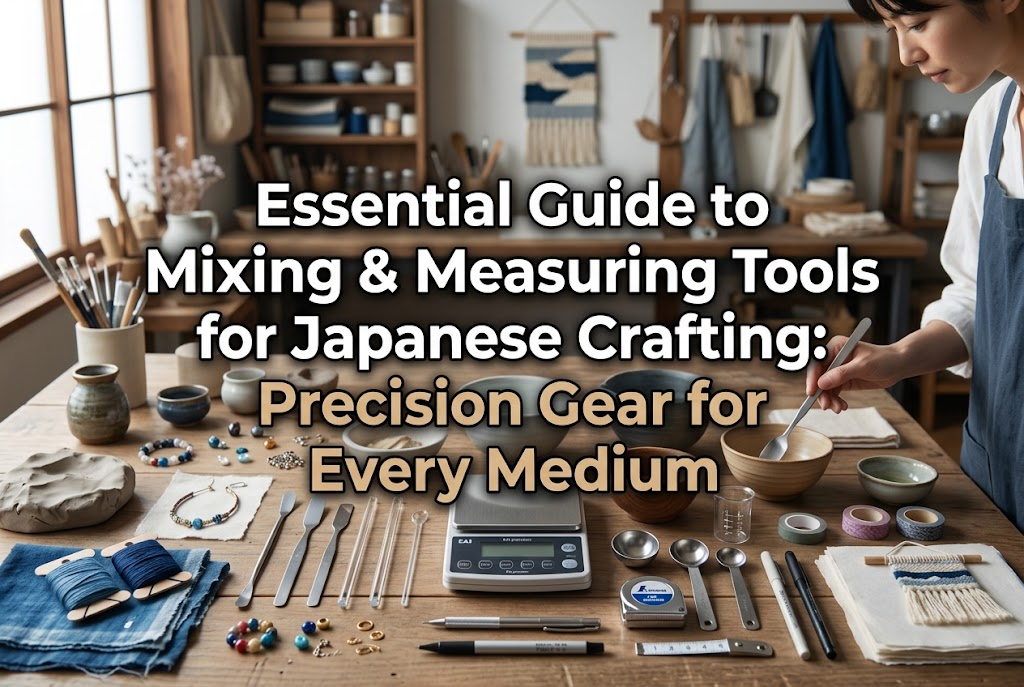
In this guide, I have compiled 11 types of measuring and stirring tools frequently used in craft workshops, organized clearly by their practical application. Designed to help you understand at a glance what each tool is and how it should be used, this comprehensive overview will help you identify exactly what your project needs for seamless, successful crafting every time.
In handmade crafting, measuring and mixing are far more than mere setup steps. Whether you are working with chemical-reaction materials like resin, plaster, and Jesmonite, or blending colors for paints and clay, these steps form the delicate core of the creative process that requires the utmost precision.
Neglecting proper measurement leads to critical failures such as:
Furthermore, insufficient mixing leaves visible pigment specks and uneven streaks in your work. Conversely, over-stirring introduces an abundance of unwanted micro-bubbles, ruining the crystal clarity of resin pieces.
All of these troubles can be completely avoided simply by choosing the right tools suited to your material's characteristics and handling them correctly. Understanding the role of each tool is your first step toward elevating your handmade creations to a professional level.
These tools are designed to accurately gauge material quantities. Depending on whether your material is managed by weight (grams) or volume (milliliters), the ideal tool changes distinctly.
A digital scale is an absolute necessity for accurately measuring material weight in grams via a digital readout. It is essential when measuring two-part epoxy resin, Jesmonite, plaster, candle wax, and resin clay.
The golden rule when choosing a digital scale for handmade crafts is that it must measure in 0.1g increments. Standard household kitchen scales usually measure in 1g increments, which introduces significant margin for error when working with tiny amounts of resin or color pigments. Preparing a precision scale capable of 0.1g (or ideally 0.01g) increments is essential.
Make good use of the "Tare" function, which resets the container weight to zero. Place your mixing cup on the scale, zero out the reading, and add your ingredients sequentially. To keep my workspace clean, I wrap transparent plastic wrap around the scale's operation panel. This simple trick reliably prevents damage caused by accidental liquid spills.
Measuring cups are designed to measure relatively large liquid volumes in milliliters (ml), such as water, liquid dyes, herbarium oil, or liquid for mixing plaster.
For crafting, choose measuring cups made of highly chemical-resistant materials like silicone or polypropylene (PP), rather than kitchenware. Silicone measuring cups are particularly economical because cured resin can be peeled off effortlessly, eliminating the hassle of washing.
Keep in mind that measuring viscous liquids in a cup can leave residue on the inner walls, creating discrepancy in the actual poured volume. Use measuring cups for free-flowing liquids, and switch to weight measurement on a digital scale for thick, viscous liquids.
Measuring spoons are incredibly handy when you want to dispense tiny, consistent amounts of powdered pigments (like mica powder), glitter, or clay aliquots in identical ratios every time.
While the amounts might be too small to weigh on a standard scale, these spoons shine when you want to achieve reproducible shades and shimmer every single time. A mini craft measuring spoon set capable of dispensing 1 ml, 0.5 ml, or 0.1 ml is ideal.
When using measuring spoons, always use a level measurement. Heaping or irregular scoops ruin consistency, so level off the top using the edge of the spoon or a flat blade.
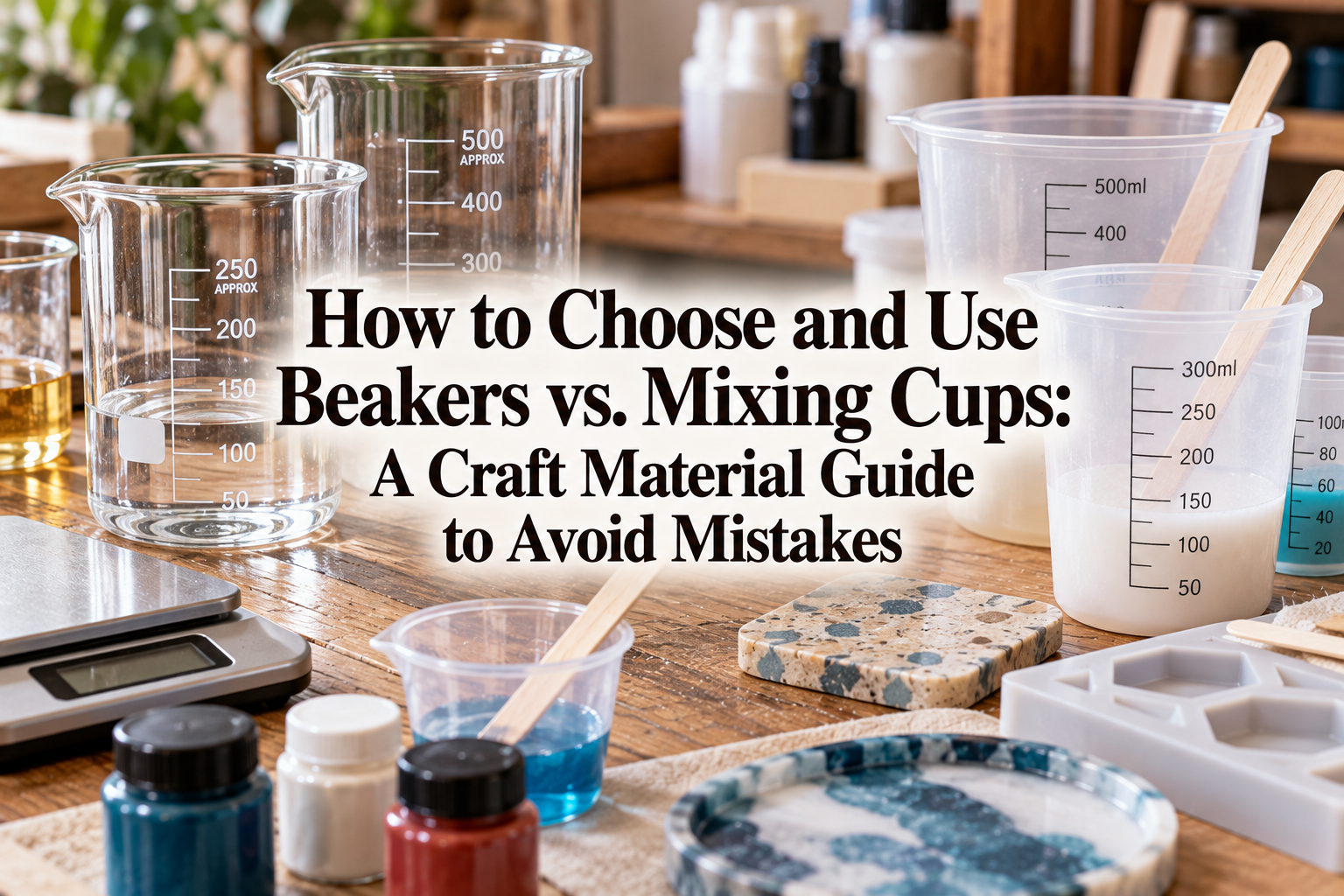
A beaker is a heat-resistant, chemical-resistant glass or plastic container featuring marked volume graduations, allowing you to measure and mix materials directly inside the vessel.
It is perfect for melting candle wax in a double boiler or precisely measuring and mixing liquids before pouring. The defining feature of a beaker is its pouring spout (beak), which allows you to measure and then pour cleanly into molds without dripping.
Glass beakers offer excellent thermal conductivity and chemical resistance, though they carry a break risk if dropped. My recommendation is glass beakers for candles and essential oils, and plastic (PP) beakers for water-based resins and general crafting.
These tools are designed for drawing up small quantities of liquid or making delicate, drop-by-drop adjustments. They shine during tinting and intricate liquid injection work.
A dropper is a basic tool used to draw up liquids and dispense them drop by drop wherever needed. Use it for adding liquid dyes to resin, measuring essential oils, or adding water to watercolors.
Disposable polyethylene pipettes are the standard choice. When tinting—where just a few drops can dramatically alter color density—the fine control of a pipette is indispensable.
Attempting to draw up viscous liquids (like high-viscosity UV resin) with a standard pipette will cause clogging inside the tube. Always reserve pipettes specifically for low-viscosity liquids, colorants, essential oils, and water.
A syringe consists of a barrel and plunger for high-precision injection and volumetric measurement. Needleless plastic syringes are widely available for craft use.
Because syringes offer significantly stronger suction and expulsion force than standard pipettes, they can smoothly draw up and dispense viscous resin liquids. Furthermore, marked graduations on the barrel allow ultra-precise volumetric control down to 0.1 ml.
When you need to inject resin into tiny crevices or narrow channels of intricate silicone molds where bubbles easily get trapped, nothing outperforms a syringe. By filling liquid from the bottom up without trapping air, you can drastically reduce bubble formation in your finished pieces.
These tools ensure materials and pigments are blended thoroughly without lumps. Select the shape and material based on the hardness and viscosity of your craft medium.
Stirring rods are stick-shaped tools used to swirl liquids together or mix liquids with powder pigments. They come in various materials, including glass, metal tinting sticks, and wooden sticks (craft sticks or skewers).
In resin crafting, metal tinting sticks or silicone stirring rods are the primary choice. Wooden sticks contain micro-cavities and moisture within their porous structure; when submerged in resin, friction and trapped air create massive amounts of micro-bubbles. For resin work where bubbles must be avoided, smooth metal or glass rods are the absolute rule.
Choosing a stick with a flat, spatula-like tip ensures you reach the bottom and corners of your container, preventing unmixed resin from being left behind.
A spatula features a flexible, flat blade designed for kneading and mashing high-viscosity, paste-like materials into a uniform consistency.
It is invaluable for blending resin clay colors, kneading putties, creating paste mixtures of paint and medium, or transferring gel materials. Even for heavy materials where stir rods lack leverage, a spatula uses broad surface pressure to achieve a powerful, even blend.
Stainless steel spatulas are highly durable and easy to clean—simply wipe off dried or wet residue with alcohol or wet wipes—making them a fantastic tool to keep in your toolkit across many craft genres.
Beyond mixing, scrapers and paddle knives are used for leveling, scraping off excess material, and spreading adhesives or paints evenly over broad areas. They come in plastic, wood, rubber, and metal.
Applications are vast, ranging from shaping clay pieces and spreading glue in woodworking to pulling ink across screens in silkscreen printing. Compared to spatulas, scrapers typically have wider blades specialized for surface work.
If you want to avoid scratching your working materials or silicone molds, choosing a soft plastic or silicone scraper is the way to go.
A palette is a flat vessel used to hold paint or colorants and mix multiple shades to create your target color. Types include flower-shaped ceramic palettes, paper palettes, and silicone palettes.
For acrylics and watercolors, disposable paper palettes are overwhelmingly convenient. There's no need to wash them; simply tear off and discard after work, keeping your sink clean.
For tinting UV resin, use a silicone palette (or silicone mixing cup). Any leftover resin can be cured under a UV light and cleanly peeled off using tape or your fingers, making cleanup effortless. Match your palette material to the drying and curing properties of your medium.
Finally, let's look at dedicated vessels designed specifically for the mixing process itself.
Mixing cups are specialized small cups made specifically for stirring, tinting, and compounding resin, Jesmonite, paints, and plaster.
Their greatest advantage lies in the shape of their base. Standard paper cups have a sharp right-angle seam around the bottom edge where unmixed liquids or powders trap and remain unblended. In contrast, craft mixing cups feature rounded inner bottom corners, allowing the tip of your stir rod to reach every single spot smoothly.
They come in disposable plastic varieties and reusable silicone types. For large batches of epoxy resin or Jesmonite, silicone cups are best; when preparing multiple small color batches simultaneously, lining up several disposable mixing cups is the most efficient workflow.
Here is a quick summary of which tools from the 11 items discussed above belong in which craft genre. Check the essential items for your preferred medium:
As you can see, ideal tool setups are clearly defined by the work involved. Selecting the correct tools tailored to your chosen material is key.
When starting out, many crafters wonder: "Should I buy high-end tools right away, or are dollar store (100-yen shop) items good enough?"
Here is my clear criteria: Buy items where precision directly impacts finished quality from specialty craft stores, and utilize affordable 100-yen shop items for tools where disposability or hygiene is the priority.
Balancing your purchases this way keeps your budget under control while maximizing the quality of your finished work.
Once you've gathered your tools, proper post-use cleaning and maintenance is vital. Mixing and measuring tools left with residual material will become unusable. Always perform proper maintenance suited to your material.
Never wash uncured UV or epoxy resin with water. Water will not break down resin oils and will clog or damage your plumbing. Always wipe away uncured resin thoroughly using paper towels soaked in ethanol (anhydrous or disinfectant ethanol).
For residual resin inside silicone cups or on silicone stir rods, do not wipe it while wet; instead, cure it under a UV light or direct sunlight. Once fully hardened, simply press a piece of tape against it and peel it off cleanly. It's the easiest and neatest method.
Water-based resins and plasters can be washed with water before setting. However, pouring large amounts of liquid powder residue directly down the sink will cause solid blockages deep in your drain pipes.
Perform a preliminary wash inside a water bucket, allow solids to settle out, dispose of the sediment in the trash, and finish with a rinse under running water. Any remaining material in silicone cups can be flaked off cleanly by gently flexing the dried cup outward.
Acrylics and fabric paints become water-resistant once dry and cannot be removed with water alone. Immediately after finishing work, wash tools with water and a sponge before the paint dries. If paint has hardened, use a specialized paint cleaner or nail polish remover.
With consistent care, your favorite craft tools will stay in peak condition for years to come.
In this guide, we explored 11 essential mixing and measuring tools that directly shape the outcome of your handmade projects:
No matter how wonderful your materials or ideas are, if fundamental measuring and stirring steps crumble, achieving a satisfying finish becomes difficult. Selecting tools tailored perfectly to your medium eliminates crafting stress and dramatically raises your finished quality.
Start by assembling the essential gear for your favorite craft genre. With proper tools in hand, your creative journey will become even more enjoyable and rewarding!
For deeper insights into specific tools and expert techniques, check out my individual detailed guides. If you found this helpful, please share this article with your crafting friends on social media! See you in the next article—this was Yassy from Crafters!




For example, if you are looking for articles about mizuhiki, try searching for "mizuhiki"; if you are interested in tools, try keywords like "nippers" or "pliers."