Which Glue Works Best for Resin? How to Attach Findings Permanently with Pro Techniques
yassy
Crafters!

Hello, crafters! It’s Yassy from Crafters! (・∀・)
Whether cutting fabric, marking lines on leather, or taking precise paper measurements, a ruler is an indispensable tool across every craft discipline. What kind of ruler do you typically use in your workspace? Many crafters simply reach for a random clear plastic ruler lying around the house or an inexpensive one picked up without much thought.
I personally love making, admiring, and collecting handmade crafts, and I have tackled a vast variety of genres over the years. From that experience, I can say with confidence: 90% of uneven or crooked finished projects stem from choosing the wrong tools. People often dismiss rulers as simple stationery, but selecting the right one dramatically transforms both the quality of your finished work and your crafting speed.
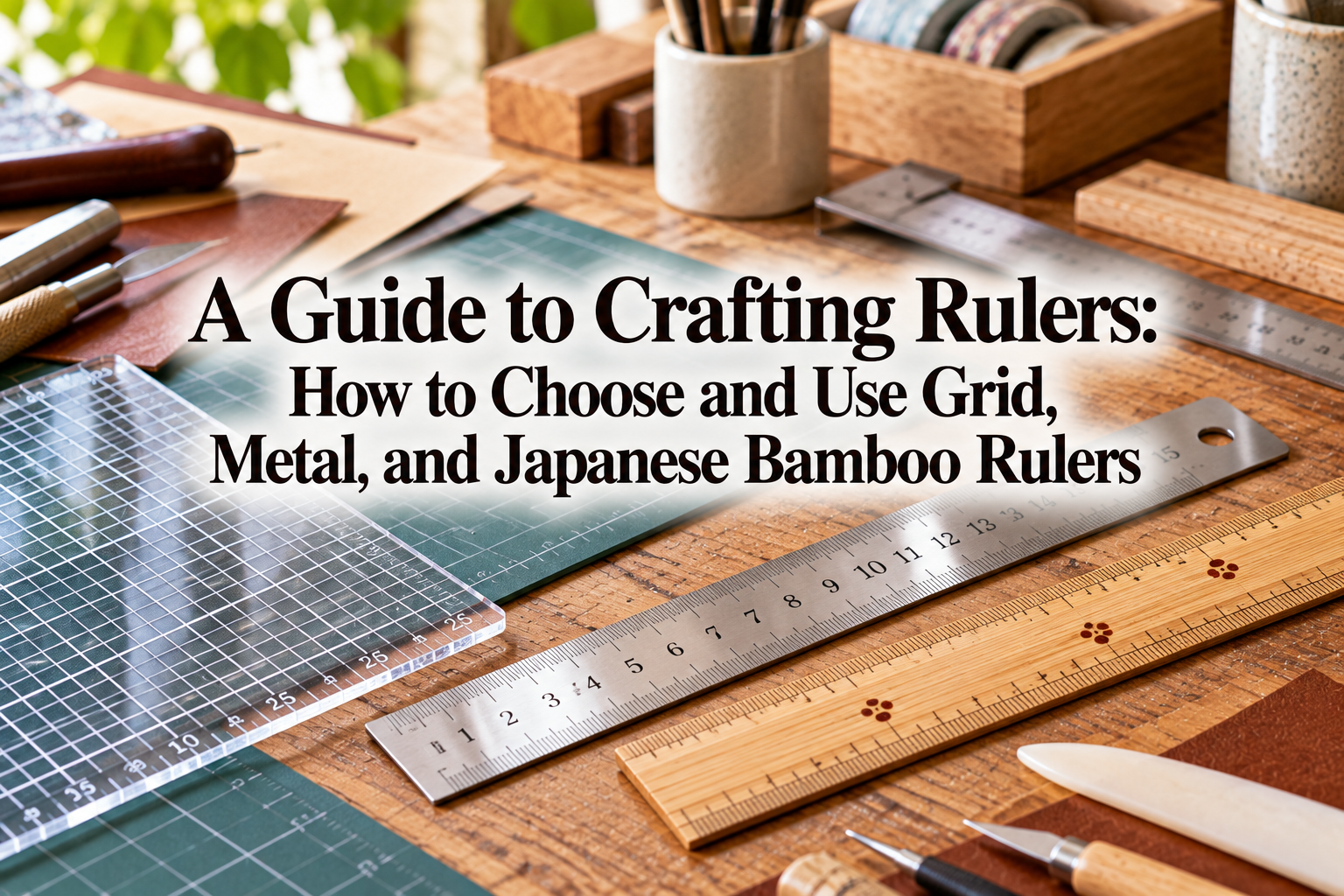
In this guide, I will thoroughly break down the characteristics, distinct roles, and smart selection criteria for four essential types of rulers: standard acrylic rulers, grid rulers, traditional Japanese bamboo rulers (takeshaku), and metal stainless steel rulers. By the end of this article, you will know exactly which ruler your toolkit needs. Grab the right tool and take your craftsmanship to the next level!
Even though they are all called rulers, their materials and constructions make them suited for entirely different tasks. First, let’s explore the basic features, pros, and cons of these four core craft tools.
The most familiar stationery tool is the clear straight ruler made from plastic or acrylic. Commonly found in lengths of 15 cm to 30 cm (approx. 6 to 12 inches), they are lightweight and affordable.
Their biggest advantage is transparency. Because you can see the underlying pattern or material directly through the ruler, aligning reference marks is effortless. For drawing straight lines on paper with a pencil or checking quick dimensions, it is exceptionally easy to handle.
However, you must never run a utility knife or craft blade directly along an acrylic edge. The steel blade bites into the plastic side, shaving away the ruler itself. A nicked edge not only ruins the measurement markings but also causes any future cut lines to wobble.
A grid ruler is a clear acrylic ruler featuring a printed grid across its entire surface, usually marked in 5 mm or 10 mm increments. These shine brightest in sewing, quilting, and papercraft.
Their greatest strength is letting you effortlessly draw parallel lines and perfect right angles relative to the edge of your material. With a regular ruler, you have to measure two separate points and draw a line connecting them. With a grid ruler, you simply align one of the grid lines along the edge of your fabric or paper to create an instant, accurate parallel line.
Some models feature colored backing highlights (such as green or red grid lines) designed for high visibility on patterned fabric, or dedicated bias lines (45-degree angles). For anyone working with textiles or paper, this is an absolute must-have.
Traditional bamboo rulers, known in Japan as takeshaku, have long been cherished in Japanese tailoring (wasai) and Western dressmaking (yosai). Typically crafted in longer lengths like 50 cm or 1 meter, they historically exist in traditional Japanese tailoring units (kujirashaku) as well as modern metric centimeter scales.
The signature advantage of a bamboo ruler lies in its gentle touch on materials and its remarkable heat resistance. Its finely polished, natural surface will never snag or scratch delicate silks and thin textiles. Furthermore, unlike synthetic materials, it will not melt or warp under an iron's heat, making it an outstanding guide for pressing and folding crisp hems directly with an iron.
Because natural bamboo can slightly expand or contract with ambient humidity and dryness, it is not suited for sub-millimeter metal fabrication. However, for measuring, pressing, and handling fabric, it remains one of the finest tools available.
Constructed from stainless steel or aluminum, metal rulers—often referred to in workshop environments as steel rules (chokushaku)—are built for heavy-duty precision.
The undeniable advantage of a metal ruler is its total durability against craft knives and rotary blades. No matter how firmly you press the blade against the side, the steel edge will never chip or shave away. For leathercraft, cutting heavy cardboard, or trimming plastic sheets, a metal ruler is an absolute requirement.
Many metal rulers feature non-slip rubber backing on the reverse side or a "zero-start" edge, where the 0 mm mark begins flush with the physical edge of the ruler. This flush edge makes them fantastic for measuring depths, step heights, and three-dimensional structures.
Now that you understand the tools, let's look at how to pair them with specific crafting processes. Mismatching your ruler with your task compromises project accuracy and increases the risk of wasted materials or workshop injuries.
When working with fabric, the golden rule is to use a combination of a grid ruler and a bamboo ruler.
When drafting patterns or marking seam allowances (such as 1 cm or 1.5 cm) directly onto cloth, reach for a 50 cm clear grid ruler. Aligning the grid lines with the raw fabric edge lets you draft accurate seam allowances in seconds.
When cutting long yardage straight off a bolt or measuring finished garment dimensions like body length and shoulder widths, switch to a bamboo ruler. Natural bamboo does not generate static electricity, preventing lightweight fabrics from clinging to the ruler and throwing off your measurements.
Whenever you use a utility knife, rotary cutter, or Japanese leather knife (kawabōchō), your choice is strictly a metal ruler. There are no exceptions here.
Slicing through leather or dense cardstock requires substantial lateral pressure against the guide. If you lean a sharp blade against an acrylic or bamboo ruler, the blade can easily ride up over the edge and skip across your fingers, creating a severe hazard. To ensure both safety and a razor-clean edge, always cut against stainless steel.
For miniature crafting requiring millimeter precision or measuring clay components, a 15 cm to 30 cm clear acrylic ruler or a compact zero-start metal ruler works best.
When rolling clay components to a uniform thickness or verifying the proportions of miniature furniture, a transparent ruler allows you to inspect the piece directly underneath as you work. Just remember: the moment you pick up a craft knife to trim the clay, swap the acrylic out for a metal ruler.
Many beginners struggle with accuracy because they confuse rulers designed for drawing with measuring sticks designed strictly for dimensioning. Here are the critical distinctions to keep in mind.
In Japanese tool culture, a clear distinction is made between jōgi (rulers) and monosashi (measuring rules/scales), even though the terms are often used interchangeably in casual speech.
If you use a ruler with an edge margin when trying to measure flush against a boundary, that gap will introduce an error of several millimeters. When measuring absolute lengths from an edge, always use a zero-start tool like a bamboo ruler or stainless steel rule.
Crafters often think, "It’s just a tiny cut" or "I'll be careful," and slice along an acrylic or grid ruler. In handmade crafts, this is an absolute mistake.
Utility blades are made of steel, which is far harder than acrylic plastic. Running a blade along plastic even once creates microscopic cuts and gouges on the guide edge. The next time you try to draw a line with a pencil along that edge, your pencil will catch, producing an uneven, wavy line.
Once a ruler's edge is nicked, it cannot be repaired. Keep your measuring and line-drawing tools (acrylic and grid rulers) strictly separate from your cutting tools (metal rulers).
Flexible tape measures are made to measure three-dimensional contours, curves, and circumferences (such as waist sizes or bag gusset depths). They should never be used for drafting flat patterns on a worktable.
Due to the flexible nature of the tape ribbon, pulling on it introduces subtle stretching. For flat, reliable dimensions, always rely on a rigid ruler that does not deform under tension.
If you are wondering what to buy first, here is the starter set I recommend. You do not need a large collection of specialized measuring tools right away; these two (or three) rulers cover the vast majority of projects:
Having great tools means little if they aren't handled correctly. Here are practical techniques to maximize your working precision:
When cutting paper or leather, simply pressing down with a few fingertips in the center is not enough. If only the middle is pinned down, the ends can lift, allowing the blade to slip underneath or causing the ruler to pivot under the cutting pressure.
Instead, spread your fingers wide like an open hand and press down with vertical body weight from directly above. As your knife travels down the cut line, shift your holding hand along with it so pressure is always applied right next to where the blade is cutting.
Keep your blade perfectly perpendicular (90 degrees) to the side of the ruler. Tilting outward pulls the blade away from the guide, while tilting inward risks running the sharp edge up onto the ruler's corner, creating a serious slip risk.
When cutting rectangles from fabric or paper, any slight angular error will warp your final assembly. Use the vertical and horizontal grid lines of your ruler to square true corners:
This creates an exact 90-degree right angle without needing a separate drafting square or protractor. Connecting two marked dots with a straight line often introduces slight errors from pencil tip thickness, so aligning an entire grid line directly against the edge is much more reliable.
When using a bamboo ruler on fabric, do not stretch or press down forcefully on the cloth. Lay the fabric out naturally flat on your cutting surface and gently place the bamboo ruler on top.
The natural heft of the bamboo gently settles minor wrinkles without distorting the weave. When reading the measurement, look straight down from directly above rather than from an angle. Viewing from an angle causes parallax error, easily throwing off your measurement by 1 to 2 millimeters.
Rulers are precision measuring instruments. Rough handling compromises their accuracy and shortens their lifespan. Protect them with these storage habits:
Acrylic and grid rulers are vulnerable to heat and organic solvents. An iron's direct heat or steam will instantly warp the plastic edge. Whenever you need to check dimensions while pressing fabric, always reach for a heat-resistant bamboo ruler or a dedicated iron-safe pressing guide.
Additionally, contact with UV resin, acetone, nail polish remover, or adhesive removers will melt acrylic surfaces, causing cloudy discoloration and erasing printed measurement scales. Keep chemical supplies well away from your plastic rulers.
Never toss your rulers loosely into the bottom of a heavy tool chest. Weight pressing down from above will gradually bow both plastic and metal rulers over time. Once a ruler is warped, it can never produce a straight line again.
Most rulers feature a hanging hole at one end. Hang them on wall hooks or store them standing vertically, much like books on a shelf. Keep them out of direct sunlight near windows, as long-term solar heat can cause warping and fade printed markings.
Choosing the right ruler transforms your making experience in noticeable ways:
The success of any handmade piece is largely decided during the initial measuring and cutting steps. If you have been relying on whatever ruler was within arm's reach, treat yourself to dedicated tools suited to your favorite crafts. The moment you upgrade your measuring tools, your creative process will become noticeably smoother and your finished creations far more refined!
If you found this guide helpful, please share it with your fellow makers on social media! See you in the next article—happy crafting from Yassy!


For example, if you are looking for articles about mizuhiki, try searching for "mizuhiki"; if you are interested in tools, try keywords like "nippers" or "pliers."
