A Crafter’s Guide to Wood Adhesives: Types, Characteristics, and Pro Clamping Techniques
yassy
Crafters!

Hello, this is Yassy from Crafters! (・∀・)
The world of knitting and crochet is so wonderfully deep. It is full of joy, creating a wide variety of items from just a single skein of yarn and a needle or hook. Personally, I absolutely love making various handmade crafts, looking at wonderful creations in craft shops and exhibitions, and purchasing special items made by talented craft artisans. Whenever I come across sophisticated knitted works on online shops or craft markets, I always find myself closely observing what tools were used and how they were crafted.
When you decide to start knitting or crocheting, many people are surprised by the sheer number of tools lined up in craft stores and online shops. Just looking at needles, there are numerous shapes and materials, alongside a whole array of small notions like stitch markers and gauges. If you don't understand the specific role of each tool, it is completely natural to feel lost about what you should buy first.
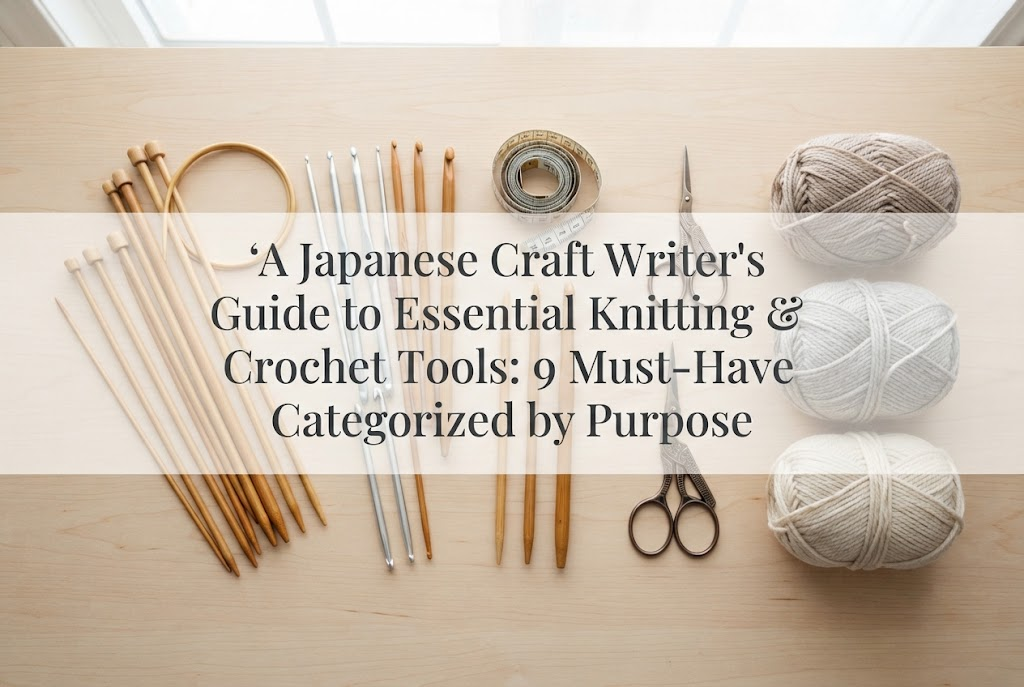
Knitting and crochet tools can be broadly divided into four main categories: "Crafting tools (for knitting/crocheting)," "Finishing/Joining tools," "Auxiliary tools (notions)," and "Storage tools." Understanding this division of roles is your very first step toward choosing your tools without making mistakes.
In this article, I will introduce 9 main tools categorized by their purpose. Let's get a complete overview of each tool so you can perfectly understand exactly what you need for your crafting journey.
To make your crafting process go smoothly, the fastest route is to organize and learn which tool handles which task. If you blindly buy tools without a plan, you'll end up realizing halfway through a project that you needed a completely different type of needle. By understanding the purpose of each tool in advance, you can prevent unnecessary spending and focus entirely on creating your projects.
The crafting process generally flows through four stages: "shaping," "joining parts," "measuring & managing," and "organizing." There are specific tools designed for each step, and if even one is missing, your work efficiency drops significantly. A common point where beginners stumble is underestimating the importance of auxiliary tools (notions).
Speaking from my perspective as someone who loves making, viewing, and buying crafts, I can confidently say that professionals and advanced crafters excel precisely because they use auxiliary tools skillfully. Placing the right tool in the right spot is the biggest secret to creating beautiful stitches. Let's start by unpacking the roles of each tool, beginning with our main stars: the crafting needles and hooks.
The core of knitting and crochet lies in the needles and hooks that interweave yarn to form a shape. There are three main types, and you choose between them based on the shape and structure of the item you want to make. Make sure to grasp the features and strengths of each type.
A crochet hook is a single tool made of metal, bamboo, or plastic with a curved hook at its tip. Its structure allows you to catch the yarn with the hook and pull it through loops to build stitches. The biggest appeal is that with just one hook and a single ball of yarn, you can easily start crocheting anywhere, even without a table.
Crochet hooks shine brightest when creating three-dimensional items or small accessories, such as amigurumi (plush toys), coasters, pouches, and granny square motifs. Because crochet produces a firmer, sturdy fabric, it is ideal for items where you want to maintain a defined shape. Additionally, because each crochet stitch is self-contained, fixing mistakes is exceptionally easy even if a stitch unravels. For beginners who want to make cute projects quickly and easily, the crochet hook is the ultimate partner to pick up first.
Knitting needles are straight, rod-like needles, typically used in pairs for flat knitting (working back and forth) or in sets of 4 to 5 for tubular knitting in the round. They operate by holding multiple loops on the needle shaft while working the needles alternately to form stitches. Materials include bamboo, wood, and metal, and the size of the stitches changes depending on the needle's thickness.
Knitting needles excel at wearable items and cold-weather gear, such as scarves, sweaters, cardigans, and cowl snoods. Compared to crochet, knitted fabric is significantly softer, offering superior stretchiness and heat retention. The greatest strength of knitting needles is their ability to bring out the soft texture of cozy yarn to the absolute maximum. If you want to create fluffy, soft knitwear, choosing straight knitting needles is the definite right answer.
Circular needles consist of two short needle tips connected at their ends by a flexible cord made of nylon or similar materials. Originally, they were developed for knitting seamless, tubular items such as hats, socks, and the body of sweaters. However, in modern craft culture, circular needles are no longer just for knitting in the round.
Because the weight of the knitted fabric is distributed across the cord, using circular needles greatly reduces strain on your wrists when making large lap blankets or long scarves. Furthermore, if you work back and forth, you can execute standard flat knitting perfectly. They cause less fatigue during long sessions, and the fabric won't get in the way in tight spaces. Storage is also very compact, making them the versatile tool that I personally use most frequently.
Simply knitting or crocheting the fabric to length doesn't mean the project is complete. Finishing steps—such as weaving in yarn ends or sewing separate pieces together—are essential. These dedicated finishing tools handle this critical phase.
A tapestry needle looks like a large sewing needle, but its defining feature is its rounded, blunt tip. The tip is rounded so it can pass smoothly between yarn stitches without splitting or damaging the yarn fibers. The eye is also designed wide so yarn can thread through easily.
Its main uses include "weaving in ends" (hiding thread tails inside the fabric at the start or finish) and "seaming/joining" (stitching sweater sleeves to bodies, or assembling amigurumi parts). If you try to substitute a regular sharp sewing needle, it will split the yarn and spoil the finish. To elevate the durability and quality of your work to a professional standard, a tapestry needle is an indispensable item you cannot skip.
Chunky yarn needles feature even larger eyes and overall thicker, sturdier construction than standard tapestry needles. They are used when working with thick bulky/super-bulky yarn, novelty yarns, linen threads, or extra-chunky arm-knitting style yarns. They are commonly made from plastic or metal.
Forcing thick yarn through a standard tapestry needle crushes and frays the fiber, or simply won't fit through the eye. A chunky yarn needle allows heavy threads to pass through without stress, enabling you to seam thick fabrics securely. Matching your needle to your yarn thickness is an absolute rule to prevent fiber damage and achieve a beautiful finish.
Ring stitch markers are small, unbroken ring-shaped tools made of plastic or metal. They are primarily used in needle knitting and circular needle work by slipping them directly onto the needle shaft. By inserting them between stitches, they help you track stitch counts.
You place them where stitch pattern transitions occur or where decreases and increases are scheduled. As you knit, you simply transfer the ring from one needle to the other, so there's no risk of it falling off the fabric. This saves you from having to recount stitches from the beginning every time, allowing you to maintain a steady rhythm with exact counts.
Locking stitch markers look like safety pins and feature an opening-and-closing hook mechanism. Unlike ring stitch markers, they are attached directly to the fabric loops rather than the needles. Their biggest strength is that they can be attached and removed freely at any time.
Their uses are wide-ranging: counting rows in crochet, marking the starting stitch of a round in amigurumi, or recording key spots in knitting patterns. They also function as visual markers for mistakes or as stoppers to keep your loop from unraveling when you take a break. For beginners especially, using locking stitch markers generously is the best defense against getting frustrated mid-project.
A needle gauge is a flat plate featuring numerous small circular holes. It is used to accurately measure the thickness (size) of your crafting needles. Many designs also integrate a ruler function and a swatch counting window for measuring stitches in a 10cm x 10cm (4-inch) area.
When needles are used for many years, the printed size markings on their surface often rub off. Furthermore, needles from different countries may use metric sizes (mm), US sizes, or Japanese sizes (Gou), which can be confusing. By simply inserting a needle into the holes of a needle gauge, you can instantly determine its exact size. Having one nearby makes needle management and gauge checks completely stress-free.
As you continue knitting or crocheting, your collection of needles and notions naturally grows. To prevent losing the size you need or having sharp needle tips poke out inside your bag, dedicated storage tools are essential.
A needle case is a specialized organizer designed to neatly store needles of various lengths and thicknesses, alongside tapestry needles and stitch markers. They come in various styles, including fabric roll-up wraps, zippered pouches, and hard cases. With dedicated pockets for different needle types, you can pick out the size you need at a glance.
Beyond preventing needles from scratching against one another, they are fantastic for taking your craft projects on the go. An environment where your tools are organized boosts your creative motivation tremendously. Setting aside time to tuck your tools away into a case with your favorite design is one of the true pleasures of handmade crafting.
When beginners gather their knitting and crochet tools, there are several common mistakes and misunderstandings. Drawing from my own experience and observing many beginners over time, here are key points to keep in mind. Please keep these in mind so you don't repeat the same missteps!
First, the biggest mistake is "buying all your needles exclusively from 100-yen / discount value stores." While recent budget tools are surprisingly decent, there is still a clear difference in quality compared to dedicated craft manufacturers—especially regarding how smoothly yarn glides over the needle, how comfortable ergonomic crochet handles feel, and how smoothly tapestry needle tips pass through stitches. Using needles with poor glide forces extra tension into your hands, causing hand pain and uneven stitches. To enjoy crafting for a long time, choosing trusted craft brand products for your most frequently used needle sizes is definitely the right move.
The next common misconception is assuming that "crochet hooks and knitting needles can be used interchangeably if you have one or the other." As explained earlier, their structures and the resulting fabrics are entirely different. You cannot work a crochet pattern with knitting needles, nor can you do the reverse. Always check the recipe or pattern for the item you want to make and prepare the exact type of needle specified.
Also, delaying the purchase of auxiliary tools like stitch markers thinking "I can manage without them" is a big mistake. Beginners are actually the ones who lose count most easily, often getting discouraged after spending time undoing and re-knitting work. Small notions are actually secret weapons for preventing frustration and achieving neat, beautiful fabric.
When gathering your tools, you don't need to buy expensive, complete sets right from the start. A smart approach to avoid unnecessary spending is to start minimal: buy only the yarn, needles, tapestry needle, and stitch markers needed for the single project you want to make right now, and build from there.
If I were a complete beginner starting from scratch today, here is the exact step-by-step process I would follow to gather my tools. If you're ever unsure, follow these steps to prepare your craft kit!
Step 1: Decide on one project you want to make.For crochet beginners, I recommend an acrylic scrubbie or a simple zip pouch. For knitting beginners, a garter stitch scarf is ideal. Once you choose a project, check the yarn band (label). The label always lists recommended needle or hook sizes.
Step 2: Purchase the specified size tool.Buy an ergonomic crochet hook (or smooth bamboo/metal knitting needles) in the recommended size, a set of plastic tapestry needles, and a few locking stitch markers. With just these, your preparations for your first project are complete! You keep your budget minimal and can jump straight into crafting.
Step 3: Add tools gradually as you expand your skills.As you complete two or three projects and want to try yarns of different weights, add needles individually. Once you find yourself using multiple sizes, that is the perfect time to invest in a dedicated needle case or needle gauge. Collecting tools alongside your personal growth and expanding range of projects is what maximizes the fun of handmade crafts!
Even the magnificent, professional-grade works sold in craft markets and boutiques were originally born from these exact basic tools. As long as you use the right tools in the right way, anyone can shape warm, beautiful creations just as envisioned.
In this article, I detailed 9 essential knitting and crochet tools categorized by their purpose and role.
Crafting tools like crochet hooks, straight needles, and circular needles; finishing tools like tapestry needles and chunky yarn needles; auxiliary helpers like ring stitch markers, locking markers, and needle gauges; and storage solutions like needle cases—each tool exists for a clear reason. Using them appropriately provides powerful support for your craft projects.
Once you understand the role of each tool, you won't feel lost in craft stores or online shops anymore. Grab the perfect partner tools for the project you want to make and enjoy the excitement of watching yarn transform into a finished creation. Starting with a small accessory is completely fine! Warm knit and crochet items created by your own hands bring color and rich, fulfilling time to your everyday life.
If you enjoyed this article, sharing it with your friends on social media or messaging apps would make me super happy and encouraged! Well then, see you in the next article! This was Yassy from Crafters!

For example, if you are looking for articles about mizuhiki, try searching for "mizuhiki"; if you are interested in tools, try keywords like "nippers" or "pliers."
