Complete Leather Care Guide: How to Prevent Mold, Cracking, and Losing Shape for a Lifetime of Use
yassy
Crafters!

Hello, everyone! I'm Yassy from Crafters! (・∀・)
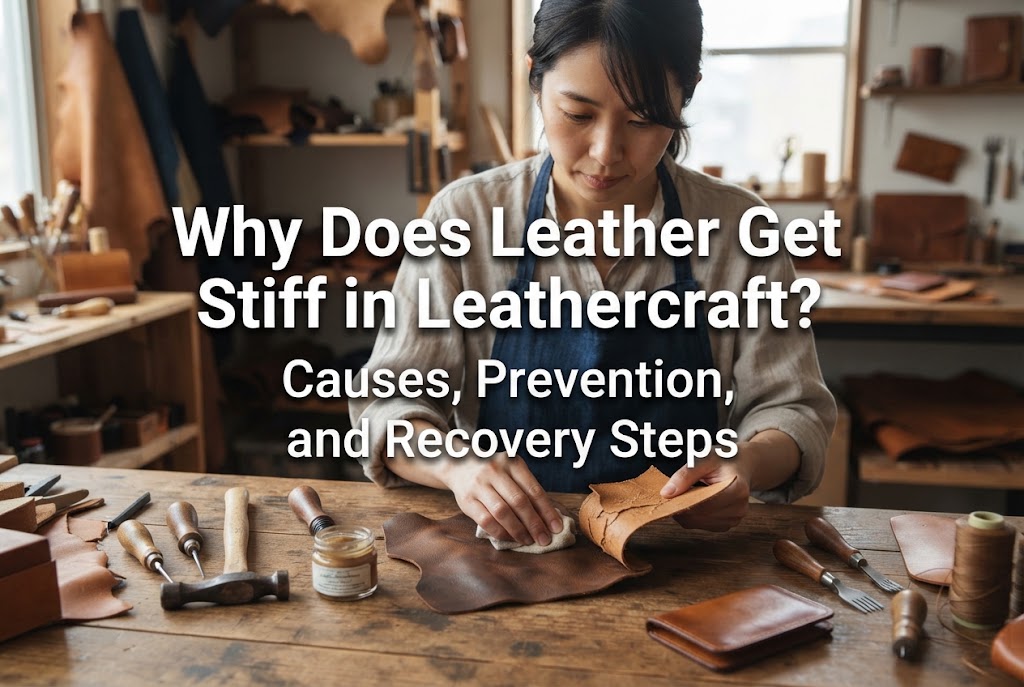
Have you ever had the experience while enjoying leathercraft where a piece of leather was soft and supple when you bought it, but turned stiff and rough while you were working on it or after completing a project? Or perhaps you conditioned your leather item, only to find that it hardened even more than before?
Leather is fundamentally a natural material made by processing raw animal hides to make them easy to care for. Because leather was once the skin of a living creature, it maintains its flexibility through a delicate balance of moisture and oils. For that reason, changes in the environment or minor missteps in handling can cause it to harden surprisingly easily.
In this article, I will explain the specific causes of leather hardening in leathercraft, the internal mechanics behind what is happening inside the leather, and effective recovery methods to bring stiffened leather back to a soft, pliable state!
To understand why leather becomes stiff, the fastest route is to learn about its internal structure. The main component of leather is a dense bundle of fine protein fibers called collagen. These fibers are intricately intertwined, and in the microscopic gaps between them, an appropriate balance of moisture and oils—stored during the fatliquoring process—allows the structure to move flexibly.
The oils and moisture act like lubricants when the fibers rub against one another. If this lubricant is lost or if the internal components undergo chemical changes, the collagen fibers stick directly to each other and solidify.
This adhesion of internal collagen fibers is the true identity of the phenomenon we call stiff leather. In other words, due to some reason, the lubricating moisture and oils have escaped, or the fibers themselves have shrunk and contracted.
The single biggest factor that causes leather to harden is drying, where internal oils and moisture escape into the atmosphere. From the moment leather is produced, it continuously releases minute amounts of moisture and oils into the surrounding air.
Rapid drying occurs especially during dry seasons from autumn through winter, or when leather is left in places directly exposed to air conditioner airflow. When moisture and oil drop below a certain level, the fibers lose their flexibility, the surface tightens, and the entire piece turns stiff and rough.
Vegetable-tanned leather (such as Japanese Nume leather), which is widely used in leathercraft, loses moisture and oils much faster than chrome-tanned leather, making it particularly prone to hardening from dryness.
It is often said that leather is vulnerable to water, but the drying process after leather gets wet is actually one of the major causes of severe hardening. Caution is necessary not only when leather gets wet from rain or water droplets, but also when using water during leathercraft crafting steps.
When water soaks into leather, it penetrates deep inside and binds with the oils already present. As the absorbed water evaporates, it carries those precious internal oils out into the air along with it.
When leather dries after losing both moisture and oils at the same time, the fibers are pulled tightly together and stick. As a result, the leather transforms into a rigid, plastic-like texture.
Never use hot air from a hair dryer or place wet or freshly dyed leather near heating appliances to dry it quickly. Applying heat is an extremely dangerous action that can instantly harden leather.
The main component of leather, collagen, is a protein. Just as applying heat to a raw egg turns it into a hard cooked egg, leather undergoes thermal denaturation, shrinks, and hardens when exposed to high temperatures.
Once collagen fibers shrink and harden due to thermal denaturation, no amount of oil or conditioner applied afterward can restore them to their original supple state. Rapid heat drying causes irreversible damage to leather.
A very common mistake among beginners is thinking, "My leather has turned hard, so I should apply a lot of oil to soften it," and slathering on mink oil or leather conditioner.
When you apply more than an appropriate amount of oil, the pores and gaps between fibers on the leather surface become completely clogged with excess oil. Once the oil reaches saturation, the leather can no longer breathe or regulate moisture intake and release.
Furthermore, solid wax components contained within oils can solidify inside and on the surface of the leather, making the entire piece heavy, rigid, and stiff. In an attempt to care for the leather, you end up damaging it and accelerating its hardening—a classic failure pattern.
In leathercraft, various topcoats and finishing agents are used, but depending on the chemical components applied, leather can become rigid. Typical examples include dyes and finishes containing extremely high amounts of wax or resin.
If you repeatedly layer acrylic coats that strongly protect the leather surface, or hard waxes with high gloss effects, a hard film forms over the leather.
Coating the surface with a stiff layer causes the surface film to pull tight whenever the leather is bent, resulting in leather that feels hard and difficult to flex. Using hard-type coating agents on projects where you want to maintain flexibility will lead to unintended stiffness.
Within leathercraft techniques and procedures, there are situations where leather is intentionally or accidentally hardened. Pay close attention to edge burnishing (koba-migaki) and wet forming (mizu-narei).
When finishing the cut edges (koba) of leather, applying a large amount of water and rubbing vigorously with a slicker strongly compresses the fibers near the cross-section, causing them to harden. While hardening along the edge adds structural strength, if water bleeds onto the main face of the leather, the entire part can become stiff.
Additionally, wet forming—used to create three-dimensional shapes—is a technique built entirely on the principle of soaking leather, shaping it, and allowing it to harden as it dries. If you soak leather parts without understanding how wet forming works, unintended areas will harden, causing the project to lose its suppleness.
Overusing PVA white glue (polyvinyl acetate resin adhesive) or rubber cement when bonding leather parts together is another cause of hardening.
When low-viscosity glue is applied to thin leather or pieces with a thin grain side (gin-men), the adhesive can seep deep into the internal collagen fibers from the back side and solidify. Because the resin hardens between the fibers, that area naturally turns stiff.
In particular, if glue seeps into folding sections that experience bending or moving parts like card slots in wallets, the piece becomes rigid and difficult to use.
If scrap leather, leather rolls, or finished leather goods are stored in poor conditions, they will rapidly harden alongside age-related degradation.
Leather left near windows or exposed to direct sunlight (ultraviolet rays) suffers catastrophic damage to its fibers beyond its natural limit. UV rays break down tannins and oils within the leather, triggering stiffness and cracking simultaneously.
Conversely, sealing leather in airtight plastic bags or closets with poor ventilation for long periods blocks air moisture or causes skin fats to alter due to moisture and mold, leading to hardening.
If your leather material or finished item has turned hard, what steps should you take? While leather that has been completely burned or thermally denatured cannot be restored, if the cause is simple dryness or oil loss, you can dramatically regain its softness using the proper procedure!
Here is a practical, step-by-step guide to care for your leather with zero risk of failure:
If old oils, dust, or coating agents previously applied remain on the surface of stiff leather, new nourishing ingredients will not penetrate inside.
First, thoroughly brush off surface dust using a horsehair brush. If solid wax or heavy oil is clogged on the surface, take a small amount of dedicated leather stain cleaner or delicate cleaner on a soft cloth, and gently wipe the surface to remove dirt and excess oils.
Do not apply heavy oils like mink oil right away! If you apply heavy oil to bone-dry leather, the oil will slide off and fail to penetrate deep inside.
The first item to apply is a delicate cream or a moisturizing cream containing lanolin, which has high water content and mild oil content. Take a small amount on your fingertip or a cloth, and quickly spread a thin layer over the entire leather surface.
When you apply a delicate cream, the dried fibers absorb moisture and soften, preparing the leather to accept the oil that will be applied next.
Once moisture replenishment makes the leather slightly softer, replenish the oil content using an oil that penetrates easily into the interior.
To deliver flexibility deep inside hardened leather, liquid oils such as 100% plant-based penetrating oils or neatsfoot oil are far more effective than solid conditioners.
Using the pads of your fingers, warm the oil with your body heat while working a tiny amount evenly into the surface. An extremely small amount—where you feel "Is this slightly too little?"—is the golden ratio.
Immediately after working in the oil, gently knead the entire piece of leather by hand. In Japanese leathercraft, this technique is called te-momi (hand kneading).
By gently bending the leather in various directions and applying pressing force with your fingers, the absorbed oil spreads between the fibers, physically separating and loosening collagen fibers that had stuck together.
Bending the leather too sharply at once carries a risk of creating wrinkles or cracks on the grain surface (gin-wari). The trick is to warm the leather in a warm room and gently knead it as if stroking the entire surface.
Restoring a piece of leather that has turned rigid back to a perfect condition requires significant time and effort. That is why preventing leather from hardening through small daily habits is so important.
To keep your leather soft and supple at all times, practice these three preventive measures:
In particular, do not leave leather materials used in leathercraft exposed on your workbench; wrap them in non-woven fabric and store them in a dark place with minimal humidity fluctuations. This simple habit will dramatically improve the lifespan and flexibility of your leather.
The causes of stiff leather go beyond mere aging over time. From natural drying like lack of moisture and oil loss to over-conditioning, incorrect hairdryer drying, and glue seepage, many causes hide within everyday handling.
By thoroughly understanding the relationship between internal collagen fibers, moisture, and oils, you can accurately diagnose why a piece of leather has turned hard.
By performing proper moisture replenishment, appropriate oil care, and gentle hand kneading tailored to the specific cause, you can preserve the beautiful flexibility of your precious leather projects and materials indefinitely! Acquire the right knowledge and enjoy crafting attractive leather items with a wonderful feel!
If you share this article with your friends on social media or messaging apps, it would make me very happy and encourage my writing!
Well then, see you in the next article! This was Yassy from Crafters!


For example, if you are looking for articles about mizuhiki, try searching for "mizuhiki"; if you are interested in tools, try keywords like "nippers" or "pliers."