How to Swirl and Pattern Handmade Soap: From Marbling to Layering Techniques
yassy
Crafters!
Hello, everyone! It’s Yassy from Crafters! (・∀・)
As someone who loves crafting, exploring other artists’ creations, and collecting handmade pieces, I know firsthand the joy of planning and creating. Whether it is UV resin, papercraft, fabric crafts, or clay modeling, nothing beats the feeling of bringing an idea to life with your own hands.
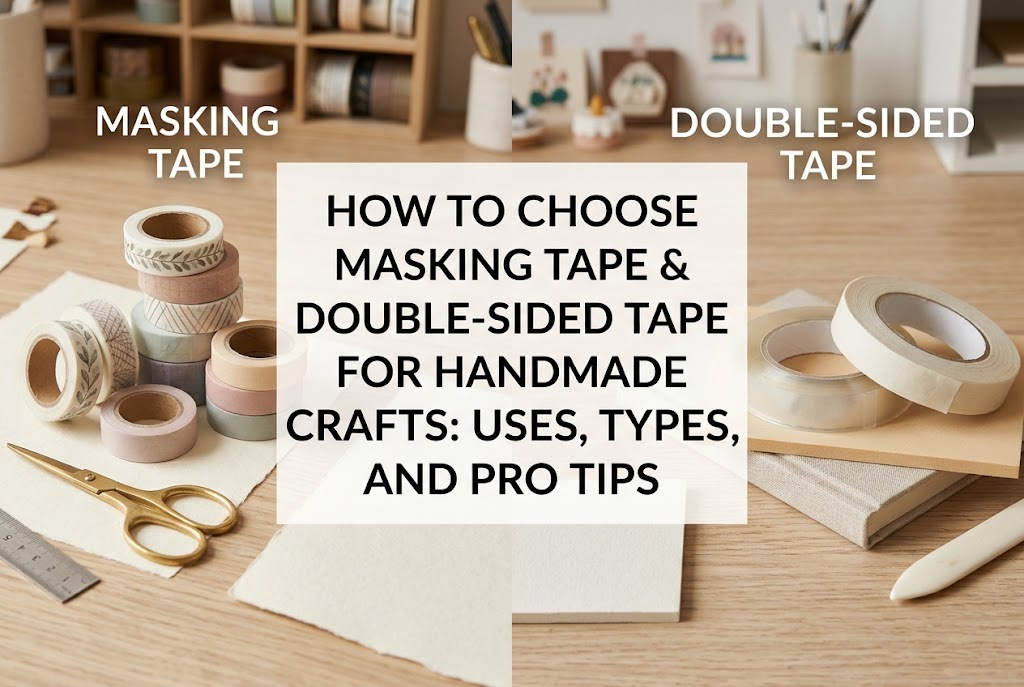
Today, I want to talk about two unsung heroes that are completely indispensable in any crafting workspace: masking tape and double-sided tape.
You might be thinking, “Can’t I just grab whatever spare tape I have lying around in my stationery drawer?” Trust me, relying on whatever is at hand can lead to frustrating mistakes. The right choice of tape—and how you use it—dramatically affects the clean finish, working efficiency, and long-term durability of your craft projects.
In this guide, I will share practical, hands-on knowledge gained from my own crafting experience: the different types and uses of masking and double-sided tapes, how they compare to similar tools, how to choose the right tape without fail, and essential precautions to avoid common beginner mistakes!
When working on handmade projects, there are countless tasks where liquid glue or craft bond simply cannot do the job properly. That is where masking tape and double-sided tape shine.
Liquid adhesives take time to dry, and applying even a little too much carries the risk of oozing out and staining your workpiece. Tapes, on the other hand, provide immediate holding power the second you apply them—no waiting for glue to dry.
Masking tape is particularly invaluable for temporary holding and masking (surface protection and barrier prevention). Whether you are painting cleanly, pouring resin into open bezels, or securing delicate parts before final assembly, it is an unbeatable support tool for high-precision steps where mistakes are not an option.
Double-sided tape offers clear advantages: it bonds evenly across an entire surface, adds virtually no thickness, and eliminates drying wait times completely. From paper and fabric to joining different materials together, mastering double-sided tape significantly speeds up your workflow and elevates the neatness of your finished pieces.
In short, knowing how to choose and utilize these two tapes correctly is the fastest shortcut to leveling up from beginner to advanced maker.
Masking tape was originally developed for industrial painting and construction work to cover and protect areas that should not be painted. Because it is engineered to be peeled off cleanly, its defining characteristic is a gentle adhesive strength that leaves minimal residue behind.
In the world of crafting, masking tapes generally fall into three categories. Keeping their distinct characteristics in mind will help you pick the right one for each task.
Widely available in Japanese craft shops, stationery stores, and 100-yen shops, these are colorful, patterned tapes made from traditional Japanese washi paper. They tear easily by hand and look wonderful on finished items.
Their primary craft uses include surface decoration, gift wrapping, journal decorating, and paper embellishments. Because washi paper is thin and flexible, it conforms smoothly to curved surfaces.
However, decorative washi tapes are designed mainly for aesthetics, meaning adhesive strength varies widely between brands and rolls. Keep in mind that they are generally unsuitable for precision masking or tasks requiring dependable temporary holding strength.
Typically found in hardware and home improvement stores in solid colors like ochre, yellow, or blue, these are professional tapes originally intended for vehicle and architectural painting.
These tapes offer extremely consistent adhesion, leave almost zero residue upon removal, and minimize surface tearing on delicate paper. They create razor-sharp paint lines and prevent pigment from seeping underneath.
In crafting, they are ideal for masking during wood or clay painting, securing workpieces to your cutting mat, and holding components together during dry fits. While not decorative, they provide unmatched reliability as a behind-the-scenes working tool.
Used frequently in UV resin crafting and scale modeling, these are specialized tapes designed for ultra-tight adhesion. They often feature silicone-based adhesives or clear polyester film backings.
A classic application is sticking the tape to the back of an open-back metal bezel (resin frame) to act as a temporary bottom plate while pouring and curing resin, or creating leak-proof barriers for fluid media. Many types withstand heat and let UV/LED light pass through freely without inhibiting resin curing.
Whenever I use masking tape, I stick strictly to one essential rule: always wipe dust and oils from the surface completely, then press the tape down firmly with the pad of your finger to eliminate any microscopic gaps.
When masking against paint or liquid resin, even the slightest lifted edge will invite capillary action, drawing the liquid underneath and causing a mess. Once you apply the tape, use the back of your fingernail or a craft spatula to firmly rub down the edges. This tiny extra step ensures crisp, professional results every single time.
Next, let’s look at double-sided tape, which is designed to bond materials permanently. Double-sided tapes behave very differently depending on the combination of their core backing material (carrier) and the adhesive used.
Choosing a random double-sided tape can lead to attached components falling off days later or uneven thickness warping your project. Here is how to select the right tape for the job.
This is the standard thin double-sided tape featuring a non-woven fabric carrier. It provides high adhesive strength and bonds paper, wood, and rigid plastics firmly.
It works wonders for papercraft, box construction (cartonnage), and securing display backing cards. Because it adds virtually no bulk, the bonded seams remain flat and neat.
Some varieties can be torn by hand, while others require scissors. Whenever you want a completely flat, crisp finish without warping, thin non-woven tape is your go-to choice.
These thick tapes use polyethylene foam or solid acrylic foam as a carrier. The cushioning layer fills small gaps and conforms to textured, slightly irregular surfaces for an exceptionally strong bond.
They can bond dissimilar materials such as wood to metal, glass, or ceramics, with ultra-strong versions even rated for outdoor exposure. They are also perfect for adding dimension in cardmaking or providing structural integrity to handmade accessories.
This double-sided tape uses a mild adhesive that peels away cleanly after use—essentially a double-sided version of masking tape.
It is ideal for temporarily fixing paper patterns to fabric or leather before cutting, or holding materials in place inside a die-cutting machine so they do not shift. Because it is peeled off after the step is finished, it is an essential aid whenever you cannot leave adhesive residue on the piece.
Specially formulated for textiles, this double-sided tape bonds deeply into fabric fibers and withstands washing and moisture.
It is excellent for basting hems before machine stitching, positioning zippers securely, or crafting "no-sew" pouches and bags. Unlike liquid fabric glue, it does not leave the fabric stiff or crunchy, preserving the natural drape and texture of your textile.
When it comes to bonding steps that determine the lifespan of a handmade piece, I never rely on generic, bargain-bin "all-purpose" tapes.
I match the tape strictly to the task: thin non-woven tape for paper, textile tape for fabric, and acrylic foam heavy-duty tape for joining metal or plastic components. Selecting the proper adhesive strength based on material weight and surface texture is a fundamental duty of any crafter selling work to customers.
Crafters often wonder: “How is masking tape different from painter's curing tape or mending tape?” or “If I have craft glue, do I really need double-sided tape?” Here is how to tell them apart clearly.
First, Japanese cloth curing tape (often called yojo tape) uses a woven polyethylene backing that offers high tensile strength and tears straight across by hand. It is meant for covering large surfaces, furniture, or floors during home repairs. For delicate handmade items, however, it is far too thick and coarse; masking tape is much better suited for fine detail work.
Second, mending tape features a matte acetate film backing that becomes invisible once applied and can be written on with pen or pencil. While fantastic for repairing torn documents because it resists yellowing, its adhesive is stronger than masking tape and can easily tear paper surfaces when peeled away. For temporary holding, always stick with masking tape.
The decisive contrast between double-sided tape and liquid glue comes down to instant hold and flatness versus penetration and high-stress durability.
Double-Sided Tape bonds instantly upon contact and contains no moisture, meaning paper and lightweight fabrics will not ripple or wrinkle. For covering broad, flat surfaces smoothly and evenly, double-sided tape wins hands down.
Liquid Glue, however, excels at complex three-dimensional joints, pinpoint dot bonding, moist environments, and high-tensile stress points. Because liquid adhesive penetrates into fibers and crevices before setting, its physical grip in tight spots is superior.
A simple rule of thumb: use double-sided tape to join broad surfaces quickly and smoothly, and liquid glue to anchor small contact points or irregular dimensional gaps.
Even though masking tape and double-sided tape are simple tools, improper use can ruin a piece in an instant. Here are the most frequent mistakes beginners encounter, along with pro techniques to prevent them.
Never assume that masking tape can always be peeled off safely. If you stick masking tape onto delicate surfaces like watercolor paper, fine print paper, or handmade washi and pull it off quickly, it will easily tear the paper's surface fibers.
Leaving masking tape applied for an extended period can also cause the adhesive to set permanently, leaving sticky residue behind.
To prevent this, use the back-of-the-hand de-tacking trick. Before applying masking tape to delicate paper, press the adhesive side against the back of your hand once or twice. The natural oils on your skin slightly tame the tackiness, drastically lowering the risk of paper tearing when removed.
When peeling it off, avoid pulling straight up. Instead, fold the tape back flat against itself at a 180-degree angle and peel it away slowly along the surface.
Have you ever had a project look flawless right after making it, only for the double-sided tape to turn yellow, dry out, or turn into a gummy mess months later? This happens when adhesives degrade from exposure to ultraviolet light and atmospheric oxygen.
Inexpensive double-sided tapes made with rubber-based adhesives degrade rapidly. They should never be used on items intended for long-term display or sale.
To keep your creations pristine over time, choose high-quality tapes featuring acrylic adhesives. Acrylic formulations are highly resistant to heat and light, maintaining their bond without yellowing or deteriorating over the years.
If you have ever taped the back of a resin bezel only to find resin liquid leaking out all over your work surface, microscopic gaps between the tape and the frame were the culprit. The same applies to paint bleeding under tape edges.
To stop leaks and bleeds, take a silicone burnisher, craft spatula, or the flat edge of your fingernail and rub the inner border of the taped area with firm, deliberate pressure. Especially around metal frames or textured wood, thorough burnishing makes all the difference in achieving a clean edge.
If you are wondering what to buy first, here is my recommended starter trio that covers the vast majority of everyday craft projects:
Budget shops offer an impressive variety of tapes nowadays. Crafters often ask me if 100-yen store tapes are good enough. My answer is: choose based on the purpose.
For decorative gift wrapping, casual mockups, or quick temporary holds during prototyping, budget tapes from 100-yen shops work just fine.
However, for structural bonding on products made for sale or critical masking where resin or paint must not bleed, always invest in professional brand materials. Established manufacturers provide uniform adhesive thickness, reliable heat resistance, clean peeling lines, and superior longevity. Investing a little more in your core adhesives and masking tools protects all the hours you invest into your handmade pieces.
Masking tape and double-sided tape may seem like basic stationery, but understanding their individual properties and matching them to the right step eliminates crafting frustration and instantly lifts the quality of your finished work.
Use de-tacked masking tape for delicate temporary holding, and select durable acrylic double-sided tape tailored to your materials when permanent, invisible joins are required. Mastering these simple fundamentals is the secret to creating clean, long-lasting handmade crafts.
Try adding these reliable tapes to your craft table, and let the right tools support your creative journey! If you found this guide helpful, sharing it with your fellow crafting friends would mean the world to me. See you in the next article—happy crafting from Yassy!


For example, if you are looking for articles about mizuhiki, try searching for "mizuhiki"; if you are interested in tools, try keywords like "nippers" or "pliers."