Why Super Glue Turns White (Frosting) and How to Prevent and Fix It: Pro Crafting Tips
yassy
Crafters!

Hello, this is Yassy from Crafters! (・∀・)
Crafting with a needle and thread is such a joyful process—whether you are hand-sewing bags and cloth accessories, stitching embroidery onto your favorite pattern, or making cute Japanese sashiko kitchen cloths (fukin). Personally, I always get thrilled just selecting fabrics for my next project, and I love admiring and collecting beautiful embroidery pieces!
However, almost every crafter has experienced the frustration of struggling to push thread through a tiny needle eye, or having to pause a project because your fingertips hurt from pushing through stubborn, heavy fabric. These minor stresses can significantly drain your motivation.
That is where needle threaders and thimbles become absolutely indispensable. Far from being simple luxury accessories, they are essential tools designed to boost your stitching speed dramatically while enhancing the neatness and beauty of your finished work. Once you know how to choose and use them correctly, your crafting time will instantly become smoother and far more enjoyable.
In this guide, I will share my practical knowledge as a Japanese craft writer—covering the key roles of needle threaders and thimbles, their different types, how they differ from similar tools, and how beginners can choose and use them without mistakes.
When starting any hand-stitching project, the very first hurdle is threading the needle. Trying to rely purely on naked eyes and steady fingers can be extremely time-consuming—especially when working with multi-stranded embroidery floss, stitching in dimly lit rooms, or using fine needles with microscopic eyes. A good needle threader eliminates this wasted time in an instant.
Meanwhile, a thimble is a tool designed to efficiently transfer the force needed to push a needle through fabric. When sewing heavy textiles or multiple layered fabrics, pushing the head of a needle with bare fingers causes sharp pain and can even damage your skin. Equipping the proper thimble shields your finger while letting you pass the needle smoothly through fabric with minimal effort.
In addition, thimbles help prevent your fingers from slipping when pulling the needle out. Together, needle threaders and thimbles act as natural extensions of your hands—not only protecting your skin, but also enabling you to create even, beautiful stitches in far less time.
If you skip using these tools and force your way through bare-handed, your hands will quickly tire, leading to uneven or distorted stitches. For beginners in particular, adopting quality threaders and thimbles early on is the fastest shortcut to improving your hand-stitching skills.
Although they all serve a similar goal, needle threaders come in several distinct structures and designs. It is best to choose the right type depending on your craft project, as well as the thickness of your needle and thread.
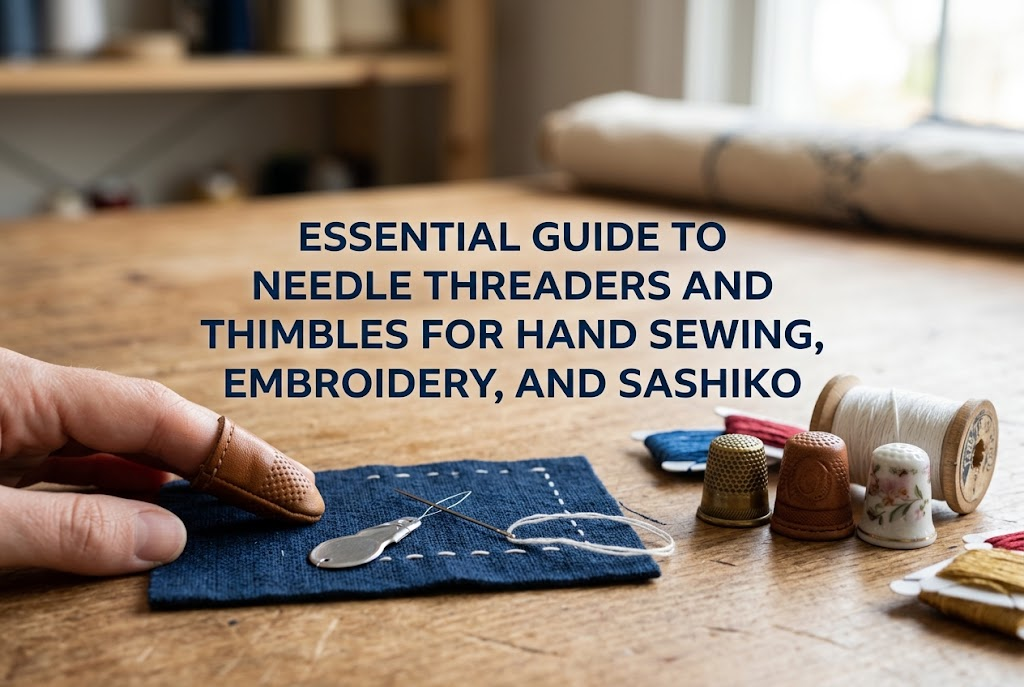
The classic wire threader—featuring a thin diamond-shaped wire attached to a small oval aluminum plate—is included in almost every standard sewing kit or crafting set. It is the most popular and affordable style, so most crafters have seen one before.
Using it is very simple: insert the diamond-shaped wire through the eye of the needle, place your thread through the wire loop, and pull the threader back out. Because the wire flexes easily, its biggest advantage is that it can fit into relatively small needle eyes.
However, due to its construction, the joint where the wire meets the metal plate is fragile. Applying excessive force can cause the wire to pull out and break, making it unsuitable for forcing heavy or stiff threads through tight openings.
A desktop threader (or desk threader) is a stationary device where you set your needle into a slot, lay the thread across, and press a button or lever to thread the needle automatically. It is arguably one of the most revolutionary tools for boosting hand-sewing efficiency today.
With a single press of a lever, a fine internal mechanism precisely pushes a tiny loop of thread straight through the needle's eye. It works wonders for anyone with strained eyesight, as well as for multi-color sewing or embroidery where you frequently switch thread colors.
While desk threaders have limitations on the needle sizes they can accommodate, the sheer convenience they offer makes them an indispensable asset once you try one. If you enjoy hand sewing regularly, this is a tool well worth keeping on your workbench.
Designed specifically for thick threads like Japanese sashiko thread, yarn, or multi-strand embroidery floss, these threaders consist of a flat, sturdy metal plate rather than a thin wire. The metal plate itself features built-in hooks or precise notches to catch the thread.
Because there is no delicate wire to snap, these flat metal threaders excel at pulling thick threads through needle eyes with solid force. They are exceptionally durable and built to last almost indefinitely.
They deliver peak performance when paired with needles featuring wide, elongated eyes—such as sashiko needles, tapestry needles, or cross-stitch needles.
Thimbles vary greatly in material and shape, which directly affects how they feel during use. Choosing an incompatible thimble can actually make stitching harder, so understanding their unique characteristics is key.
Ring-shaped thimbles made of metal or plastic have long been used in traditional Japanese tailoring (wasai) and general hand sewing. Worn around the second joint of the finger, they allow you to push the end (head) of the needle using the side or pad of your finger.
The outer surface features fine dimples or a grid-like texture to catch the needle head securely and prevent it from slipping. This shape is ideal for continuous, rhythmic stitching motions like running stitches (naminu'i).
Sizing is extremely critical for ring thimbles; if the fit is not exact to your finger's diameter, the ring will rotate awkwardly or slip off mid-stitch.
Crafted from supple cowhide or pigskin, leather thimbles have the unique quality of molding comfortably to your finger's exact shape over time. Common styles include full-coverage cap types and coin-backed types that reinforce specific pressure points.
Unlike metal thimbles, leather feels soft against the skin, keeping your fingers comfortable during long crafting sessions. Leather is also breathable, preventing your fingers from getting uncomfortably sweaty.
Choosing a leather thimble with an embedded metal coin plate gives you full finger protection even when driving thick needles through tough materials. It is currently one of the most popular thimble choices for patchwork, quilting, and embroidery.
Rather than pushing a needle forward, rubber or silicone thimbles are designed to grip and pull the needle out from the fabric. Their high surface friction gives you a firm, nonslip hold on slick metal needles.
They are especially helpful when a needle gets stuck in heavy denim, leather, or dense multi-layered fabrics where bare fingers cannot get a solid grip. With rubber thimbles, you can pull the needle through cleanly without straining your hand.
Typically worn on the thumb and index finger, rubber thimbles are incredibly effective when finishing off embroidery threads or pulling fine beading needles through tight stitches.
Full metal cup-shaped thimbles that cover the entire fingertip are standard tools in Western dressmaking, tailoring, and patchwork quilting. They are typically worn on the middle finger to push the needle straight forward with firm power.
Deeply dimpled across their surface, cup thimbles securely catch the needle head regardless of the angle. They offer outstanding durability and high safety when sewing heavy fabrics.
Craft shops often display tools near needle threaders and thimbles that look somewhat similar, which can confuse beginners. Clarifying these differences will help you avoid misusing them.
Some beginners attempt to push thread through a needle eye using tweezers, but this is inefficient. Tweezers simply pinch the end of a thread; they lack a guiding mechanism to funnel thread through a tiny eye. Doing this often squashes the thread end, making it even harder to pass through.
Similarly, a tailor's awl (meuchi) is designed to spread fabric threads or shape neat corners on cloth items—it has an entirely different purpose from a needle threader. Trying to push thread into a needle eye with an awl can cut the thread or damage the needle, so avoid doing this.
While rubber crafting thimbles look similar to office rubber finger cots used for turning paper, their structural strength is completely different. Office finger cots are made of very thin rubber; a sharp needle tip or metal needle head will easily puncture right through them.
Rubber thimbles designed for handcrafts are specially reinforced with added thickness and tear resistance to withstand needle pressure. For safety, always use thimbles intended specifically for handcrafts and sewing.
To avoid selecting the wrong tool, choose items tailored to the specific genre of work you are making, as well as the specifications of your needle and thread.
For general garment sewing, alterations, or small fabric craft items, a desktop needle threader paired with a soft cap-style leather thimble is the best setup. This combination handles a wide range of tasks while keeping hand fatigue to a minimum.
If you focus mainly on embroidery or Japanese sashiko, you will handle thick, multi-stranded threads. In this case, choose a flat metal plate threader or a dedicated sashiko threader, along with rubber thimbles to assist in pulling needles through taut fabric.
For patchwork and quilting with multiple layers of fabric and batting, a metal cup thimble worn on the middle finger, or a leather thimble with an integrated metal coin, is the ideal choice.
When selecting a needle threader, always consider the size of your needle eye. Forcing a thick wire threader into ultra-fine quilting or beading needles will either deform the needle eye or break the threader.
The golden rule is to use fine-wire threaders explicitly labeled for fine needles, and flat metal threaders for heavy threads. Matching the tool to the needle allows the thread to pass through smoothly without force.
Getting the right fit is the single most important factor when buying a thimble. A thimble that is too large will drop off during stitching, while one that is too small restricts blood circulation, causing finger numbness.
Thimbles are most commonly worn on the middle finger or index finger. Observe which part of your finger touches the needle head when you push it, then measure the circumference around your first or second knuckle before choosing a size.
For leather thimbles, keep in mind that the material will stretch slightly and conform to your finger over time. Buying a snug or slightly tight fit is a helpful tip when choosing leather.
Even with great tools, knowing how to handle them properly ensures you get 100% of their intended benefits. Here are practical techniques used by experienced crafters.
When using a wire needle threader, the ironclad rule is: never pull with brute force. Follow these steps for best results:
If you pull at an angle, the wire rubs against the sharp inner rim of the needle eye and snaps. If you feel strong resistance, stop pulling immediately; either reduce the thread strands or adjust the needle angle.
When pushing a needle with a thimble, relax your wrist rather than trying to force the motion with your arm muscles. Rest the needle head securely against the textured dimples of your thimble, and push it through using gentle leverage.
Once the tip clears the fabric, grip the needle tip with your thumb and index finger to pull it straight through. When this push-and-pull rhythm becomes seamless, joint strain on your fingers and wrists decreases dramatically.
Keep your shoulders relaxed and keep your elbows close to your torso while stitching to maintain a fatigue-free posture during long sessions.
Here are frequent mistakes beginners make and how you can prevent them ahead of time.
The single most common tool breakdown is a snapped wire on a threader. This almost always happens when the thread is too thick for the needle eye being used.
Because the wire loop holds the thread folded over, pulling it through means the needle eye must accommodate two strands of thread plus two strands of wire simultaneously. If this combined thickness exceeds the eye capacity, no amount of pulling will work.
If you encounter heavy friction, stop immediately. Switch to a needle with a larger eye or reduce your thread thickness.
Using an ill-fitting thimble not only lowers efficiency but can also cause discomfort or minor injuries. A metal thimble that is too tight cuts off blood flow, causing ache and numbness after extended use.
Conversely, a loose thimble can slide off right as you exert pushing pressure, causing the needle head to dig into your unprotected skin. Always select a thimble that fits snugly without gaps.
When sewing delicate silk or fine cotton fabrics, rough metal thimbles rubbing against the material can snag or fray the fabric surface.
When working with fine textiles, opt for smooth leather thimbles or hold your thimble hand so it avoids abrasive contact with the fabric face. Paying attention to tool-and-material compatibility is a secret to achieving professional-looking work.
Here are my top recommended setups tailored to popular crafting categories:
This pairing is ideal for everyday hand sewing—such as drawstring pouches, small bags, and garment repairs. The desktop threader lets you set up effortlessly, while the soft leather thimble shields your finger comfortably as you stitch.
For thick sashiko threads or multi-stranded embroidery floss, a sturdy flat metal threader is essential. Meanwhile, rubber thimbles stop your fingers from slipping when pulling needles through taut fabric held in an embroidery hoop.
Because quilting requires slender, sharp needles, a delicate fine-needle threader works best. To push needles through dense quilt batting and layered cotton, a metal cup thimble or coin-reinforced leather thimble offers the maximum driving force and safety.
In this guide, we explored how needle threaders and thimbles can completely transform your hand-stitching experience—from understanding their types and functions to picking and using the right ones.
Struggling to thread a needle or feeling pain in your fingertips while sewing is not a sign of poor skill! It simply means you haven't found the right tools for the job yet.
By pairing your projects with threaders and thimbles designed for your specific needle, thread, and fabric, crafting frustration disappears completely. When your tools feel like natural extensions of your hands, your stitching speed increases, your seams become neater, and your finished crafts look far more refined.
I hope you find your perfect crafting companions to make your hand sewing and embroidery time even more relaxed and enjoyable!
If you found this guide helpful, please feel free to share it with your craft-loving friends on social media. See you in the next article! This was Yassy from Crafters!

For example, if you are looking for articles about mizuhiki, try searching for "mizuhiki"; if you are interested in tools, try keywords like "nippers" or "pliers."
