Level Up Your Wire Jewelry: The Golden Order for Upgrading Your Tools
yassy
Crafters!

Hello, everyone! I'm Yassy from Crafters! (・∀・)
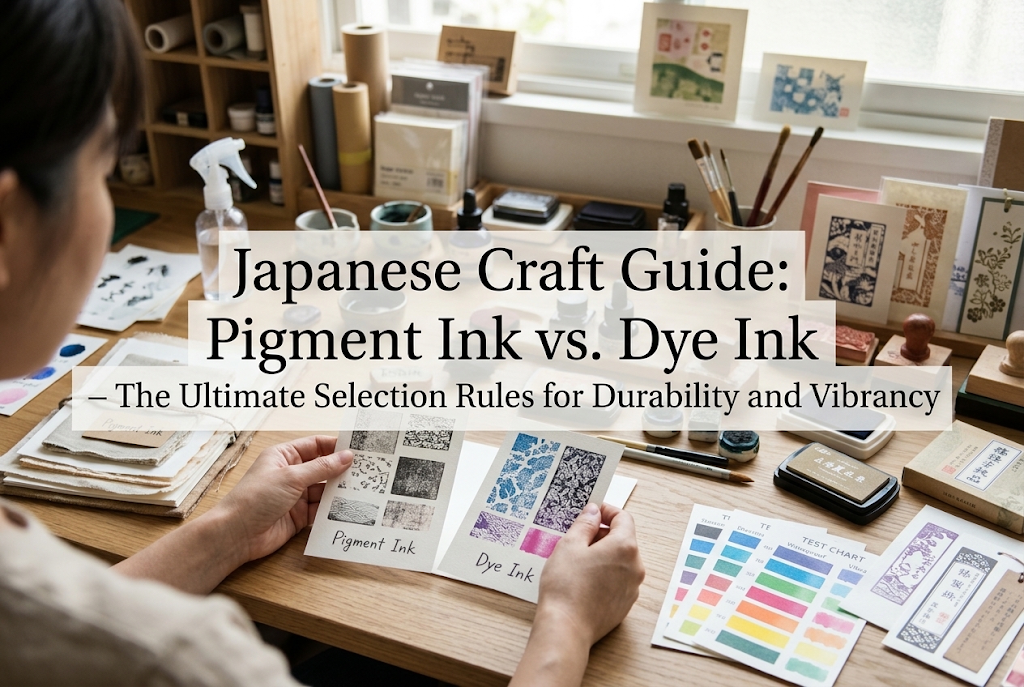
When creating handmade crafts or buying and using wonderful handcrafted items, there is one crucial element you absolutely must know: the type of ink you use. I personally love making various handmade items, admiring the amazing works of other crafters, and purchasing my favorite items from online shops. Based on my experience, I can state with confidence that the decisive difference between pigment ink and dye ink fundamentally determines both the quality and lifespan of a piece.
Have you ever experienced failures like, "I stamped a design, but it smudged when wet," or "I printed shop cards beautifully, but they faded quickly in the sunlight"? These mishaps are all caused by choosing the wrong type of ink. If you don't understand the properties of your ink, even a meticulously crafted item can lose its value as a sellable product. Conversely, once you completely master the characteristics of pigment ink and dye ink, the beauty and durability of your creations will improve dramatically.
In this guide, I will share all my knowledge and experience so that craft beginners will never get lost when choosing ink again. From their structural differences to optimal usage by material, here is your complete guide to making professional, confident choices every time.
If I had to express the difference between pigment ink and dye ink in one sentence, it would be: "Is the color component completely dissolved, or is it floating as solid particles?"
This structural difference in particles creates all the performance gaps, including water resistance, color vibrancy, and lightfastness. First, let's look at how each ink works on a fundamental level.
Pigment ink consists of fine, microscopic colored particles dispersed in liquid. Rather than dissolving completely in water like sugar, imagine tiny solid powders floating within the liquid.
When applied to paper or other materials, only the liquid component evaporates or gets absorbed, leaving the colored particles on the material's surface. In short, pigment ink operates on a mechanism of "depositing and hardening a film of color on top of the material." This process is very similar to applying paint or painting a mural. Because the color physically adheres to the surface, it is less affected by the base material and forms a strong protective layer.
Dye ink contains color components that are completely dissolved at a molecular level in a liquid base (water or solvent). This is identical to salt or sugar dissolving in water to form a transparent liquid.
When applied, the color molecules penetrate deep into the fibers and gaps of the material. In short, dye ink works by "dyeing and integrating with the material itself." Imagine staining paper with watercolors; this allows for vibrant coloration while preserving the natural texture and transparency of the material.
The structural difference between pigments and dyes results in four decisive performance differences in handmade crafting. Accurately understanding these four factors is the absolute first step toward fail-proof crafting.
When it comes to water resistance, pigment ink wins by a landslide. Once pigment ink dries, the particles bind together to form a tough, insoluble film. Therefore, even if water touches it after drying, it will not smudge at all.
On the other hand, water-based dye ink will dissolve again if exposed to moisture, even after it has dried. While dye ink is great for beautiful watercolor-like bleeding effects, you should strictly avoid using water-based dye ink on outdoor items, items used around water, or products that are handled frequently with hands.
Pigment ink is also overwhelmingly superior in its resistance to ultraviolet (UV) rays from sunlight or indoor lighting. Pigment particles have a very dense and sturdy molecular structure, making them resistant to photochemical reactions caused by UV light. As a result, they do not fade even after years.
In contrast, the molecular bonds of dye ink are easily broken down by UV rays. If you use dye ink on papercrafts displayed near a window or memorial items meant for long-term storage, the colors can fade away completely within a few months. If you want your creations to maintain their beauty over several years, pigment ink is undoubtedly the right choice.
For bright, vivid colors and delicate expressions, dye ink takes the crown. Because dye ink is clear at a molecular level, it produces extremely bright, clean, and transparent colors. Overlapping inks also creates smooth, seamless gradations.
Because pigment particles coat the surface, pigment ink yields a slightly matte, subdued finish. While it excels at bold, solid colors and heavy textures, dye ink is better suited for transparent, delicate color blending and smooth, photographic tonal transitions.
The drying speed and fixing process also differ significantly. Dye ink penetrates materials quickly, making its drying speed very fast. It won't smudge easily on your hands right after stamping on paper, which boosts work efficiency.
In contrast, pigment ink takes time for the surface moisture or solvent to evaporate and for the particles to set, resulting in a slower drying speed. When used on glossy paper or non-porous surfaces, you must not touch it until it is completely dry. However, this slow-drying quality becomes an incredible advantage when heat embossing, where embossing powder is applied and melted with heat to create a raised texture.
One of the easiest mistakes for craft beginners to make is confusing the type of solvent (water-based vs. oil-based) with the type of colorant (pigment vs. dye). Without sorting out these concepts, you are bound to make major errors when selecting supplies.
The most common misconception among beginners is assuming that "water-based pigment ink will wash away with water because it's water-based." This is completely incorrect.
"Water-based" simply means that the liquid vehicle carrying the pigment particles is water. Once stamped or printed onto paper and the water vehicle evaporates, the remaining pigment particles form a solid, water-insoluble film. Therefore, water-based pigment ink becomes completely waterproof once dry. This works on the exact same principle as acrylic paint, which cannot be washed away with water once dried.
Inks exist in four combinations: water-based pigment, water-based dye, oil-based pigment, and oil-based dye. Thinking "it's oil-based, so it will be fine" can lead to disaster.
For example, if you use oil-based dye ink on non-porous surfaces like plastic or metal, it may look fine initially, but it will fade rapidly when exposed to light. If you need long-term durability and lightfastness on non-absorbent surfaces, you must choose oil-based pigment ink or specialized inks designed to form a film.
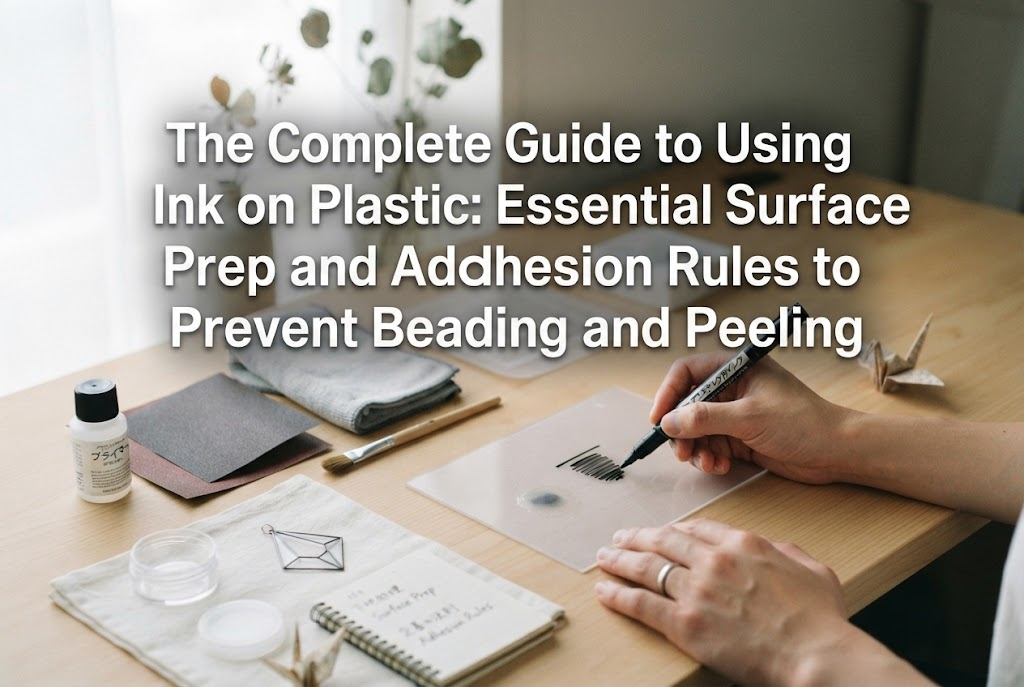
Dye ink fixes itself by soaking into materials. Therefore, if you try to use dye ink on non-absorbent materials like coated glossy paper, plastic, glass, or metal, it will never dry or adhere. The moment you touch it with your finger, it will wipe off completely or bead up on the surface.
When stamping or coloring on non-porous surfaces, the golden rule is to use pigment ink, which forms a color layer on top, or fast-drying solvent-based ink (such as StAZOn).
Now, let's explore the practical golden rules I use across various crafting disciplines to help you choose the best ink for your projects.
For paper projects, choose your ink based on the item's purpose and intended storage life:
When enjoying eraser stamp making or stamp art, ink properties directly dictate the final finish.
If you want fine lettering or detailed designs to stand out crisp and sharp, use a pigment ink pad that sits on the paper's surface. If you use dye ink for fine stamps, the ink can bleed along the paper fibers, causing delicate lines to feather and thicken.
Conversely, if you want to perform heat embossing by sprinkling embossing powder over a stamped image, you must use slow-drying pigment ink so the powder can stick. With dye ink, the paper absorbs the ink before the powder can adhere, making heat embossing impossible.
When stamping or hand-painting on canvas bags, clothing accessories, or handkerchiefs, using pigment ink formulated for fabric is an absolute must.
Fabric pigment inks contain resins that melt and bind firmly to textile fibers when heated with an iron after application. This creates strong water resistance that survives repeated washings without fading.
While dye-based fabric paints exist, their fixing process is quite complex. For handmade crafters seeking hassle-free, wash-durable results, heat-set water-based fabric pigment ink is the most reliable choice.
When coloring specialty materials like leather, shrink plastic, or resin, inspect the surface texture before choosing your ink:
As a handmade creator, printing shop cards, instruction sheets, thank-you notes, and display packaging on your home printer is unavoidable. Selecting between pigment and dye printer ink can make or break your professional finish.
For shop cards, accessory display cards, price tags, or signboards used at outdoor markets, always use a pigment ink printer.
Text and logos printed with pigment ink will not bleed, even if exposed to rain or water droplets. Furthermore, text edges print crisp and sharp, making small fonts clean and easy to read, which gives your brand a high-end feel. Your customers' cards won't fade over time under room light, reinforcing brand trust.
On the other hand, if you sell your illustrations as art prints or prioritize vibrant color depth on glossy photo paper, a dye ink printer shines.
Dye ink absorbs into the paper's color-receiving layer, preserving the natural shine of glossy papers. Gradations and vividness on photo paper printed with dye ink easily surpass pigment ink. However, because dye prints are very vulnerable to water, you must package finished prints in protective plastic sleeves (such as clear OPP bags) for sale.
Having crafted, purchased, and evaluated countless handmade goods, I want to share my personal zero-fail testing process before using new inks on final projects.
When introducing a new material or ink, I never use it directly on a finished piece. I always conduct a durability test using these steps:
Only inks that pass all five steps earn a spot as regular supplies in my studio. Even when purchasing ink online from shops like Amazon, I trust the results of this personal testing above all else.
Neither pigment nor dye ink can perform properly if stored incorrectly.
Pigment stamp pads in particular will dry out and harden if left unsealed for long periods. Always close lids tightly right after use and store them away from direct sunlight, high temperatures, and humidity.
If a pigment stamp pad begins to dry out, don't force it. Add a few drops of the official dedicated re-inker (inker) from the same brand to refresh it. Never mix in water or random solvents, as this will disrupt the pigment dispersion, clump the ink, and ruin the pad permanently.
Here is a handy comparison chart summarizing everything we've discussed for quick reference when shopping or crafting:
We've covered everything from the chemical structures to practical crafting applications of pigment and dye inks. Both ink types have clear advantages and trade-offs; neither is universally superior to the other.
The key is to accurately assess what performance your specific project requires:
By keeping these simple criteria in mind, you can eliminate mistakes in your handmade journey. Make ink properties work for you, and create amazing, high-quality pieces that never fade over time!
If you found this guide helpful, please share it with your crafting friends on social media! See you in the next article—this was Yassy from Crafters!



For example, if you are looking for articles about mizuhiki, try searching for "mizuhiki"; if you are interested in tools, try keywords like "nippers" or "pliers."
