Level Up from Starter Kits: The Golden Sequence for Upgrading Fabric Dyeing Tools
yassy
Crafters!
Hello, everyone! This is Yassy from Crafters! (・∀・)
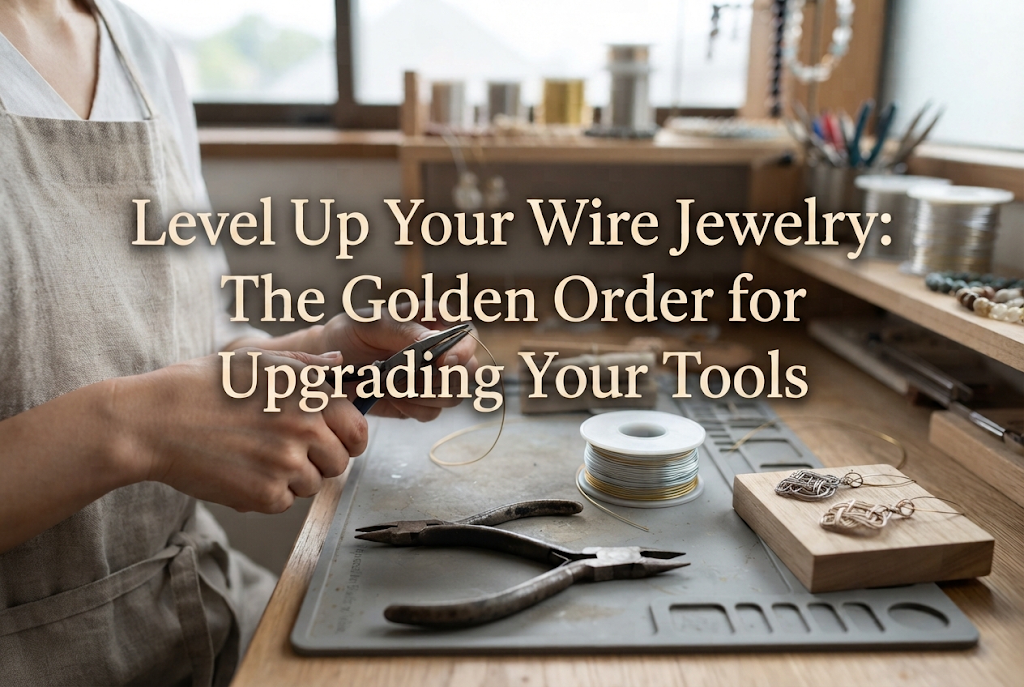
As someone who absolutely loves making, viewing, and buying handmade crafts, today I want to dive deep into a topic that every wire jewelry maker inevitably faces: upgrading your tools!
Once you have mastered the basic techniques of wire wrapping and making jewelry, your next goal is naturally to elevate the overall beauty and refined quality of your finished pieces.
If you find yourself wondering, "Why don't my wire-wrapped loops look neat and uniform?", "Why is my wire getting covered in fine scratches?", or "Why are there sharp burrs catching on clothing?", let me reassure you: it is not a lack of technique on your part. The true culprit is the physical limitation of the generic tools included in basic starter kits.
By transitioning from basic starter tools to precision, professional-grade jewelry tools, the final finish of your work will improve drastically, and your crafting speed and comfort will skyrocket.
In this guide, I will share the ultimate "golden sequence" for upgrading your tools step-by-step for maximum impact, along with specific criteria for choosing the right tools without costly mistakes!
When you first start making wire jewelry, inexpensive tool sets included in starter kits from craft stores or online shops are more than enough to get you going. However, as you gain experience and develop an eye for detail, you will inevitably become dissatisfied with the finer points of your work.
Tools in basic kits are cheap, mass-produced items meant only for absolute beginners to try out simple tasks. As a result, they lack the micron-level precision and smooth surface finish required for delicate wire work.
There is a decisive structural difference between professional tools favored by jewelry artists and basic starter kit tools. Understanding these differences is the key to seeing why simply changing your tools can dramatically boost the quality of your craft.
The reasons your work quality plateaus when using starter kit tools can be narrowed down to three main issues: wire damage, misaligned jaws, and rough cuts.
First is wire damage caused by unpolished interior jaw surfaces. Inexpensive flat-nose or round-nose pliers lack fine polishing. The moment you grip a wire tightly, these rough surfaces scrape off the outer coating or plating. Scratched wire not only looks untidy, but it also begins to oxidize, causing discoloration and deterioration over time.
Second is uneven shapes caused by loose tool joints. If you try to form a loop with round-nose pliers whose jaws wobble at the fulcrum, unequal pressure is applied to each side, making it virtually impossible to form a clean, round circle.
Third is sharp protrusions (burrs) left behind by imprecise wire cutters. Cutting wire with dull or poor-quality cutters crushes the wire rather than slicing it clean, leaving a sharp, V-shaped tip. This is the main reason wire ends scratch the skin or catch on delicate clothing fibers.
No matter how meticulously you work with your hands, if the tools themselves are misaligned or rough, creating flawless pieces is physically impossible.
The difference between high-end jewelry-making tools loved by professionals and cheap kit tools lies in the grade of metal (steel hardness) and the precision of the craftsman's polishing process.
Professional tools utilize high-carbon steel or specialized stainless steel, ensuring that the tips and cutting edges do not wear down or deform even after repeated use. Furthermore, when closed, the jaws leave no gaps whatsoever, offering the precision needed to securely grip something as thin as a single sheet of paper.
In addition, the spring tension and ergonomic grip shape are carefully engineered. They fit comfortably in your palm and provide just the right amount of bounce, preventing hand fatigue during long crafting sessions and allowing subtle control without applying excessive physical force.
The precision of your tools translates directly into the beauty of your finished work. Choosing uncompromising tools is the shortest path to moving past the beginner stage.
Even when you understand the value of good tools, replacing all of them with high-end options at once can be a heavy financial investment. You do not need to buy everything at once!
In wire jewelry craft, there is a clear, strategic priority list based on how significantly each tool impacts the final appearance and how easily it prevents common mistakes.
Here is the golden order for upgrading your tools to minimize unnecessary expense and achieve the maximum return on your investment.
Here is the upgrade sequence I recommend with absolute confidence:
Your top priority should be wire cutters, as they directly affect both the safety and aesthetic refinement of your piece. Next are round-nose pliers, which control geometric symmetry, followed by flat-nose pliers, the core tool for forming and assembly.
Let's take a closer look at why each tool holds its specific rank, along with exact selection criteria.
The undisputed king of tools to replace first from your starter kit is a pair of wire cutters.
Some might find this surprising, but in wire jewelry, the quality of your cutters is the single most critical factor determining the professional polish of your piece.
If you could only upgrade one single tool, choose your wire cutters without hesitation. The moment your cut edges become precise, the overall quality of your jewelry changes completely.
Standard household wire cutters and basic starter kit cutters feature a "semi-flush" or double-beveled structure. The cutting edges intersect in a V-shape, crushing the wire from both top and bottom to break it.
Wire cut with semi-flush cutters leaves a pointed, roof-like peak at the end. When creating wrapped loops or trimming wire ends, these sharp points remain exposed, catching on sweater threads or scratching the wearer's skin.
In contrast, specialized precision cutters for jewelry making feature a "flush cut" (single-bevel flush) mechanism. One side of the cut edge is completely flat. When you place the flat side directly against the wire joint and snip, the resulting wire end is left completely smooth and flat.
This eliminates the tedious work of filing down sharp edges, allowing you to create neat, seamless wrapped loops instantly. Once you experience this stress-free feeling and polished finish, you will never go back to starter kit cutters.
When selecting flush cutters, always verify these three key specifications:
A very common mistake made when buying precision flush cutters is using fine cutters on thick wire, resulting in chipped blades.
Because the edges of precision flush cutters are honed to extreme sharpness, their maximum wire gauge capacity is strictly defined.
Use your precision flush cutters exclusively for delicate wires, such as 24-gauge (approx. 0.5 mm) or 26-gauge (approx. 0.4 mm) Artistic Wire commonly used in wrapped loops.
If you need to cut thick base wires of 18-gauge (approx. 1.0 mm) or larger, or harder materials like stainless steel wire, make it an absolute rule to keep a separate pair of heavy-duty, medium-thick cutters.
Ranked second in the upgrade sequence is a good pair of round-nose pliers.
A major factor in judging the quality of wire jewelry is the consistency of loop sizes and the neatness of wire-wrapped wraps. Upgrading your round-nose pliers to a professional grade makes creating uniform loops and wrapped loops vastly easier.
If you have struggled with kit pliers because your loops turn out oval instead of round, or because you cannot make loops the exact same size twice, the cause lies in the imprecise roundness and thick tips of kit pliers.
Inexpensive round-nose pliers often have uneven cone angles on each side, or jaws that are not true circular cones in cross-section. Furthermore, the tips are often too thick, making it impossible to form delicate loops under 2 mm in diameter.
No matter how much you practice, if the tips of your tool are misshapen or oval, the loops you shape around them will always end up misshapen and oval.
High-quality round-nose pliers from specialized tool brands feature tips precisely ground to an ultra-fine diameter of around 1.0 mm, tapering into perfect circular cones toward the base.
The ultra-thin tip allows you to shape tiny, delicate wrapped loops that perfectly suit dainty gemstones.
Additionally, because the left and right jaws meet flawlessly from tip to base without gaps, the wire will not slip or twist while you wrap it. Applying even pressure around the conical jaw allows anyone to create perfectly round loops with ease.
Keep these three points in mind when evaluating round-nose pliers:
The moment you hold a pair of round-nose pliers that meet these conditions, the aesthetic quality of your wire wraps will jump to a professional level.
Taking the third spot in the golden order are flat-nose pliers.
Flat-nose pliers are versatile tools used constantly throughout the crafting process for bending wire at sharp right angles, holding ends securely, or flattening components.
Because they are used so frequently, variations in tool quality directly impact both the visual elegance of your work and your frustration levels during crafting.
General DIY pliers or low-quality craft pliers often feature serrated ridges (grooves) inside the jaws to grip objects firmly.
In wire jewelry making, using serrated tools is a complete non-negotiable NO.
If you clamp wire with serrated pliers, those metal teeth will bite directly into your soft wire, leaving ugly impressions behind. For color-coated wires like Artistic Wire, serrations strip away the outer enamel, exposing the bare copper wire beneath.
When upgrading your flat-nose pliers, always choose smooth-jaw pliers with completely flat, polished interior surfaces.
Professional flat-nose pliers feature smooth interior jaws that make flat surface-to-surface contact. This allows you to hold wire firmly with surprisingly little gripping force.
Equally important are tip thinness and sharp, square edges.
Flat-nose pliers with thin, crisp tips easily reach into tiny gaps within intricate wirework, allowing you to create sharp 90-degree bends at the exact spot intended. To achieve crisp, structured geometric wire designs that are impossible with thick, rounded kit tips, precision flat-nose pliers are indispensable.
At the same time as flat-nose pliers—or shortly thereafter—consider adding bent-nose pliers to your toolkit.
Bent-nose pliers feature tips angled at roughly 45 degrees. This shape allows you to tuck in wire ends or manipulate tight wire wrapping without obstructing your line of sight.
For crafters who focus on wire wrapping gemstones (framing) or detailed wire weaving, bent-nose pliers keep your wrist at a comfortable angle, making them a game-changing tool for accuracy and comfort.
Once you have upgraded the core trio (flush cutters, round-nose pliers, flat-nose pliers) to high-quality options, you can move on to specialty tools that expand your design possibilities.
While these are rarely included in basic starter kits, having them in your arsenal instantly elevates your creative flexibility.
Featuring jaw tips covered in plastic or nylon, nylon-jaw pliers are essential for wire wrapping artists.
Because metal does not touch metal directly, you can grip, pull, or bend wire as firmly as needed without leaving a single mark or scratch on the surface.
Furthermore, if your wire gets kinked or pulled unevenly from the spool, simply clamp it softly between the nylon jaws and slide the pliers down the length of the wire to straighten it out cleanly. They are indispensable when working with square or half-round wire, where maintaining a pristine wire texture is paramount.
When working on designs that require multiple loops or jump rings of the exact same diameter, stepped bail-making pliers (multi-sized looping pliers) are extraordinarily useful.
Standard round-nose pliers are tapered, meaning that if your positioning shifts by even a millimeter, your loop size changes. Stepped pliers, however, feature cylindrical steps of fixed diameters. No matter where you hold the wire on a specific step, you get an identical, perfect circle every time.
They are your greatest ally for maintaining consistent quality when batch-producing chain links or repeated geometric motifs.
Even after investing in high-grade professional tools, improper handling or storage will shorten their lifespan and compromise performance.
Precision cutters and pliers are particularly sensitive to moisture and impact. Learning proper maintenance will keep your favorite tools in prime condition for a lifetime.
Many high-end jewelry tools are crafted from high-carbon steel to achieve extreme sharpness and strength. While superior in performance, high-carbon steel is susceptible to rusting from humidity or hand perspiration.
When you finish a crafting session, always wipe down the handles and metal tips with a dry, soft cloth (such as a microfiber cloth) to remove skin oils.
Additionally, once a month—or before long-term storage—apply a micro-thin layer of anti-rust oil (such as 3-in-1 oil or sewing machine oil) to the metal parts, placing a single drop into the joint mechanism. This small step preserves smooth spring action and completely prevents rust formation.
The biggest enemies of precision tools are drops that bend tip ends and collisions between tools that chip cutting blades.
Tossing delicate flush cutters or fine round-nose pliers loosely into a pencil cup or piling them into a box causes tool heads to knock together, dulling or chipping delicate edges.
Follow these storage habits:
Caring for your tools with attention and respect is directly reflected in the delicate beauty and quality of the jewelry you create.
Graduating from starter kit tools and investing in professional-grade wire jewelry tools is not just a routine purchase—it is a personal investment in taking your artistic expression to the next level.
Let's review the golden sequence once more:
The moment you hold truly precision-crafted tools, you will experience an ah-ha moment: "I can't believe how much easier and cleaner this is to make!"
You will realize that many struggles you previously blamed on your own technical skill were actually caused by tool limitations. By letting precision tools do the heavy lifting, you free yourself from frustration, making wire jewelry creation infinitely more enjoyable and fulfilling.
Based on your personal crafting style, start by picking up one great pair of flush cutters and experience the joy of making breathtakingly beautiful wire jewelry!
If you found this guide helpful, please feel free to share it with your craft friends on social media! See you in the next article—this was Yassy from Crafters!


For example, if you are looking for articles about mizuhiki, try searching for "mizuhiki"; if you are interested in tools, try keywords like "nippers" or "pliers."