Japanese Pottery Secrets: Controlling Glaze Density and Thickness for Perfect Results
yassy
Crafters!

Hello, this is Yassy from Crafters! (・∀・)
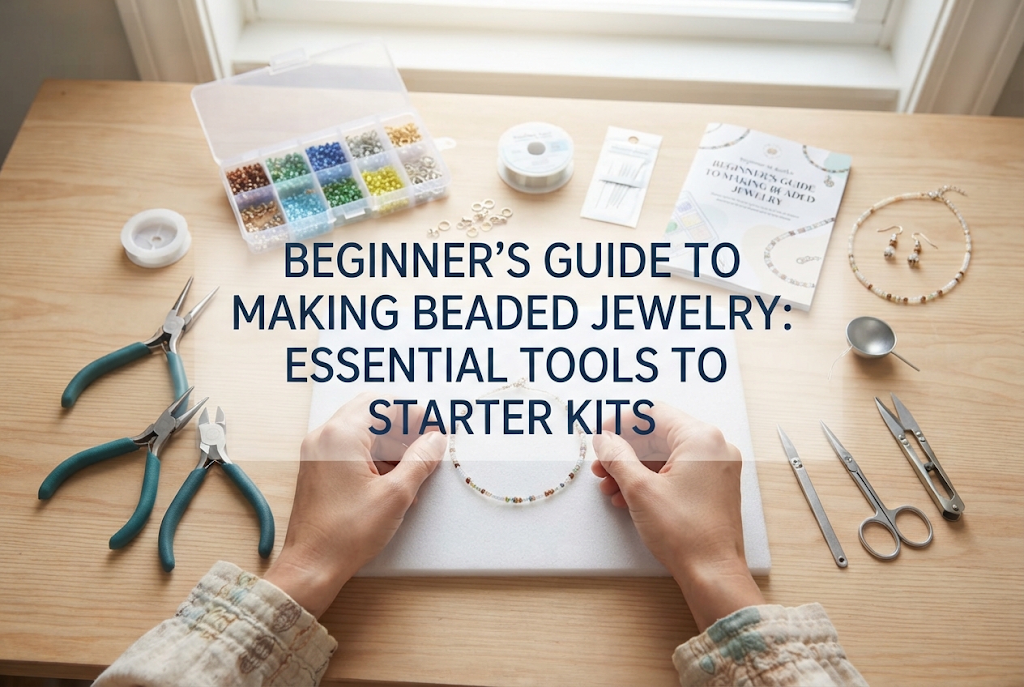
The world of bead jewelry is exciting just to look at. Sparkling glass beads, rich natural gemstones, adorable acrylic parts—just gazing at them makes your creative desire surge. Whenever I enter a bead shop, I forget about time as I carefully pick out parts. I love buying wonderful finished pieces, but I love assembling them myself from scratch even more!
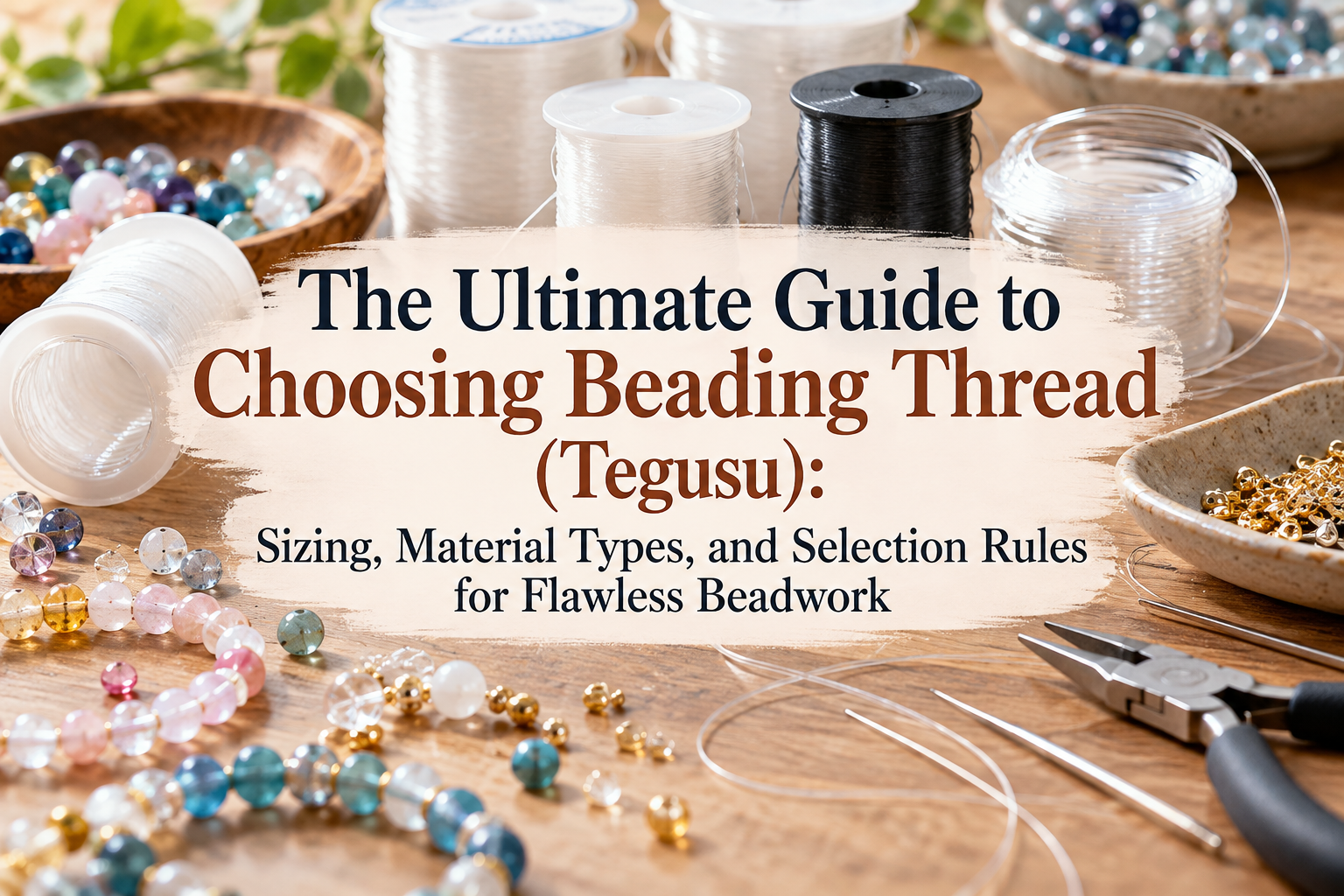
However, in bead jewelry making, there is something just as important—or even more important—than the beads themselves. That is the beading thread, known in Japan as tegusu (monofilament craft thread/line). Tegusu serves as the skeleton of your work, and it is an extremely crucial material that dictates both the durability and the aesthetic finish of your piece.
Beginners often fall into common traps: "I bought a random thickness of thread at the craft store and made something, but it was wobbly and lost its shape," or "A few days after completing it, the thread snapped and the beads went scattering everywhere." These problems are all caused by selecting the wrong tegusu for the item or beads you are trying to make.
Tegusu has clear rules for selection based on material characteristics, strength differences according to gou (Japanese thickness numbering system), and whether or not it stretches. In this article, I will thoroughly explain the "absolute rules for choosing tegusu without failure" that I have derived from years of crafting and research. Clear up all ambiguous knowledge and get the perfect know-how to create strong, beautiful pieces!
Even though we say "tegusu" in a single word, the texture, hardness, and durability vary greatly depending on the material used. If you select a material that doesn't fit the purpose of your accessory, you won't be able to maintain the intended shape, or it may degrade and snap quickly. First, accurately understand the features of the main tegusu materials used in bead crafting.
The most widely sold thread at craft stores and 100-yen shops in Japan is nylon tegusu. It is colorless, transparent, has moderate flexibility, and offers excellent cost performance.
The biggest advantage of nylon tegusu is that it is supple and easy to handle. When making 3D motifs woven with beads or flat-woven rings, it fits comfortably in your hands and allows work to proceed smoothly.
However, nylon has weaknesses: it absorbs water and gradually degrades due to ultraviolet (UV) light. If left in a sunny location for a long time or used frequently in wet environments, it hardens and becomes prone to breaking. It is fine for daily wear accessories, but caution is required for outdoor items or heirloom-style pieces you want to keep forever.
Fluorocarbon tegusu is harder than nylon, resists stretching, and is extremely strong against friction and UV rays. It is mainly found in fishing tackle shops or specialized bead craft stores.
The overwhelming strength of fluorocarbon lies in its stiffness and resistance to degradation. Since it absorbs virtually zero water, it stands up well to sweat and water, and will not yellow or degrade under UV light. Furthermore, because its crystalline structure is denser than nylon, it produces tight, sturdy, and rigid beadwork.
Selecting fluorocarbon tegusu is the correct choice when making complex 3D motifs with multiple weaving passes, rings where you want to maintain a firm shape, or when stringing heavy beads. Another major reason professionals prefer it is that knots, once tightened, do not easily loosen.
Stretchable tegusu (elastic cord) is essential for bracelets that can be put on and taken off without clasps. This is broadly divided into two types: single-strand polyurethane rubber (silicone rubber) and multi-strand operon rubber.
Polyurethane rubber consists of a single transparent rubber cord characterized by a smooth, crystal-clear appearance. Even when passed through high-transparency quartz or glass beads, the cord remains unobtrusive. However, if it receives a tiny nick or cut, it tends to snap all at once from that point.
On the other hand, operon rubber has a structure where dozens of fine polyurethane fibers are bundled together. It is supple, easy to knot, and even if a few fibers happen to break, the entire cord won't snap at once and scatter your beads. For natural gemstone bracelets where luxury and safety are prioritized, using operon rubber is an absolute rule.
In Japan, the thickness of tegusu is indicated by a unit called Gou (号). The smaller the number, the thinner it is; the larger the number, the thicker it is. If you don't understand this correctly, the thread won't fit through the bead hole, or it will be too loose, causing the finish to warp.
The following list is essential reference data summarizing the tegusu gou numbers frequently used in bead jewelry crafting, their actual diameters in millimeters (mm), and their main uses. Keep these in mind:
The most commonly used sizes in jewelry making are Size 2 and Size 3. As a starter kit, if you prepare Size 2 and Size 3 nylon or fluorocarbon tegusu, you can cover more than 80% of basic projects.
When selecting the size of your tegusu, the one thing you must never do is choose "randomly." The thread thickness is physically determined by calculating the size of the bead's hole and how many times the thread will pass through that hole.
For single-pass designs where the thread goes through the bead only once, choose a thickness that barely fits or takes up 60% to 80% of the hole's diameter.
For example, when threading once through a 4mm pearl bead with a hole diameter of about 0.8mm to 1.0mm, using Size 2 (approx. 0.235mm) will result in a thread that is too thin, creating a limp finish. In this case, using Size 3 (approx. 0.285mm) to Size 4 (approx. 0.330mm) will produce a beautiful line with both moderate firmness and flexibility.
If you use a thread that is too thin for a single pass, the weight of the beads will pull the thread downward, exposing the thread or causing the whole piece to ripple. Choosing a "slightly thicker" thread for single passes is the correct approach.
In bead weaving or motif crafting, the tegusu crosses through a single bead 2 times, or sometimes 3 or more times. In this scenario, if you pick a thick thread with the same logic as a single pass, the thread will get stuck halfway through, and your work will come to a complete halt.
When weaving flower motifs or rings with standard seed beads (hole diameter approx. 0.7mm–0.8mm), you must calculate for the thread crossing through 2 to 3 times.
With a 0.235mm Size 2 tegusu, passing it 3 times equals a total diameter of about 0.705mm, which can just barely pass through the hole of a seed bead. This is the scientific reason why Size 2 is called the absolute standard for seed bead weaving. If you have a complex structure passing 4 or more times, you will need to reduce the thickness to Size 1.5.
Elastic bracelets that can be put on quickly without clasps are classic, overwhelmingly popular items in the craft market. However, they are also the category with the most failures, such as "snapped right after making" or "the knot untied and beads flew everywhere." Here is the complete guide to mastering elastic cords.
Polyurethane rubber, which is transparent and shaped like a single cord, has aesthetic beauty as its biggest advantage. Even when strung through highly transparent natural quartz or clear acrylic beads, the cord's presence is not noticeable at all.
The criterion when selecting is thickness (0.5mm, 0.6mm, 0.7mm, 0.8mm, 1.0mm, etc.). Choose the thickest size relative to the bead hole diameter. For beads with a 0.8mm hole, use 0.7mm or 0.8mm rubber cord.
As a precaution, polyurethane rubber has a nature of tearing from any cut. If you pull the knot too hard or if the edge of the bead hole is sharp (burrs), it can cause a tear that snaps all at once. It is a strict rule to check beforehand whether the hole edges of natural gemstones are smooth, and avoid using single-strand rubber on beads with large burrs.
Operon rubber is formed by bundling dozens of fine polyurethane fibers into a single thread. It is extremely supple, highly elastic, and knots into a tiny, tight point, making it the most trusted elastic material among handmade artisans.
When using operon rubber, finishing with a double-strand or quad-strand technique is the professional trick.
Using a specialized collapsible wire needle, fold the operon rubber in half (double) or fold it in half again (quad) and thread it through the beads. Even if several fibers happen to snap after years of use, the remaining fibers will hold the beads, drastically reducing the risk of sudden popping and losing your beads.
If you are making a stretch bracelet, adopting a double-strand or quad-strand operon rubber technique is overwhelmingly the correct choice in terms of strength, durability, and safety.
If you don't know how to choose and handle tegusu, your hard work will go to waste. Here, I will reveal typical failure troubles that beginners often face and instant techniques to prevent them 100%.
Troubles like "I woven the beads according to the pattern, but for some reason it won't lie flat and warps overall" or "I made a ring, but it's limp and can't hold its shape" are caused by the tegusu being too thin and a lack of tension.
Thin tegusu has too much flexibility, so it lacks the holding power to lock beads against each other. When making motifs or rings, use the thickest thread that can barely fit through the bead holes (basically Size 2 or fluorocarbon).
Additionally, it is important to pull the tegusu firmly to both sides after weaving each stitch, keeping the mindset of reducing gaps between beads to zero.
When you pull brand new tegusu off the spool, it has a strong curly memory. If you start working in this state, threads will tangle with each other or the tip will wander away from the bead hole, causing great stress.
This coiling can be eliminated in an instant before you start crafting. Take the cut tegusu of required length in both hands, pinch it firmly between the pads of your thumb and index finger, and slide/friction-stretch it smooth a few times. (Be careful of friction burns; holding a piece of cloth or leather between your fingers is safer).
Also, exposing it to warm steam or submerging it in lukewarm water for a few seconds resets the shape memory of nylon, bringing it to a straight, easy-to-handle state. Whether you do this extra step or not changes work efficiency threefold!
Because the surface of tegusu is extremely smooth, simply repeating a basic square knot twice will slip and unravel over time.
To ensure tegusu never unties, executing a double/surgeon's knot and applying appropriate adhesive to the knot is an absolute requirement.
When tying, loop the left-top thread twice around the right-top thread before pulling tight, then loop once in the reverse direction and tighten. This locks the knot in place.
Furthermore, apply a tiny amount of multi-purpose transparent craft glue or strong bead adhesive to the base of the knot using the tip of a toothpick. Never use instant super glue (cyanoacrylate) here. Super glue hardens stiffly when dry, causing the tegusu to snap at that rigid point. Always use an adhesive that retains flexibility.
This is when the tip of the tegusu splits into two or frays during work, preventing it from passing through beads. This happens because the tegusu rubs against burrs inside the bead holes or because repeated forcing has destroyed the fibers.
If the tip flattens or frays, don't hesitate to cut it with scissors at a 45-degree angle to recreate a sharp cross-section. Also, if it's difficult to thread, apply a tiny bit of glue or clear nail polish to the tip and let it dry; creating a stiffened core allows it to slide through smoothly like a needle.
Here, I will show you the exact thought process I use when designing a new bead project and selecting tegusu. Simply tracing these steps in your head will guarantee you never make the wrong choice.
Through this selection, a solid, store-quality ring that never loses shape is completed.
This combination creates overwhelming durability and ideal elasticity, resulting in a perfect bracelet that won't snap even after years of love.
By applying project shape, bead hole diameter, number of passes, and desired texture (hardness vs. suppleness) in order, you can narrow down to the single best thread without confusion!
Even if you choose the right tegusu, storing it poorly will cause it to degrade before use. While tegusu isn't a living thing, it is a delicate material whose quality changes depending on the environment.
The three biggest enemies for nylon and rubber-based tegusu are direct sunlight (UV rays), high heat & humidity, and extreme dryness.
If left on a windowsill on its spool, UV rays from sunlight destroy nylon molecules, turning it yellow and transforming it into brittle thread that snaps the moment you pull it. Elastic materials lose elasticity in extreme dryness or heat, becoming crumbly and fragile.
Always store partially used tegusu in a light-shielding box or a dark drawer in a cool place. Storing it in a zippered plastic bag with a desiccant pack is the most reliable measure against degradation.
Also, when using old tegusu bought years ago, always perform a strength test by pulling it strongly with your hands before starting full-scale production. If it snaps easily with simple hand pulling, that tegusu has reached the end of its lifespan. Gracefully replacing it with new tegusu is the correct professional judgment to protect the quality of your craft.
We have covered materials, sizes, structures, and techniques regarding how to choose tegusu for bead jewelry making.
Tegusu becomes almost invisible behind the scenes once a project is finished. However, the strength of the completed accessory, the beauty of its silhouette, how comfortable it feels to wear, and its durability to last for years without breaking are all decided by which thread you choose.
Finally, let's review the key points for achieving zero failures:
Having correct knowledge of tools and materials is the shortcut to mastering handmade crafts. By mastering the right tegusu with proper techniques, your bead jewelry will evolve from a simple handmade hobby into professional-grade pieces suitable for sale!
Be sure to incorporate these golden rules into your crafting and create lots of wonderful bead accessories that combine both strength and beauty!
If you share this article with your friends on social media or messaging apps, it would make me super happy and encouraged!Well then, see you in the next article! This was Yassy from Crafters!


For example, if you are looking for articles about mizuhiki, try searching for "mizuhiki"; if you are interested in tools, try keywords like "nippers" or "pliers."
