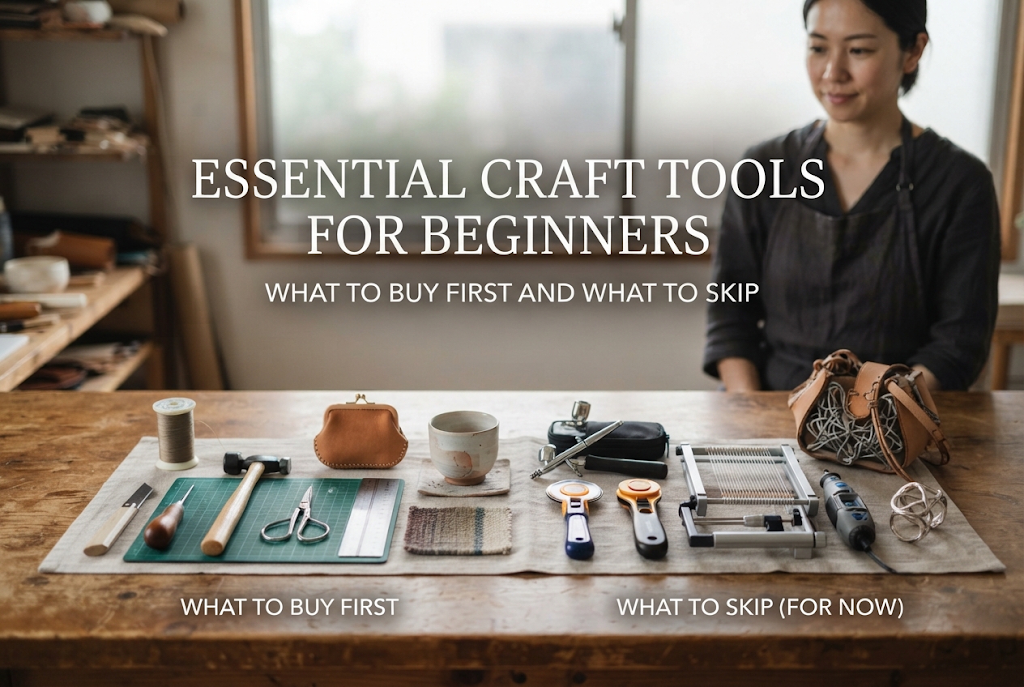
Essential Craft Tools for Beginners: What to Buy First and What to Skip
yassy
Crafters!

Hello, this is Yassy from Crafters! (・∀・)
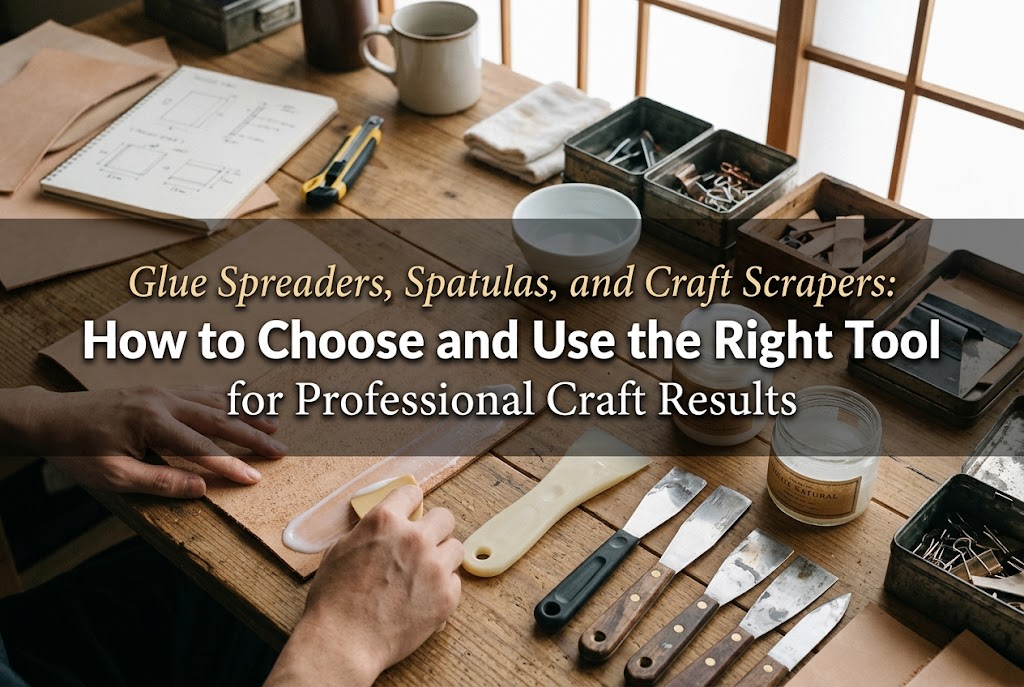
Have you ever had glue seep out and ruin an otherwise perfect project, or struggled with air bubbles and poor mixing when working with resin or clay? It is an experience every crafter has faced at least once. But there is a surprisingly simple tool that solves these frustrating issues instantly: crafting spreaders and spatulas (often referred to in Japan under the broad umbrella of hera).
At first glance, a spreader or spatula might look like an unassuming, mundane piece of equipment. However, using the right one correctly can drastically improve both the neatness of your finished pieces and the speed of your workflow. Whether it is delicate fine-tuning beyond the reach of human fingers, spreading a micro-thin, even coat of adhesive, or stirring liquids without introducing bubbles, professional-looking finishes almost always rely on these essential hand tools.
Speaking from my own experience making, analyzing, and purchasing countless handmade creations across diverse genres, I can say with confidence: if you settle for makeshift substitutes instead of proper spreaders and spatulas, you are missing out on more than half the joy and quality of crafting.
In this guide, I will break down the differences between glue spreaders, shaping spatulas, and silicone mixing tools—areas where beginners often get confused. I will cover material characteristics, how to choose by application, and professional techniques to keep your projects mistake-free.
In crafting, spreaders and spatulas are far more than tools for "just spreading" or "just stirring." They function as extensions of your fingertips, compensating for the physical limits of manual work and pushing project precision to its peak.
Applying glue directly with your fingers can transfer natural oils onto the material, weakening adhesion, or accidentally smudge glue onto areas that should stay clean. On the other hand, trying to spread glue using tiny wooden sticks like toothpicks or bamboo skewers creates uneven ridges, leading to wrinkles, lumps, and bubbling once dried.
The biggest advantage of using a dedicated flat spreader is the ability to apply balanced, even pressure over a wider area, creating an ultra-thin and controlled layer of glue or paint. Keeping surfaces flat and spreading adhesive right up to the edges with uniform thickness is virtually impossible without a proper spreader.
Similarly, using dedicated metal or silicone spatulas for clay sculpting or resin mixing can easily triple your efficiency. When I first started out, I made do with 100-yen store toothpicks and random scraps of plastic, but the moment I introduced purpose-built spatulas and spreaders, the quality of my finished pieces jumped to an entirely new level.
Investing in the right basic tools may seem like an extra step, but it is actually the fastest shortcut to mastering your craft. Understanding their true value is a vital step in moving beyond beginner mistakes.
While often grouped together under generic names, these tools feature distinct shapes and functions. Using the wrong one can damage your workpiece or ruin your materials. Here is a clear breakdown of the three main categories.
Glue spreaders are primarily molded from non-stick plastics such as polyethylene (PE) or polypropylene (PP). Their defining features are a tapered, razor-thin edge and working tips that feature either a serrated (notched) pattern or a flat, beveled angle.
The serrated edge is carefully engineered to comb adhesive into uniform ridges of consistent thickness. By gently gliding the spreader across a surface, anyone can lay down an ideal adhesive film in seconds. Furthermore, because dried glue peels off easily from these slick plastics, cleanup requires minimal effort.
Modeling spatulas are typically slender, durable tools made from stainless steel or rigid plastic, resembling precision spoons or miniature sculpting knives. While similar tools exist in medical, cosmetic, and culinary fields, crafting spatulas are tailored specifically for delicate handiwork.
Most feature double-ended designs with different tips on each side—such as a spoon end paired with a pointed, rounded, or flat chisel blade. They excel at millimeter-level precision tasks, including carving fine details into clay, placing microscopic embellishments, and scraping solid pigments. Because stainless steel spatulas have little flex and high rigidity, they effortlessly handle firm materials without bending or snapping.
Silicone spreaders feature flexible tips—or are cast entirely—out of soft silicone rubber. Their elasticity allows them to conform seamlessly to curved mixing cups and container corners, scraping up every last drop of material.
They are indispensable when mixing liquids such as UV resin, 2-part epoxy resin, and Jesmonite, allowing thorough stirring without scratching plastic cups. Because cured resin and paints will not stick to silicone, dried residues can be peeled away simply by flexing the tool, offering unmatched ease of maintenance.
Many crafters ask whether they truly need dedicated tools when they already have painting palette knives or household bamboo skewers. However, structural differences place strict limits on these substitutes.
Palette knives are designed for mixing oil or acrylic paints on an artist's palette and applying thick impasto strokes onto canvas. They feature significant blade flexibility and a deep crank (bend) in the neck.
In contrast, craft glue spreaders and spatulas are built to apply firm, direct pressure for flat bonding and accurate dimensional sculpting. A springy palette knife flexes too much to knead clay firmly or drag dense adhesives into a flat, paper-thin layer. While great for color blending, dedicated craft spreaders prevent far more mistakes during assembly and 3D sculpting.
Relying on toothpicks is one of the most common beginner traps. Because small wooden sticks only touch surfaces at a single point, they cannot exert controlled, planar pressure.
Stirring resin with a toothpick introduces dense micro-bubbles that are nearly impossible to eliminate. Tiny wood fibers can also splinter off and contaminate clear resin or glue. When spreading adhesives, toothpicks leave thick and thin patches that severely weaken bonding strength. If you want pristine results, retire the toothpicks and switch to dedicated flat tools.
Spreaders and spatulas shine across nearly every handmade craft. Here are specific examples of how they elevate different mediums:
Stainless steel spatulas take center stage here. They are essential for incising textures onto miniature food, detailing eyes and mouths on figurines, and smoothing seams between joined pieces. Additionally, using a miniature glue spreader to place a micro-thin layer of adhesive between clay parts prevents messy glue run-off when assembling cured components.
For two-part epoxy, UV resin, and water-based composite resins like Jesmonite, silicone stirrers and spoon-tipped spatulas are vital. A metal spatula's micro-spoon accurately measures mica powders and pigments, while a flat silicone paddle stirs liquids smoothly. The silicone edge scrapes unmixed material off cup walls, ensuring uniform curing without trapping air bubbles.
In cartonnage—the art of covering cardboard structures with fabric or decorative paper—a wide plastic glue spreader is indispensable. After applying thinned craft glue with a brush, glide the spreader from the center outward to press out air pockets. The uniform rigidity and flat edge smooth out wrinkles completely, creating a crisp, professional finish.
In leatherworking, spreaders are used to apply edge-finishing burnishing gum (such as Tokonole) and distribute contact cement. Because leather easily stretches or warps when exposed to excess moisture, an ultra-thin, uniform coat of adhesive is critical. Scraping glue quickly across the leather grain with a flat plastic spreader ensures strong bonding without saturating the hide.
Selecting the right tool requires paying attention to material properties. Mismatched materials can warp your tools or scratch delicate workpieces.
Browsing craft supply aisles or online shops can be dizzying with all the available shapes. Here is a straightforward criteria checklist to keep your selection simple.
Never expect one tool to handle every task. Having the right dedicated tool for each step eliminates workflow frustration.
Tool size must correspond directly to your workpiece. Using an oversized spreader on a thumbnail-sized miniature will cause glue to spill everywhere. Conversely, using a tiny dental spatula to cover an A4-sized box in cartonnage is painfully inefficient. Keep a 1–3 mm tip spatula for micro-details and 1.5–3 cm spreaders for general mixing and coating.
If you are still unsure where to begin, I recommend assembling this versatile 3-piece starter set:
With these three in your toolbox, you will rarely find yourself lacking the right implement across most handmade genres.
Even the best tool provides only half its value if used incorrectly. Here are practical handling techniques to achieve clean, professional results.
Never dump glue straight from the bottle onto your spreader. Instead, dispense a small pool onto parchment paper or a palette, then scoop an even amount along the reverse edge of your spreader blade.
Rest the spreader against your material at a 45-degree angle, then glide it toward yourself with smooth, consistent speed and light pressure. A notched spreader will produce clean, parallel ridges. When you join materials over these ridges, trapped air vents naturally, resulting in a tight bond without glue oozing out the sides. Holding the tool too upright scrapes away too much glue, while laying it too flat applies an excessively thick coat—practice keeping that 45-degree angle steady.
When tinting resin or blending two-part epoxies, keep the flat face of your silicone spatula pressed firmly against the bottom and sides of your mixing cup.
Bubbles form when stirrers are lifted up and down rapidly or whipped through the liquid. Keep the tool tip in constant contact with the bottom while slowly rotating the cup and stirring in a calm, clockwise circle. Gently herd unmixed resin from the corners toward the center. This laminar, circular motion guarantees thorough blending without folding in a single air bubble.
When joining separate clay pieces, visible seam lines instantly make a sculpt look amateurish. To eliminate seams, use the curved back of a spoon-shaped stainless steel spatula.
Lightly moisten the metal tip with a drop of water or sculpting medium, then glide it parallel along the seam rather than digging in perpendicularly. Gently stretch and redistribute the clay surface back and forth across the divide. The seam will disappear seamlessly, leaving an unbroken, organic curve.
Properly maintained, quality spreaders and spatulas can last for years. Avoid these common mistakes to keep your tools in peak condition.
The worst habit is telling yourself you will clean up everything at the end of the day. If strong multi-purpose or epoxy adhesives cure on plastic tools, they bond permanently to the surface. Similarly, leaving UV resin on tools near a sunny window will harden it solid, ruining the spatula edge.
Always wipe tools immediately using an alcohol wipe or an ethanol-dampened paper towel whenever you pause. Cleaning as you go is the golden rule of craft maintenance.
Be careful when reaching for aggressive chemicals like acetone or lacquer thinner. Wiping plastic spreaders with acetone can melt, craze, or permanently soften the plastic. For everyday cleanup on plastics and silicone, stick to anhydrous or rubbing alcohol (isopropyl/ethyl alcohol). Metal spatulas can handle solvents, but avoid soaking tools with plastic handles in harsh chemicals.
The working edge of a spreader is delicate. Even a microscopic nick in a plastic blade will draw an uneven line through your glue coat. Silicone edges can also split if they catch on sharp craft knives. Periodically run your finger along the blade edge to check for damage. If a plastic edge develops small burrs, polish it smooth with ultra-fine wet/dry sandpaper, or replace it to keep your work pristine.
A simple glue spreader or precision spatula can dramatically transform your craft projects. Moving away from haphazard substitutes and embracing tools designed specifically for the job makes your creative time smoother, cleaner, and far more rewarding.
Clean bonds without glue overflow, crystal-clear resin free of trapped bubbles, and seamless clay sculptures all start with a single well-chosen tool that feels natural in your hand. Bring these versatile tools into your studio, and enjoy exploring new levels of craftsmanship!
If you found this guide helpful, please share it with your fellow makers and crafting friends! See you in the next guide—this was Yassy from Crafters! (・∀・)

For example, if you are looking for articles about mizuhiki, try searching for "mizuhiki"; if you are interested in tools, try keywords like "nippers" or "pliers."
