The Ultimate Guide to Craft Stamp Inks: How to Choose the Perfect Ink for Paper, Fabric, Leather, and Slick Surfaces
yassy
Crafters!
Hello, this is Yassy from Crafters! (・∀・)
For craft lovers, spending time with yarn is the ultimate therapy. Personally, just browsing different skeins in a craft shop fills me with excitement. Whether I'm knitting and crocheting small accessories myself or cherishing lovely handmade knitwear made by other artisans, I enjoy the fiber arts to the absolute fullest.
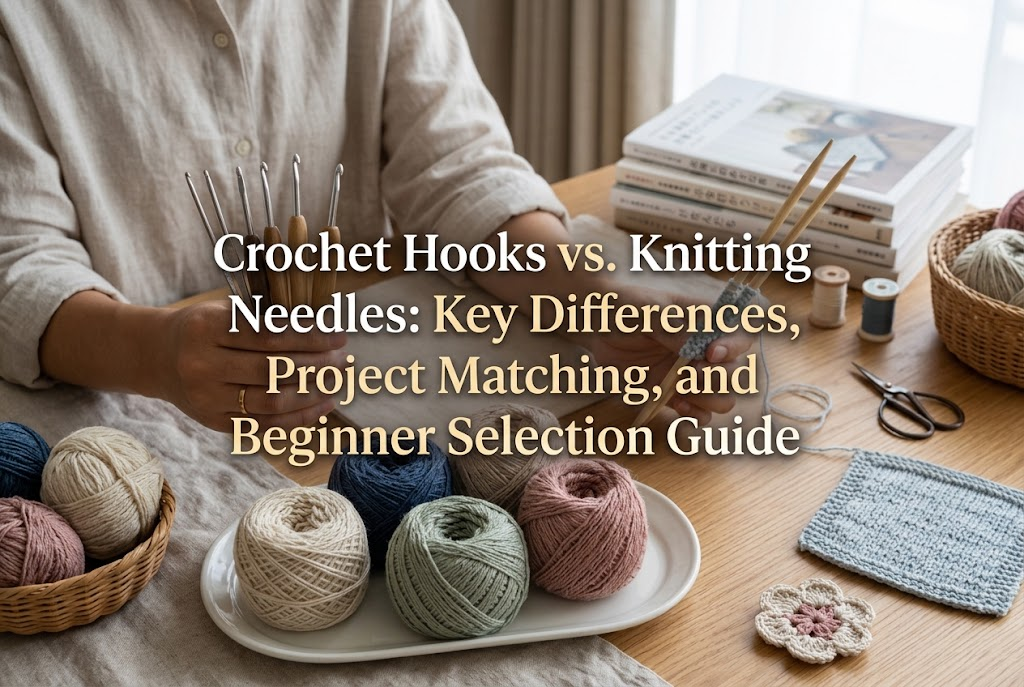
If you're looking to dive into yarn crafting, the very first question you likely face is: "Should I choose a crochet hook or knitting needles?" While these two tools look completely different and function in unique ways, failing to understand their distinct traits and the types of fabric they create can lead to choosing the wrong tool for your vision.
In this guide, I will walk you through their functions, fundamental mechanics, differences from similar tools, essential selection rules for beginners, and practical care tips to keep your tools in top condition for years. By the end of this article, you will know with 100% certainty which tool is right for the project you want to create.
When people think of working with yarn, crochet hooks and knitting needles immediately come to mind. Both create fabric from yarn, but their underlying mechanics and how they hold stitches are fundamentally different. Understanding this contrast is your very first step toward mastering yarn crafts.
A crochet hook is a slender rod made of materials such as metal or bamboo, featuring an indented groove called a "hook" at its tip. You hold this single tool in your dominant hand, hooking the working yarn looped over your non-dominant hand and pulling loops through previous stitches.
The defining characteristic of crochet is that you generally work with only one active loop on the hook at any given time. Because you don't need to hold an entire row of live stitches on the tool, your project won't unravel easily if you set it down mid-row, allowing you to craft comfortably in compact spaces.
A crochet hook consists of the tip (point), the hook, the throat (neck) that guides the yarn as you pull it through, the shaft (shank) that determines the stitch gauge, and the grip (handle) where your fingers rest. The diameter of the shaft directly regulates the size of your loops.
Knitting needles are straight, slender shafts with gently tapered points. They are typically used in pairs of two, or in sets of four to five double-pointed needles (DPNs). Unlike crochet hooks, they have no indents or hooks at the ends.
The core mechanic of knitting is that all active stitches across the row are held on the needle at the same time. An entire row of loops rests on the left needle, and you use the right needle to work fresh yarn through each stitch one by one, transferring newly formed loops onto the right needle.
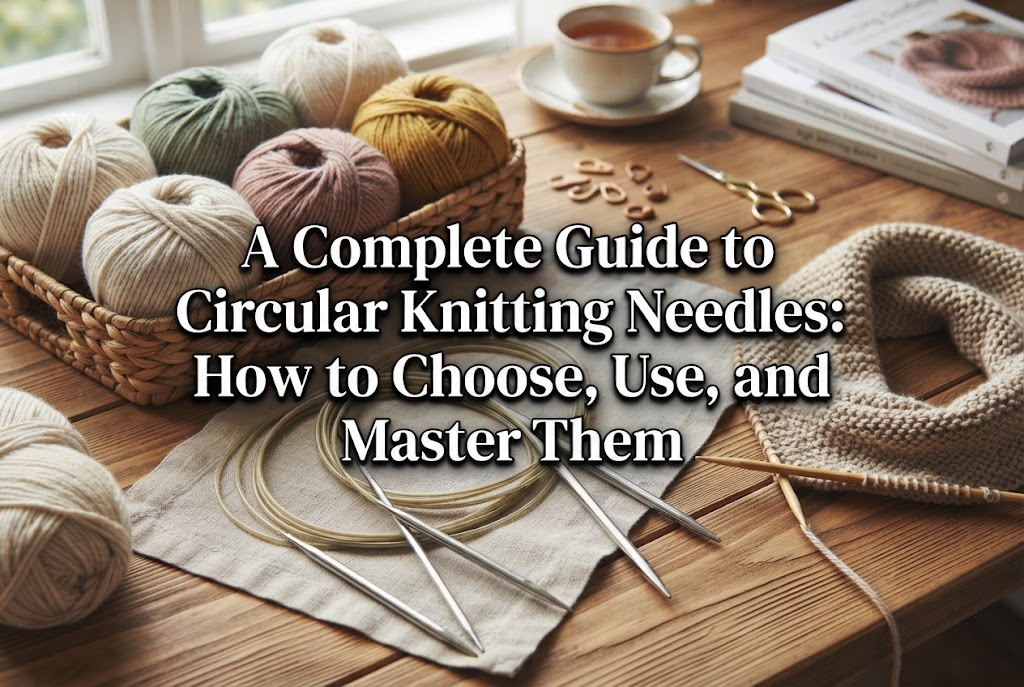
Beyond standard single-pointed straight needles, there are double-pointed needles (tapered at both ends) and circular needles (two needle tips joined by a flexible nylon cord). Because an entire network of loops is supported together on the needle shaft, knitted fabric naturally develops balanced, uniform stretch.
These structural differences directly shape the type of fabric each tool excels at producing. Your choice dictates the finished fabric's thickness, drape, elasticity, and overall design direction. Matching the tool to your desired finished object is an essential prerequisite for success.
Because crochet stitches interlock through intricate loops, crocheted fabric is dense, thick, and durable. It offers minimal stretch, resulting in a firm and sturdy structure.
These qualities make crochet ideal for three-dimensional shapes and accessories that must hold their form. If you want to create any of the following, a crochet hook is your best choice:
Crochet allows you to increase, decrease, and pivot around curves with immense flexibility, making it unmatched for freeform shapes and circular bases.
In contrast, knitted fabric is composed of supple, interconnected vertical and horizontal loops, giving it superior flexibility and stretch. It naturally creates lightweight, cozy, and airy fabrics that trap warmth effortlessly.
For garments that require stretch to fit comfortably, or items where a soft, fluid touch is essential, knitting needles are definitely the ideal option:
Classic knitting stitches like stockinette stitch and ribbing create a smooth, refined surface texture reminiscent of commercial knitwear—a look that cannot be replicated with a crochet hook.
Browsing craft tools can be bewildering when you encounter specialized implements with similar names or appearances. Here is how they differ from standard crochet hooks and knitting needles.
A lace crochet hook looks and functions identical to a regular crochet hook—it features a hooked tip and is used individually. The difference lies in the thread thickness it accommodates and its sizing convention.
Standard crochet hooks are meant for regular yarn, and the numbering usually increases with size (for example, in standard Japanese numbering, a No. 8 hook is thicker than a No. 2 hook). Lace hooks, made of durable steel, are designed for ultra-fine lace thread. In their sizing system, the higher the number, the thinner the tip (e.g., a No. 12 lace hook is vastly finer than a No. 0). They are reserved for delicate doilies, lace collars, and micro-crochet jewelry.
An Afghan hook (Tunisian crochet needle) looks like a hybrid between a knitting needle and a crochet hook. It features a long, straight shaft with a crochet hook at one end.
Used for Tunisian crochet (Afghan knitting), this craft involves picking up loops across an entire row and holding them all on the shaft like knitting, then working them off on the return pass like crochet. It produces a dense, woven-like fabric with minimal stretch, ideal for heavy jackets or structured bags. However, absolute beginners do not need to purchase this specialized tool right away.
A tapestry needle (darning needle, or toji-bari in Japanese) is not used to form stitches, but to assemble and finish your piece. Resembling an oversized sewing needle, it features a large eye and a blunt, rounded tip.
You use it to seam knitted or crocheted pieces together and to weave in loose yarn tails. The blunt tip ensures that you don't pierce or split the delicate plies of the yarn. A tapestry needle is an indispensable finishing tool for both crocheters and knitters alike.
When selecting your needles or hooks, material matters just as much as size. The friction between the tool and yarn influences your stitching tempo, hand strain, and stitch uniformity.
Bamboo is deeply rooted in traditional Japanese knitting tools, while various hardwoods are widely used globally. The defining trait of bamboo and wood is their gentle, natural friction. The yarn won't slip away unintentionally, preventing dropped stitches and accidental unraveling.
Furthermore, wood and bamboo feel warm in the hands and flex slightly under tension, reducing hand fatigue. For beginners who are not yet used to managing yarn tension, I strongly recommend starting with bamboo needles or hooks. They make yarn control significantly easier.
Metal tools—whether anodized aluminum, stainless steel, or brass—have exceptionally sleek, polished surfaces. Because friction is minimal, yarn slides rapidly across the needle.
This makes metal ideal for intermediate to advanced crafters who prefer a swift rhythm, as well as for high-friction fibers like 100% untreated wool or sticky acrylic yarns. However, because stitches glide so easily, beginners may find that loops slide off the ends by accident. Some crafters also notice a cool touch or a subtle clicking sound when metal tips touch.
Plastic and acrylic needles are lightweight and frequently available in bright, playful colors. They are most commonly used for jumbo sizes (10 mm and thicker).
If very thick needles were crafted from solid metal or dense wood, they would feel heavy and tire your wrists. Plastic keeps jumbo-gauge tools manageable. While thinner plastic needles can be prone to bending or snapping, jumbo plastic hooks and needles are perfect for quick home decor projects or chunky cowls worked with super bulky yarn.
Modern crochet hooks predominantly feature metal shafts set into molded elastomer or resin handles. Designed ergonomically, these soft grips conform to the natural curve of your fingers.
Compared to old-fashioned, flat metal hooks, ergonomic grips drastically reduce hand fatigue and cramping during marathon crafting sessions. If you are buying a crochet hook today, choosing a version with a cushioned ergonomic handle will make your crafting experience markedly more comfortable.
Facing a massive craft store display full of needle sizes can feel overwhelming. Follow these practical rules to make sure you get the right tool the first time.
Needle sizes vary widely. Choosing a tool in isolation just because it looks comfortable is a common mistake. Always choose your yarn first, then buy the corresponding needle.
Every ball of yarn has a label that indicates recommended tool sizes (e.g., "Crochet Hook: 5/0–6/0" or "Knitting Needles: US 6–8 / Japanese 6–8 gou"). Decide what project you want to make, pick your yarn, and purchase the exact size printed on that label. This is the absolute golden rule for balanced tension.
Full sets containing a dozen needle sizes can seem tempting online, but I advise beginners against buying a complete set at the start.
When you are learning, you will primarily use only two or three common medium-weight sizes (roughly suitable for DK to worsted yarn). Having a dozen unused sizes provides little value. Furthermore, budget-friendly bulk sets often suffer from rough seams or poor grip materials, causing frustration. You are much better off purchasing one or two high-quality, reliable tools individually from reputable makers.
As noted earlier, never compromise on handle ergonomics when choosing a crochet hook. Crafters typically hold their hooks in one of two ways: the "pencil grip" or the "knife grip."
A well-shaped, three-dimensional handle prevents slippage and stops you from gripping with unnecessary force, regardless of your holding style. Avoiding finger soreness keeps your creative momentum alive until your project is finished.
Once you own quality tools, caring for them properly preserves your yarn and keeps your stitches smooth.
One major pitfall in fiber crafts is the disparity between Japanese, US, UK, and metric sizing systems.
In Japan, knitting needle sizes use a unique numbering system called gou (号), where numbers increase with thickness (e.g., No. 1 = 2.4 mm, No. 5 = 3.6 mm, No. 10 = 5.1 mm). In international patterns, sizes are often given in metric millimeters (mm) or US sizes (e.g., US 7, US 8). Crochet hooks also feature nuances: in Japanese sizing, a "5/0 hook" corresponds to 3.0 mm, which is entirely different from a "5 mm hook." Whenever you are following a pattern from another region, always double-check the measurement in millimeters (mm) to ensure your tool matches the design.
Being natural materials, bamboo and wood react to fluctuations in moisture and temperature. Leaving them in direct sunlight or under the dry airflow of an air conditioner can cause warping or cracking. Excessive weight or bending pressure can also snap them.
After finishing a session, wipe your bamboo tools with a soft, dry cloth to remove natural oils and perspiration, then store them in a protective case in a well-ventilated, shaded spot. If you plan to store them long-term, applying a microscopic dab of natural beeswax polish will preserve the wood's suppleness and luster.
When you craft for hours, your hands naturally produce perspiration and oils. If left on the needle, this residue can build up, causing the yarn to drag and stick instead of gliding cleanly. In metal needles, oils can also trigger oxidation, dulling the finish.
If you notice the yarn snagging or dragging across the shaft, wipe the needle clean with a tightly wrung damp towel or a soft microfiber cloth (like a lens-cleaning cloth). Keeping the surface pristine and smooth is an essential habit for even, beautiful stitches.
Crochet hooks and knitting needles are not rivals competing for superiority—they are distinct partners chosen according to what you wish to create:
With this guideline in mind, choosing the right tool will never feel daunting again. Start by choosing one item you genuinely want to make, check its yarn band for the recommended gauge, and pick up that single tool. Feeling the comforting warmth of bamboo or the balanced weight of an ergonomic grip as each stitch forms beneath your hands is an incomparable joy.
Pick your trusted crafting companion, and enjoy every stitch of your handmade journey!
If you found this guide helpful, sharing it with your fellow makers would mean the world to me. See you in the next article! This was Yassy from Crafters!
For example, if you are looking for articles about mizuhiki, try searching for "mizuhiki"; if you are interested in tools, try keywords like "nippers" or "pliers."