Japanese Dollhouse Crafting: How to Make Perfect Walls and Floors Without Warping
yassy
Crafters!

Hello, this is Yassy from Crafters! (・∀・)
Building a dollhouse—crafting an adorable miniature world that fits in the palm of your hand—is such a thrilling creative process. Recreating your favorite interior styles or bringing your dream room to life in miniature scale never fails to spark the imagination.
However, when you visit a home center or craft store to pick out materials, do you ever find yourself overwhelmed? Many crafters face common stumbling blocks: "There are so many types of wood, which one should I pick?" "Which wood can actually be cut with a standard utility knife?" or "Why did my boards start warping halfway through the build?"
Choosing the right wood for a dollhouse affects far more than just its visual finish—it directly determines your ease of crafting, structural precision, and the project's overall durability. By simply selecting the appropriate wood for each specific part and purpose, cutting becomes drastically easier and assembly errors drop to almost zero.
In this guide, I will thoroughly explain the types of wood commonly used in dollhouse building, their unique characteristics, how to match the best wood to each part of the house, and the common pitfalls beginners should avoid. Read on, and you will never feel lost in the lumber aisle again!
When starting a dollhouse, do you ever grab random scraps lying around the house or pick up whichever lightweight wood you happen to spot at a 100-yen discount store? While using accessible materials is great, working without understanding the properties of the wood will quickly lead to frustrating obstacles.
First, it is vital to know that each type of wood has distinctly different characteristics when it comes to hardness, workability, resistance to warping, and surface smoothness.
For instance, if you choose wood that is too hard, a craft knife or utility blade will barely scratch the surface, and cutting straight lines even with a hand saw becomes an exhausting struggle. On the other hand, if you pick wood that is excessively soft, delicate components like miniature furniture legs can easily snap or dent under the slightest pressure.
Furthermore, because dollhouses are built to precise architectural scales such as 1/12 or 1/24, even a 1-millimeter distortion or slight curve in a board results in visible gaps and wobbles throughout the entire structure.
Selecting wood that is easy to cut, resistant to bending, and capable of holding exact dimensions—and tailoring that choice to each component—is the true secret to achieving a clean, professional finish.
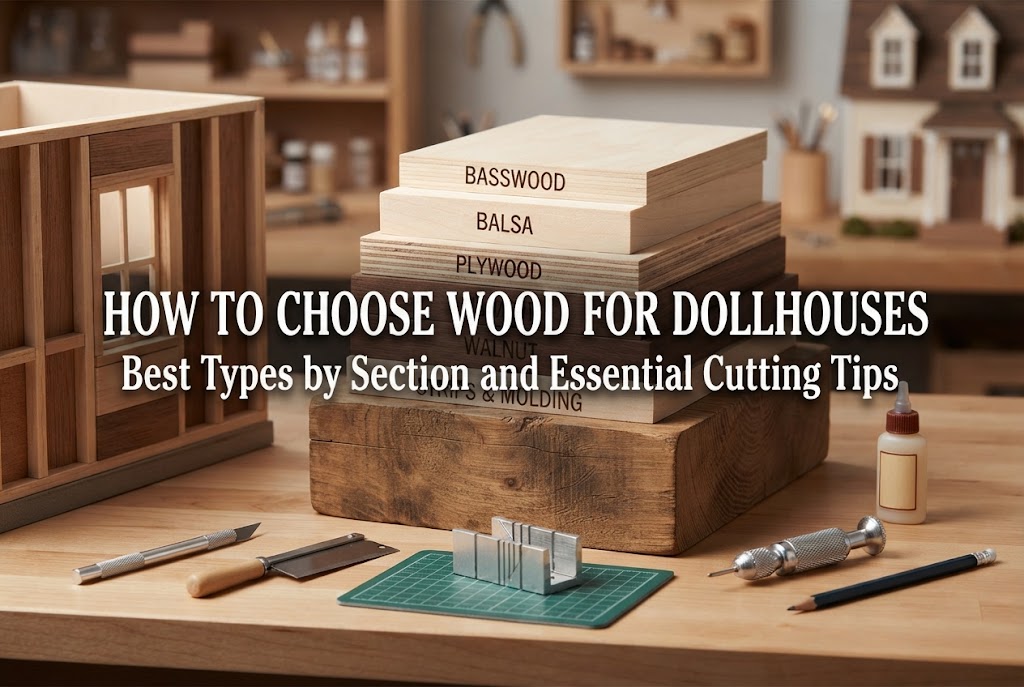
There are several staple woods trusted by miniature crafters. Let's look at the strengths and weaknesses of each.
Balsa is the lightest and softest wood available. Because a standard craft knife or utility knife glides through it without requiring heavy force, it is exceptionally friendly for beginners who do not own specialized woodworking tools.
It comes in a wide variety of shapes and sizes, from thin sheets to square strips and dowel rods.
However, that extreme softness comes with clear drawbacks. The surface can dent from a simple fingernail press, making it unsuitable for structural frames or areas supporting weight. Furthermore, cut edges tend to fray, meaning you must carefully sand the cut lines with fine-grit sandpaper to keep them tidy.
When building miniature furniture and detailed interior trim, hinoki (Japanese cypress) and agathis are the top contenders.
Hinoki is a beloved timber in Japan, famous for its tight, fine grain and an exquisite balance between strength and workability. In Japanese home centers and craft shops, it is widely stocked in craft sections as square and flat rectangular strips across various dimensions.
Agathis, sourced from Southeast Asia, features a subtle, inconspicuous grain with a remarkably uniform, smooth surface. It carves cleanly and resists chipping along corners even during intricate cuts, making it fantastic for fine furniture parts.
Both materials are harder than balsa. For thin pieces, you can cut them cleanly by scoring multiple times with a sharp craft knife; for thicker stock, a small fretsaw or fine-tooth craft saw yields the best results.
MDF is an engineered wood panel made by breaking down wood residues into fine fibers, combining them with adhesive, and hot-pressing them into rigid boards. Its defining feature is the total absence of natural wood grain.
While natural lumber inherently warps or twists with changes in ambient humidity and temperature, MDF has no grain direction and virtually never warps. As a result, it provides exceptional performance for large, flat surfaces such as floors, exterior walls, and room dividers.
Its ultra-smooth surface also accepts paints evenly and allows wallpapers to adhere cleanly without unsightly bubbling or creasing.
Keep in mind that MDF is dense and heavy, meaning cutting it with a utility knife requires substantial effort and multiple passes. Additionally, it is vulnerable to moisture; excessive water can cause it to swell permanently, so avoid applying heavy amounts of water-based paint in a single coat.
Shina plywood is an engineered sheet composed of cross-laminated wood veneers faced with clean, pale Japanese basswood (shina).
Thanks to the alternating cross-grain structure of plywood, it resists snapping and offers tremendous strength even in slim profiles. Sheets between 2 mm and 4 mm thick are invaluable for dollhouse room shells, baseboards, and the back panels of larger furniture pieces.
The outer shina veneer features a creamy, fine-textured grain that takes wood stains and clear finishes gorgeously. Just be sure to use a sharp blade when cutting to prevent the layered plies from splintering along the edges.
American basswood is widely regarded in Western miniature making as the premier standard wood. Possessing a balanced softness and uniform grain, it carves smoothly under a knife blade and is universally favored for high-end miniature furniture. It is also carried in specialty Japanese craft shops.
Meanwhile, kiri (paulownia wood)—frequently found in Japanese 100-yen craft aisles—is lightweight and very easy to cut. However, its prominent, distinctly coarse grain can clash with Western interior styles, and its soft surface dents easily. You need to pick the right place to use it.
The key to success in dollhouse construction is avoiding the temptation to build everything out of a single wood type. Instead, mix and match materials according to the structural demands of each part.
Here is my recommended combination strategy that I personally follow in my builds:
For the core structural foundation, I strongly recommend MDF or shina plywood (4 mm to 6 mm thick).
If your walls or floors warp mid-project, roofs will fail to sit level, and joints will develop gaps that leave the entire structure rickety. Building the structural shell from warp-resistant MDF or rigid shina plywood creates a solid, stable foundation that will not budge.
For architectural trim that defines the room's character—such as window sashes, doors, baseboards, and decorative moldings—slender square and rectangular strips of hinoki, agathis, or thin basswood (1 mm to 2 mm thick) are ideal.
These elements make a miniature look dramatically sharper when their edges are crisp and straight. Close-grained hinoki and agathis hold sharp corners without snapping easily, even when sliced down to narrow strips.
When crafting miniature furniture, divide your materials according to each component's thickness and mechanical role.
For slender parts requiring structural strength, such as table legs and chair backrests, use hinoki strips or agathis. For broader planes where you want smooth edges and clean shaping, such as tabletop panels or shelf sides, combine them with basswood or thin hinoki boards.
If you want to quickly build furniture using only a craft knife, incorporating balsa is fine for select sections. To ensure longevity, reserve balsa for zero-stress areas such as internal drawer boxes or back panels.
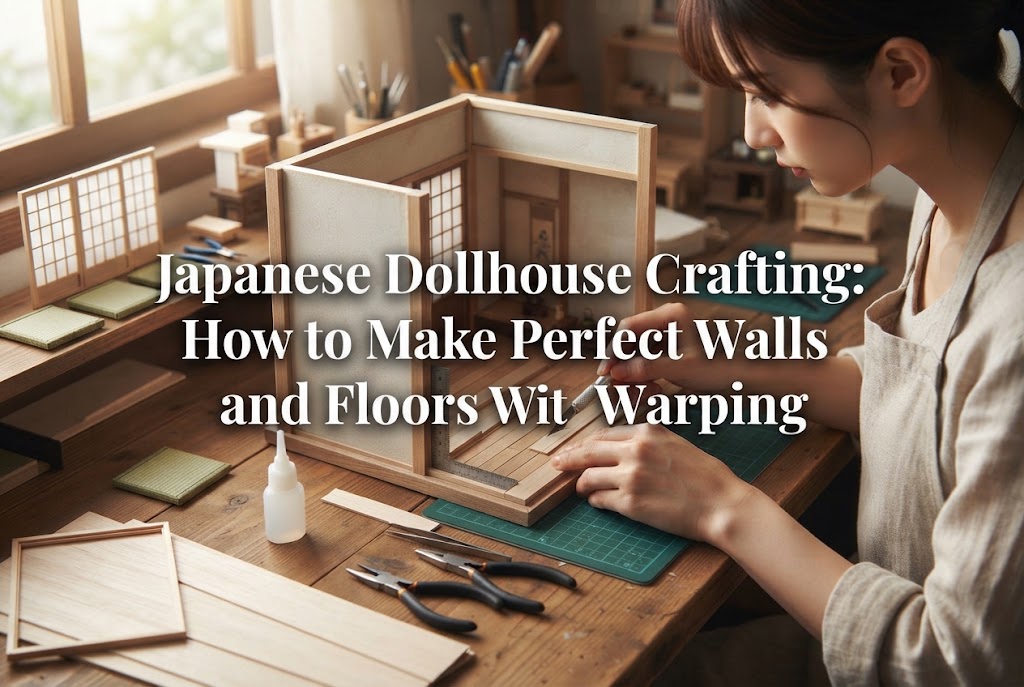
To create realistic wood plank flooring, cut thin agathis, hinoki boards (around 1 mm thick), or thin veneer strips into narrow floorboards and lay them side by side.
Layering thin wood strips onto a rigid subfloor base (such as an MDF foundation) creates realistic depth and tactile texture identical to genuine architectural plank floors.
Here are typical mistakes novice dollhouse builders make when choosing lumber, along with practical solutions for each.
The most widespread mistake among beginners is picking wood that is too thick for the scale.
For example, if you are building in standard 1/12 scale and a real-world dining tabletop is 2 cm (20 mm) thick, the accurate miniature thickness is calculated as: 20 mm ÷ 12 ≈ 1.6 mm.
If you build that tabletop out of a 5 mm board simply because it was easy to handle, that translates to a massive 6-centimeter-thick slab in real life! The proportions will look heavy and unconvincing, immediately revealing amateur construction.
Solution: Always keep your target scale (such as 1/12 or 1/24) in mind. Divide real furniture and architectural dimensions by your scale ratio, and purchase wood sized to precise millimeter increments (such as 1 mm, 1.5 mm, or 2 mm) beforehand.
Home centers carry affordable dimensional lumber like SPF (2x4s), cedar (sugi), and pine (matsu). Avoid bringing these home for dollhouse projects.
General construction lumber is heavy, features coarse grain, and is far too dense. Slicing tiny parts with manual craft tools will bind your saw blades, split the grain, and cause wood to tear. Sticky resin (sap) can also seep through, repelling miniature paints and finishes.
Solution: When shopping at home centers, skip the general construction lumber department and head straight to the dedicated craft timber or hobby woodworking section.
Even among identical products of natural wood like hinoki or balsa, each piece is unique. Depending on storage conditions and humidity, individual boards on display shelves may already be bowed or twisted.
Trying to construct a square room or box out of warped lumber means corners will never align squarely. Even if forced together with glue, the built-in tension can eventually cause joints to pop apart.
Solution: Before purchasing, lay the board down on a flat surface to check for rocking, or hold it up to eye level and sight down its length to confirm it is truly straight.
Another frequent issue is boards curling as soon as paint is applied, or adhesives failing to bond properly.
Thin plywood and balsa have a strong tendency to absorb moisture unevenly. If you apply a heavy coat of water-based acrylic paint to only one side, the damp fibers expand, causing the board to bow severely as it dries.
Solution: When painting thin wood with water-based colors, coat the reverse side as well to balance moisture uptake, or use moisture-free oil stains. Pre-sanding and staining individual parts before final assembly is another reliable rule of thumb.
Where should you shop, and what should you inspect before paying? Here is my practical buying checklist.
When selecting wood in a physical store, inspect each piece using these three criteria:
Taking a few extra seconds for this inspection will make your building sessions significantly smoother!
If you are thinking, "There are still too many options to choose from!" here is my foolproof beginner combination formula.
If you are taking on your first miniature room box or dollhouse vignette, gather these three materials:
By pairing these three, you achieve a rock-solid, warp-free room shell while keeping decorative parts easy to cut with a simple craft knife!
For adhesives, standard PVA wood glue, fast-drying wood craft glue, or high-strength multi-surface craft adhesives work perfectly to lock your build together.
While all craft wood may look similar at first glance, understanding each material's distinct strengths—the effortless cutting of balsa, the stable, warp-free rigidity of MDF, and the crisp, beautiful grain of hinoki and agathis—makes choosing materials a joy.
Matching the right wood to each specific miniature component eliminates cutting frustrations and rewards you with crisp, clean joints that look breathtaking upon assembly.
Pick up your favorite wood, and enjoy bringing your very own miniature world to life!
If you enjoyed this guide, sharing it with your fellow crafting friends on social media is always deeply appreciated and keeps me inspired!
See you in the next article! This was Yassy from Crafters!

For example, if you are looking for articles about mizuhiki, try searching for "mizuhiki"; if you are interested in tools, try keywords like "nippers" or "pliers."
