Japanese Glass Fusing for Beginners: Top 3 First Projects & Success Tips
yassy
Crafters!

Hello, this is Yassy from Crafters! (・∀・)
With its vibrant colors, beautiful transparency, and smooth, glossy texture, glass fusing is a truly captivating craft. Many of you might be interested in this technique, where glass pieces are melted and joined together using an electric kiln. The sheer variety of items you can make—from accessories and small dishes to chopstick rests—is one of its biggest appeals.
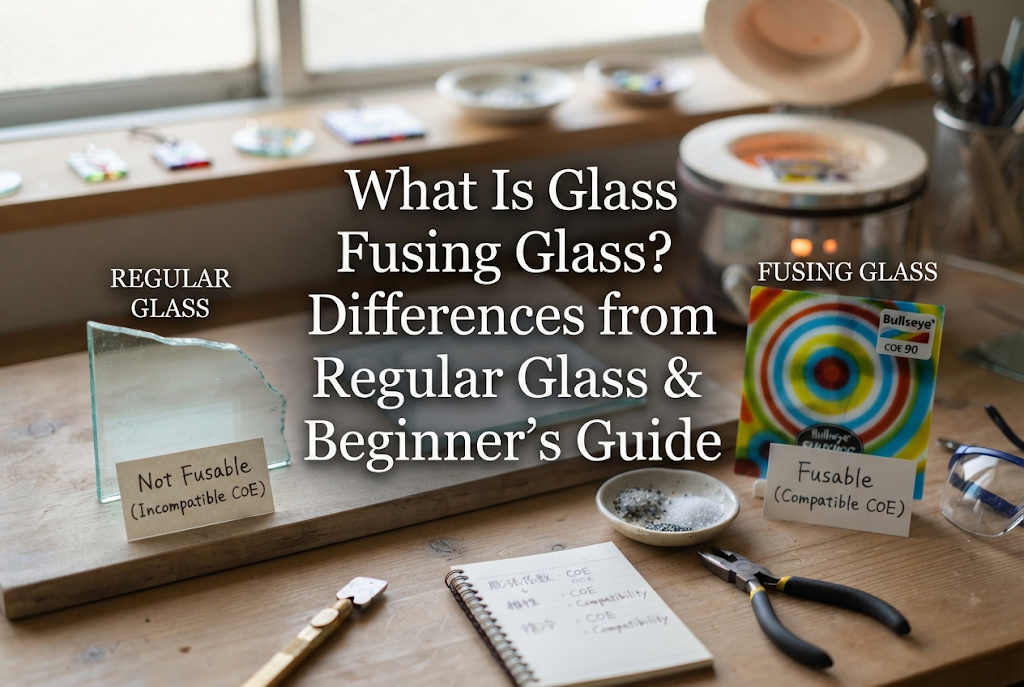
However, when beginners think, "I want to try glass fusing!" they almost always run into the exact same initial question: "What is the difference between glass fusing glass and regular glass?"
It's very common to wonder, "Can't I just melt empty bottles around the house, glass tiles from the 100-yen store, or sheet glass meant for stained glass?" Actually, if you don't correctly understand the types of glass used in glass fusing, it can lead to a fatal failure where your finished piece suddenly shatters into tiny fragments after cooling down.
In this article, I will explain the basic characteristics of glass fusing glass, how it differs from regular glass, the crucial mechanism of COE (Coefficient of Expansion), and the various shapes and selection methods for fusible glass. I've packed this guide with essential tips so you can enjoy creating safely and successfully, so please read through to the end!
As the name suggests, glass fusing glass is a specialized glass material specifically manufactured to be heated in an electric kiln so that pieces melt and join together (fusing).
There are countless glass products in our daily lives—window glass, tableware, beverage bottles, and stained glass. However, even if you combine those glasses at random and put them into a kiln, you cannot create a beautiful, durable piece. Glass made specifically for fusing undergoes a special manufacturing process designed to withstand the heating and cooling cycle.
The primary reason dedicated fusing glass is necessary is to perfectly match the rate at which glass expands and contracts during heating and cooling. Glass expands with temperature and contracts as it cools on a level invisible to the naked eye. Because dedicated fusing glass has its contraction rate strictly controlled during production, you can layer and fuse different colors of glass together without them cracking upon cooling.
Furthermore, the chemical composition of fusing glass is adjusted so that it maintains its brilliant transparency and gloss without discoloring, even when exposed to high temperatures around 800°C (1472°F). Fusing glass is a special material scientifically calculated for hot glass crafts.
Let's dive deeper into the common question: "Why can't I use everyday glass?" by comparing fusing glass with regular glass and stained glass.
Window glass and glass bottles are made from common soda-lime glass. Because these are manufactured to be used at room temperature as containers or building materials, they are not designed to be melted and joined with other glasses.
If you only melt fragments of window glass with other window glass of the exact same batch, or bottles of the exact same type, you might be able to melt and reshape it as a single material. However, if you mix bottles from different manufacturers or combine different glass types, each piece will cool and shrink at a different rate. This creates intense internal tension (stress) as they pull against each other while cooling. As a result, right after taking it out of the kiln—or even several days later—the piece will crack with a sharp ping and shatter on its own.
Additionally, when soda-lime glass is heated to high temperatures, it has a tendency to turn cloudy or develop a dull, rough surface through devitrification. It is simply not suitable for making pieces where clear transparency and shine are desired.
You also need to be careful with sheet glass sold at craft stores labeled for "stained glass." Stained glass is a technique where glass is cut and joined physically using copper foil and solder or lead cames. Because the glass pieces are not melted together, there is no need to align their expansion and contraction rates under heat.
Because of this, most stained glass sheets do not have controlled expansion rates and will crack if fused in a kiln. While "dual-purpose glass" suitable for both stained glass and fusing is widely available today, as a golden rule, you should avoid melting any stained glass that isn't explicitly marked as "Fusible" or "Fusing Compatible."
The single most important concept you cannot skip when learning glass fusing is COE. Understanding this system is an absolute requirement for making crack-free work.
COE stands for Coefficient of Expansion. Simply put, it is a numerical value indicating how much a specific glass expands and contracts with a 1-degree change in temperature.
Glass expands when heated and contracts when cooled. Glass with a higher COE number expands and contracts more drastically, while glass with a lower COE number experiences a smaller range of expansion and contraction.
What happens if you stack two pieces of glass with different COEs and melt them together in a kiln? Inside the hot kiln, they will melt smoothly and bond as one. However, a major issue arises as they cool and solidify. One piece tries to shrink significantly while the other shrinks much less, causing immense pulling forces (thermal stress) to concentrate at the seam where they joined. Even if invisible to the eye, severe internal strain remains, and eventually, the glass cannot withstand the force and breaks.
The absolute golden rule in glass fusing is "Only combine glass with the exact same COE." No matter how pretty two colors look together, you must never melt glass of different COEs together.
In handmade glass fusing, the following standards are most widely distributed:
For example, you can never place a COE 96 millefiori piece onto a COE 90 base glass and fire them together. To make durable creations that won't crack, you must decide whether to build your materials around COE 90 or COE 96 and manage them strictly.
The fun of glass fusing doesn't stop at cutting and arranging flat sheets of glass. Dedicated glass comes in various shapes and forms. Combining them freely allows you to enjoy painterly expressions, delicate details, and three-dimensional designs!
This is the flat base glass for almost all projects. You can cut it to your desired size to use as a foundational base, or cut small shapes out of it to layer as patterns. Beyond the standard thickness of approximately 3mm (1/8 inch), there is also thin sheet glass (approx. 2mm) which is excellent for layering without getting too thick.
Types of colors are varied, including transparent (clear and colored see-through glass), opal (opaque glass that light doesn't pass through), and streaky (glass with two or more colors mixed in swirls).
Frit is glass crushed into granular forms. Depending on the grain size, it is categorized into coarse, medium, fine, and powder.
By sprinkling frit over sheet glass before firing, you can create polka dots, soft color gradients, or unique frosted-glass textures. Fine powder frit can even be applied over stencils to print crisp patterns like screen printing.
Thin, spaghetti-like cylindrical glass rods are called stringers, while flat, ribbon-like glass strips resembling wide noodles are called noodles.
Since you can snap them easily with your hands to any length, they are ideal for drawing geometric straight lines, lattice patterns, or lettering. They save you the trouble of cutting thin strips from sheet glass with a glass cutter, making them super helpful items for beginners.
Meaning "a thousand flowers" in Italian, millefiori are small glass cross-sections featuring flower patterns or geometric designs, created like sliceable pattern rolls.
Simply popping a few millefiori pieces on top of a base glass and firing it creates adorable accessories or small items that look like a field of flowers in full bloom. Because it easily yields high-quality results, it is overwhelmingly popular among beginners. Just make sure to buy millefiori with the exact same COE as your base sheet glass!
Dichroic glass features a micro-thin coating of special metallic oxides on its surface. Depending on the viewing angle and light reflection, it displays a brilliant, iridescent metallic shimmer.
While more expensive than regular glass, simply cutting a tiny piece and embedding it as an accent adds an overwhelming gem-like luxury to your work. It is an indispensable material for jewelry making, such as pendant tops and rings.
As you begin gathering fusing glass materials, there are a few points that easily confuse beginners. Knowing these in advance will save you from unnecessary repurchases and mistakes.
Among fusing glasses, there is a category called "Strikers." These are glasses that achieve their target color only after being heated in the kiln.
For instance, a sheet glass that looks pale yellow or murky white when it arrives at your workshop may transform dramatically into a vibrant red or deep orange after firing. This phenomenon is common in glasses containing metal elements such as gold, copper, or cadmium.
It's easy to panic thinking, "They sent me the wrong color!" But if the product code or description says "Striker," you're completely fine! It is best to check post-firing color samples beforehand and do a small test fire with scrap pieces before using it on your main project.
A question I often get is: "If both are labeled COE 96, can I mix glass from Brand A and Brand B?"
In short, as long as they are brands guaranteed to be compatible for fusing under the same COE standard, you can generally fire them together. For example, current Oceanside glass is specifically designed to be compatible with older Spectrum and Uroboros COE 96 glass.
However, different manufacturers may have subtle differences in glass viscosity (how soft it gets when melted) or softening temperature. Sometimes edges pull slightly differently or specific color combinations react with each other. If you want absolute peace of mind, unifying your supplies within a single manufacturer's same COE series is the safest path.
The metallic ingredients used to color glass can sometimes react chemically with each other under heat. A famous example is combining sulfur-bearing glasses (mainly yellows, oranges, and reds) with copper-bearing glasses (mainly blues and greens).
If you place these two types next to each other or layer them, a distinct black or brown reaction line can form right along the boundary where they touch. Advanced crafters sometimes intentionally use this for artistic line designs, but if you do it unintentionally, you might be shocked when your smooth gradient turns out scorched-looking at the border!
As you continue glass fusing, cut scraps and small pieces will quickly pile up on your workbench. The scariest hazard here is a COE mix-up accident.
It is virtually impossible to tell whether a piece of clear or white glass is COE 90 or COE 96 just by looking at it. If a tiny stray scrap of a different COE accidentally gets mixed into your project, that single fragment can cause the entire piece to crack and be ruined.
To prevent this trouble, I strongly recommend sticking to these storage and organization rules:
Glass fusing is a wonderful craft, but it involves sharp materials and electric kilns that reach temperatures close to 800°C (1472°F). Please follow basic safety measures so you can enjoy your crafting journey safely.
When cutting glass, tiny, invisible glass dust and chips can fly into the air. Always wear safety glasses to protect your eyes. Also, to prevent cutting your fingertips on sharp edges, wear gloves or handle cut edges gently without applying excessive force.
When operating an electric kiln, always place it in a well-ventilated area and read the manufacturer's instruction manual thoroughly to follow correct operating steps. Never place the kiln near flammable objects, adhere to maximum temperature and heating rate limits, and never touch the kiln with bare hands immediately after firing.
For those thinking, "There are so many glass types that I don't know what to buy first!" here is my practical advice on how I would gather materials if I were starting glass fusing from scratch today.
I would start by choosing a "Fusible Glass Assortment Pack" unified under either COE 90 or COE 96.
If you buy large individual glass sheets right at the beginning, it gets expensive quickly and limits your color variety. Assortment packs sold at online craft shops offer multiple palm-sized sheet glasses in various colors, letting you try out different shades little by little.
Here is my recommended priority order for gathering materials:
Starting with this simple combination to fire small items like chopstick rests, earrings, or pendant tops is highly recommended. Once you experience the thrilling magic of glass melting together into smooth, rounded art under heat, you will definitely fall in love with the depth of glass fusing!
In this guide, we covered the fundamental role of fusing glass, how it differs from ordinary everyday glass, and the COE mechanics required to avoid cracks.
Glass fusing glass is a dependable material engineered to handle thermal expansion and contraction, ensuring clear, beautiful shine and color even after high-temperature firing. As long as you strictly follow the core rule—never mix regular glass or different COE standards—you can prevent cracks and fractures with surprising consistency!
By combining sheet glass with frits, stringers, and charming millefiori, your creative expression becomes infinite. Grab a beginner-friendly glass set today and start enjoying the brilliant world of creating your very own glass art!
If you enjoyed this article, sharing it with your friends on social media or messaging apps would make my day and keep me inspired!
See you in the next article! This was Yassy from Crafters!

For example, if you are looking for articles about mizuhiki, try searching for "mizuhiki"; if you are interested in tools, try keywords like "nippers" or "pliers."
