Why Dried and Pressed Flowers Fade: The Science of Color Loss and How to Preserve Vivid Hues
yassy
Crafters!

Hello everyone! It’s Yassy from Crafters! (・∀・)
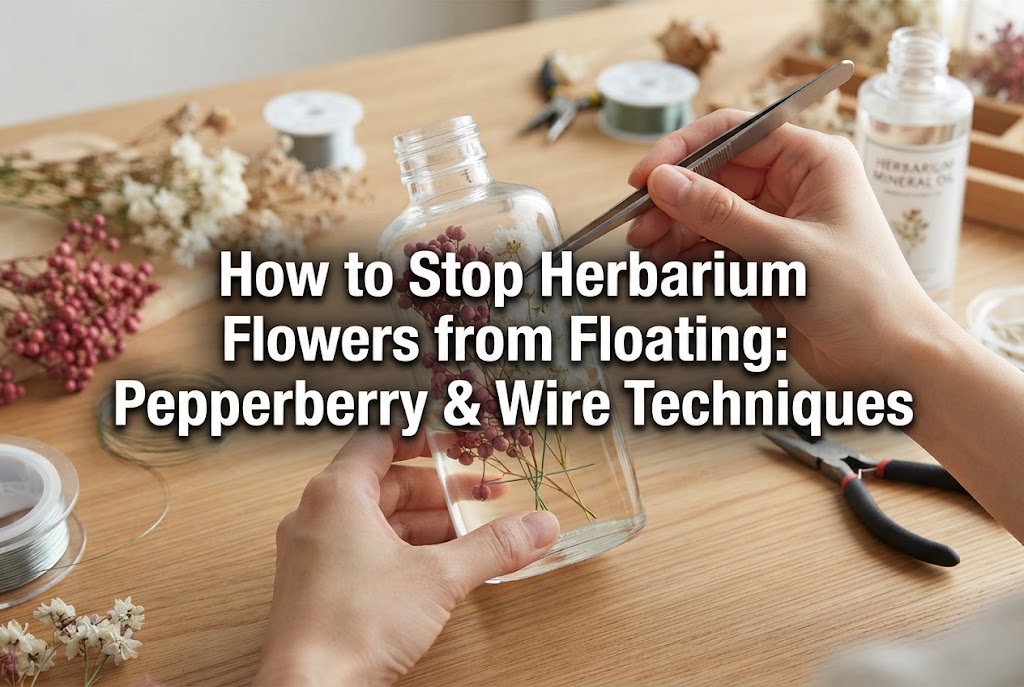
Creating herbariums by sealing beautiful blossoms inside glass bottles is such a rewarding craft! But have you ever spent time meticulously arranging dried or preserved flowers, only to watch them float away and ruin your design the second you pour in the oil? It can be so frustrating!
In fact, floating flowers is easily the number one obstacle that almost every beginner herbarium maker faces. No matter how much you try to push them back down with tweezers, they shift out of place once the liquid fills the bottle. The issue isn't a lack of design sense—it's simply a matter of understanding physical mechanics and clever anchoring techniques.
In this article, I’ll break down the mechanism of why flowers float in herbarium oil and share two pro-level positioning methods: natural anchoring using pepperberries and hidden wirework tricks that keep your design firmly locked in place without ruining its organic look. Let’s dive into these techniques so you can create stunning, long-lasting herbariums with confidence!
Before jumping into techniques, let's understand the root cause of why flowers float. Once you know the "why," you can design your arrangements while calculating for buoyancy from the start.
When flowers are dried or preserved, their moisture evaporates, leaving behind tiny hollow cavities inside. Unseen air pockets remain trapped within layered petals, hollow stems, and tight calyxes.
Herbarium oils are slightly lighter than water (with a specific gravity of around 0.92 to 0.96) and possess viscosity. When lightweight, air-filled botanicals are submerged in this viscous oil, strong buoyant forces push them upward.
Herbarium crafts primarily use two types of liquid: mineral oil and silicone oil. Both have a thick, syrup-like consistency. If you pour oil into the bottle too quickly, the liquid current sweeps up the delicate botanicals, causing them to drift or float completely out of place.
Not all flowers behave the same way in oil. Botanicals vary greatly in buoyancy depending on their physical properties:
If you build a design using only buoyant materials, all your flowers will gather at the top of the bottle, leaving the lower half looking empty and sparse.
To prevent floating, you need to create internal structures inside the glass bottle that keep flowers fixed in place. Professional crafters rely on a combination of these three structural approaches:
Let's look at how to use pepperberries as a natural stopper. Pepperberries are popular for their cute pink or green berries, but in herbarium making, they double as one of the most effective structural anchoring materials available!
Pepperberries excel at positioning because of their unique physical shape and flexible, resilient branching:
When securing lightweight main flowers (such as strawflowers or miniature roses), here is the step-by-step method I use:
Step 1: Cut branches leaving Y-forks.Don't pluck individual berries! Always cut stem pieces that retain a branched "Y" shape. This fork is crucial for creating your anchor point.
Step 2: Create a tension bridge in the bottle.After placing your main flower inside, slide a pepperberry branch directly above it. Using tweezers, gently press the branch ends against the glass walls. The stem's natural elasticity will hold it firmly in place.
Step 3: Tuck the main flower's stem or calyx into the berries.Slightly intertwine the base of your main flower into the dense berry cluster. If the lower flower tries to float, the cluster above blocks its path.
When pepperberries alone aren't enough, or if they don't fit your design aesthetic, wirework is your ultimate secret weapon.
Beginners often worry that using wire will look messy or noticeable, but choosing the right wire gauge and applying clever camouflage tricks renders wire completely invisible in oil!
Selecting the right wire gauge (thickness) and coating makes all the difference:
Technique A: The Twisting Method (Stem Extension & Spring Base)Wrap wire around the calyx of short-stemmed flowers (like Helichrysum heads) and extend the wire downward like a stem. Bend the bottom end into a small "S" shape or spiral. This springy base hooks into neighboring flowers or rests against the bottom, keeping the flower from rising.
Technique B: The Loop Anchor Method (Wall Tension)Form a small loop in the middle of a wire segment and extend both ends outward. Attach your flower to the center loop, then trim the outer wire ends so they are slightly wider than the bottle’s inner diameter. When inserted, the wire flexes against the glass, letting the flower hover mid-air exactly where you want it.
Technique C: The Joint Method (Pairing Heavy & Light Botanicals)Bind floating flowers directly to heavier botanicals or wooden stems out of sight. For instance, wire a strawflower to a cinnamon stick or a thick dried stem placed behind it to neutralize its buoyancy.
Beyond pepperberries and wire, here are other versatile botanicals that serve as natural stoppers:
Preserved hydrangea is a staple in herbarium making. Its intricate, interlocking petals act as both a buffer to prevent top flowers from floating and a cushion to support bottom layers.
Sliced dried oranges or limes fit snugly across bottle diameters. Placing a citrus slice vertically or diagonally creates a divider that blocks lower elements from drifting upward.
The fine, branched structure of baby's breath acts like hook-and-loop fasteners. Wrapping it around main flowers locks the entire arrangement together seamlessly.
Different bottle shapes present different challenges. Here is how I approach arrangements depending on the vessel shape:
Smooth inner walls make cylindrical bottles slippery and trickier to work with.My Approach: Use the "bottom-up stacking method." Place firm hydrangeas or seed pods at the base, lean pepperberry branches against them, interlock main stems as you build upward, and top off with a small pepperberry branch as an "anchor cap."
Square bottles feature distinct corners, making them easier to anchor into than round bottles.My Approach: Leverage the four corners! Bend wired stem bases into L-shapes and tuck them directly into corners. Hook pepperberry branches diagonally across corners to hold wide central spaces clear while securing floating elements.
Creating designs where flowers appear to float effortlessly in mid-air without filling the whole bottle requires precision.My Approach: Always use the "Loop Anchor Method" with delicate #28 silver wire. Adjust the wire length to match the inner bottle width so the flower stays suspended effortlessly without any filler underneath.
Even the strongest anchoring setup can unravel if oil is poured carelessly. Follow these golden rules when filling your bottle:
Q1: When I poured the oil, everything floated up to the top at once!Cause: Not enough material density, or lower anchors failed to catch.Solution: Don't panic! Grab long herbarium tweezers. Insert a branched pepperberry piece or a small wired hydrangea cluster, sliding it above the floated flowers to act as a "lid" against the glass wall.
Q2: My flower flipped upside down inside the oil!Cause: Top-heavy balance.Solution: Attach a small piece of wire or a dense pepperberry cluster to the base or calyx of the flower to shift its center of gravity downward.
Q3: Will wire rust or discolor inside the herbarium oil?Cause: Moisture inside flowers or poor wire quality.Solution: Herbarium oils (mineral and silicone) contain no water, so wire will not rust on its own. However, if using homemade, incompletely dried flowers, internal moisture can affect metals. Using completely dry botanicals and floral craft wire ensures rust-free results!
Floating flowers might be the most common frustration in herbarium crafting, but mastering pepperberry anchoring and hidden wirework techniques changes everything!
By understanding how buoyancy works and applying these structural hacks, you can craft professional-grade herbariums where every flower stays exactly where you intended.
It might take a little practice to get used to wire gauges and branch tension, but soon it will become second nature. Give these techniques a try on your next botanical creation!
If you found this guide helpful, please share it with your fellow crafters on social media! See you in the next article—Yassy out! (・∀・)

For example, if you are looking for articles about mizuhiki, try searching for "mizuhiki"; if you are interested in tools, try keywords like "nippers" or "pliers."
