Why Dried and Pressed Flowers Fade: The Science of Color Loss and How to Preserve Vivid Hues
yassy
Crafters!

Hello, this is Yassy from Crafters! (・∀・)
Herbarium crafts—capturing fresh, vibrant botanicals inside clear glass bottles—remain exceptionally popular as home interior accents and thoughtful handmade gifts. The greatest charm of this craft is simply pouring a specialized preserving oil over botanical elements, allowing you to enjoy the vivid colors and delicate textures of flowers for an extended period.
However, when crafters visit craft supply shops or browse online, they often find multiple options labeled "Mineral Oil (Liquid Paraffin)" and "Silicone Oil." It is very common to wonder which one to choose.
Thinking, "It's just clear oil, so any cheap option will do," can lead to disappointing results: flower dyes bleeding out into the liquid over time, or the oil turning milky and cloudy during the winter months.
In this guide, I will explain the essential types of herbarium oils, their specific properties, and how to choose the right one to elevate your creations. I will also cover common beginner mistakes and safety tips, so you can craft with confidence!
First, let's look at why specialized oil is necessary for making a herbarium.
The primary purpose of herbarium oil is to protect dried flowers and preserved flowers from oxidation and ambient moisture, maintaining their beauty over time. By sealing the botanical materials away from the air, the oil prevents degradation and dust accumulation.
Additionally, the liquid provides a crucial optical effect: light reflection and refraction. Because specialized herbarium oil has a higher refractive index than water or air, light passes through the flowers smoothly, producing a bright, luminous, and crystal-clear appearance far beyond that of standard dry arrangements.
You cannot simply use water. Even fully dried botanical materials will quickly rot or develop mold if placed in water. Therefore, highly refined, non-water-soluble dedicated oils are strictly required.
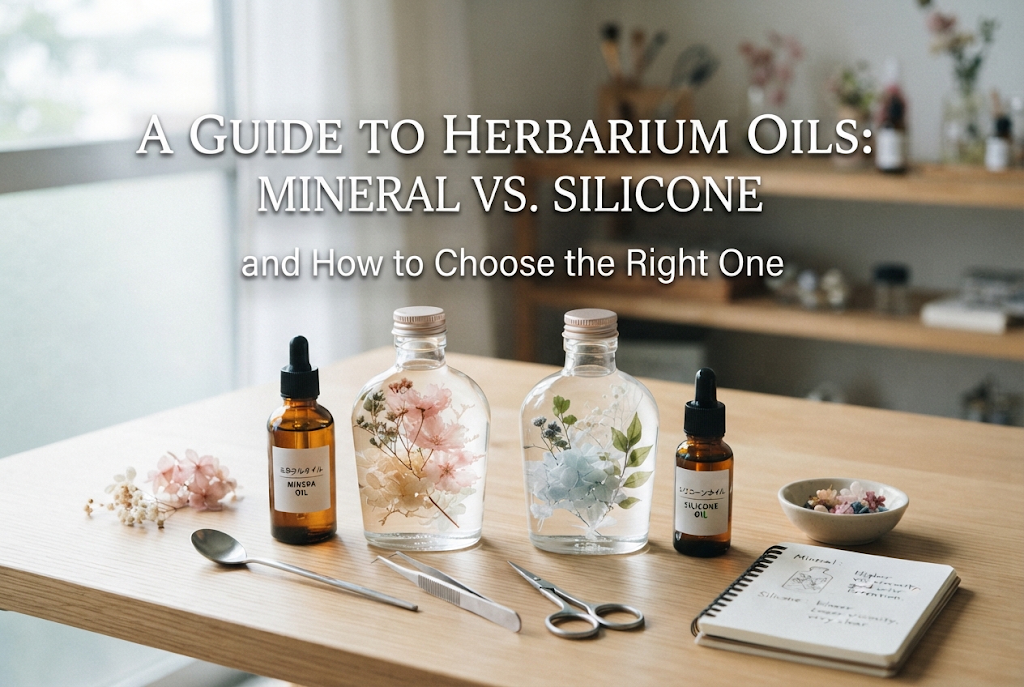
The two primary dedicated oils used in the handmade crafting scene today are mineral oil (liquid paraffin) and silicone oil. While both appear completely colorless and transparent, their chemical makeup and performance characteristics differ significantly.
Mineral oil is a highly refined mineral-based oil derived from petroleum. Also called liquid paraffin, it is renowned for its safety and is widely used as a base for baby oils, cosmetics, and medical ointments.
Its greatest advantages are its relatively affordable price point, wide availability, and high refractive index, which makes floral arrangements look radiant, crisp, and vibrant. Because its refractive index is very close to glass, it sparkles beautifully when catching natural light.
It also has a slightly lower specific gravity than silicone oil, which makes floral elements somewhat less prone to floating up. For beginners looking to easily enjoy herbarium making, mineral oil is often the primary candidate.
However, note that mineral oil tends to turn cloudy or solidify when the temperature drops to around -10°C (14°F). If you live in a cold region or plan to ship creations during winter, this is an important factor to consider.
Silicone oil is a synthetic oil chemically derived from silica (silicon). It offers exceptionally high safety alongside remarkable stability against heat and light.
Its biggest strength is that it causes very little pigment bleeding (color leaching) from flowers. It also boasts outstanding resistance to both high and low temperatures, retaining crystal clarity even in extreme cold down to -50°C (-58°F).
Because it minimizes color transfer and fading, silicone oil is the safer choice when working with dyed preserved flowers that bleed easily, such as helichrysum or dyed roses. It is strongly recommended for long-term display and pieces made for sale.
The main drawbacks are its higher cost compared to mineral oil and a slightly higher specific gravity, which causes lightweight botanical materials to float more easily.
Here is a side-by-side comparison of the key features of both oils:
As shown, each oil has its strengths and trade-offs. Selecting the right option based on your design goals, budget, and materials is key to crafting a successful piece.
Along with choosing between mineral and silicone compositions, selecting the right "viscosity" (the thickness or flow rate of the liquid) is equally vital.
Viscosity is measured in units called "cSt" (centistokes). The higher the number, the thicker and more syrup-like the oil becomes.
The standard viscosity for herbarium crafting is 350 cSt. Its texture feels close to light cooking oil or a lightweight cosmetic body oil.
It pours smoothly into bottles and flows easily into the tiny gaps between delicate petals and leaves. Air bubbles also escape quickly, making 350 cSt the most reliable, foolproof choice for beginners.
These oils feature a thick, rich consistency resembling honey or starch syrup.
Because the liquid possesses noticeable weight and resistance, it prevents botanicals from shifting or rising to the surface after pouring. High-viscosity oils shine when you want to leave open negative space inside the bottle or lock elements firmly into exact positions.
However, thick oils trap air bubbles easily, and once bubbles form, they take a long time to disperse. You will need the technique of pouring the liquid very slowly along the inner glass wall of the tilted bottle.
Here are answers to frequent questions and misconceptions encountered by new crafters.
Small packets of herbarium oil are now readily available at discount and 100-yen stores, which is very convenient if you just want to experiment with a tiny batch.
However, you must carefully read the back of the packaging to verify whether the base is silicone or mineral. Buying tiny pouches can also end up being costlier per milliliter than purchasing bulk bottles from specialized craft suppliers, and quality can vary. You should also check the stated flash point.
While fine for quick practice or miniature bottles, purchasing specialized, bottled herbarium oil from recognized craft material manufacturers is recommended when making larger arrangements or gifts.
You might wonder whether baby oil or regular vegetable cooking oil from your kitchen could work, but substitutions must strictly be avoided.
Cooking oils oxidize rapidly, creating unpleasant rancid odors. Over time, they turn yellow and cause the botanical materials inside to rot and decay.
While baby oil is often mineral oil-based, it frequently contains added preservatives, fragrances, and moisturizing ingredients designed for skin safety. These additives can react with flower dyes, causing immediate cloudiness or rapid color breakdown. Always use oil explicitly designated for herbarium use.
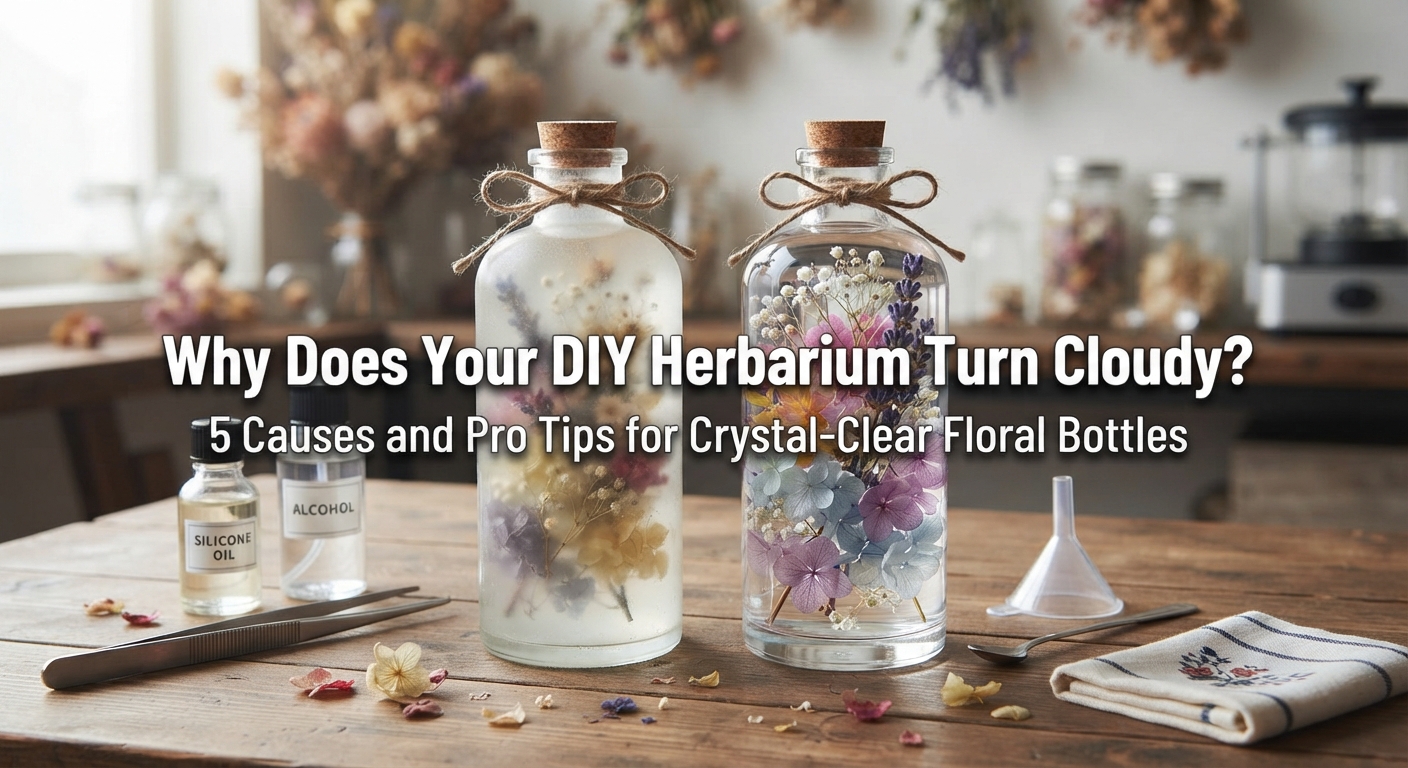
Never mix them! Mineral oil and silicone oil have completely different chemical structures. If combined, they will not blend; they will either separate into two distinct layers or turn the entire bottle completely milky white.
Once an oil turns cloudy from mixing, it cannot be fixed. When topping off a bottle or reusing tools like tweezers and pins, wipe them thoroughly so the two distinct oils never cross-contaminate.
It is frustrating to carefully arrange a design only to have it ruined the moment the liquid is poured. Here are three common issues and their solutions.
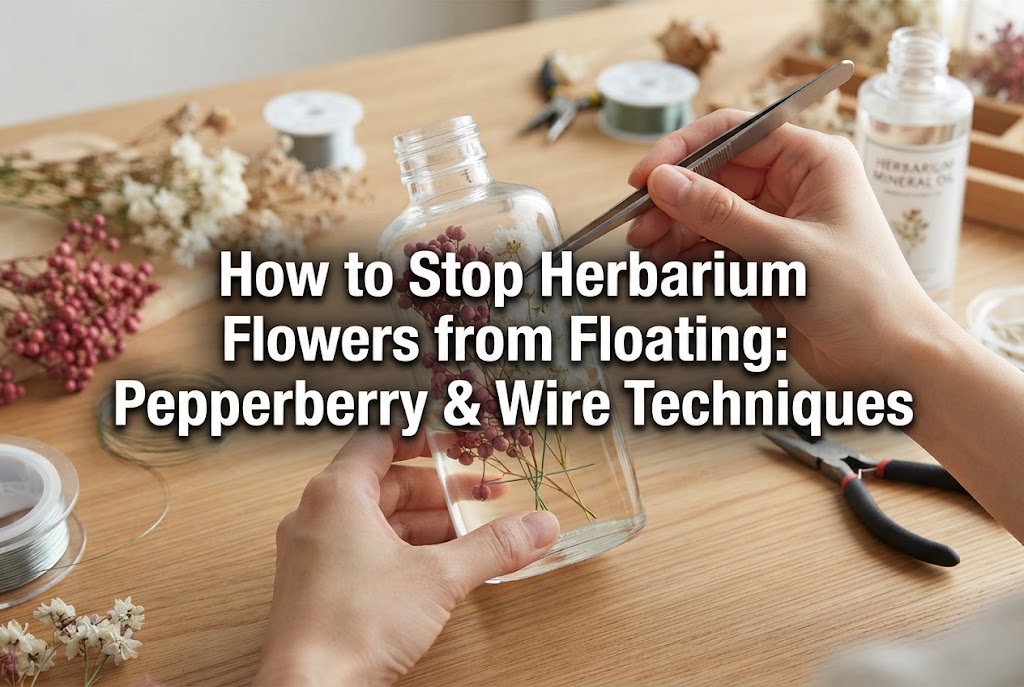
A frequent problem is placing botanicals near the base, only to watch them drift up to the bottle's neck once the liquid is added.
Dried flowers hold a significant amount of air inside their structures, creating natural buoyancy. As a countermeasure, arrange branching materials with structure—such as preserved hydrangea stems or baby's breath (gypsophila)—to act as an internal anchor, interlocking stems to hold lighter blossoms down.
Using mineral oil (which has a lower specific gravity than silicone) or choosing a high-viscosity oil will also reduce unwanted floating.
A few days after completion, flower dyes may bleed into the liquid, tinting the whole bottle pink, red, or purple.
This occurs when the colorants used on preserved flowers react with the solvent properties of the oil. Mineral oil, in particular, tends to dissolve certain oil-soluble dyes and pigments.
If your design relies heavily on richly dyed preserved flowers, using silicone oil is the most reliable way to prevent color leaching.
Fine air bubbles trapped throughout the oil can compromise the clear aesthetic of the piece.
Pouring the oil too fast pulls ambient air into the bottle. To prevent this, tilt the bottle slightly and pour the oil slowly, letting it slide down the inner surface of the glass.
If bubbles do get trapped, leave the bottle uncapped for half a day to a full day; most bubbles will rise and disperse naturally. If you are in a hurry, gently tapping the bottom of the bottle on a cushioned surface or warming it slightly in lukewarm water will help speed up bubble release.
If you are still wondering which oil fits your project best, here is the quick breakdown I recommend:
Choose Mineral Oil if you:
Choose Silicone Oil if you:
When I create pieces myself, I cleanly divide them: I use accessible mineral oil for my everyday experiments and home display, and switch to dependable silicone oil for meaningful gifts and items crafted for sale!
While herbarium oils are safe craft supplies, following basic safety practices and disposal rules is essential.
Herbarium oils are classified as combustible liquids. They will not spontaneously ignite at room temperature, but their flash point is generally around 250°C (482°F).
Do not place or display bottles near kitchen stovetops, candles, or sunny windowsills subjected to intense, concentrated heat. Always read the manufacturer’s label and safety guidelines before crafting.
If you have leftover oil or need to dispose of a failed project, never pour herbarium oil down the household sink or drain! Doing so can clog plumbing and harm the environment.
Dispose of herbarium oil in the same manner as used cooking oil: pack an empty milk carton or plastic bag with scrap paper towels or old newspaper, pour the oil in to let it fully absorb, seal it tightly, and dispose of it as burnable/solid household waste according to your local municipal regulations.
In herbarium crafting, the preserving oil is far more than a liquid filler—it is an essential element that determines the visual clarity, color vibrancy, and longevity of your finished work.
Mineral oil provides cost-effective brilliance and vivid light reflection, while silicone oil delivers outstanding stability against temperature shifts and color bleeding. By pairing the right chemical base and viscosity with your selected botanical elements, you can prevent common crafting hurdles and create stunning, lasting arrangements.
Choose the oil that best suits your project and flowers, and enjoy sealing a vibrant botanical world inside glass!
If you found this guide helpful, sharing it with your crafting friends on social media or messaging apps means the world to me!
Until next time, happy crafting—this was Yassy from Crafters!

For example, if you are looking for articles about mizuhiki, try searching for "mizuhiki"; if you are interested in tools, try keywords like "nippers" or "pliers."
