Handmade Crafts 101: Discover the Joy, Find Your Craft, and Take Your Very First Step
yassy
Crafters!

Hello everyone, this is Yassy from Crafters! (・∀・)
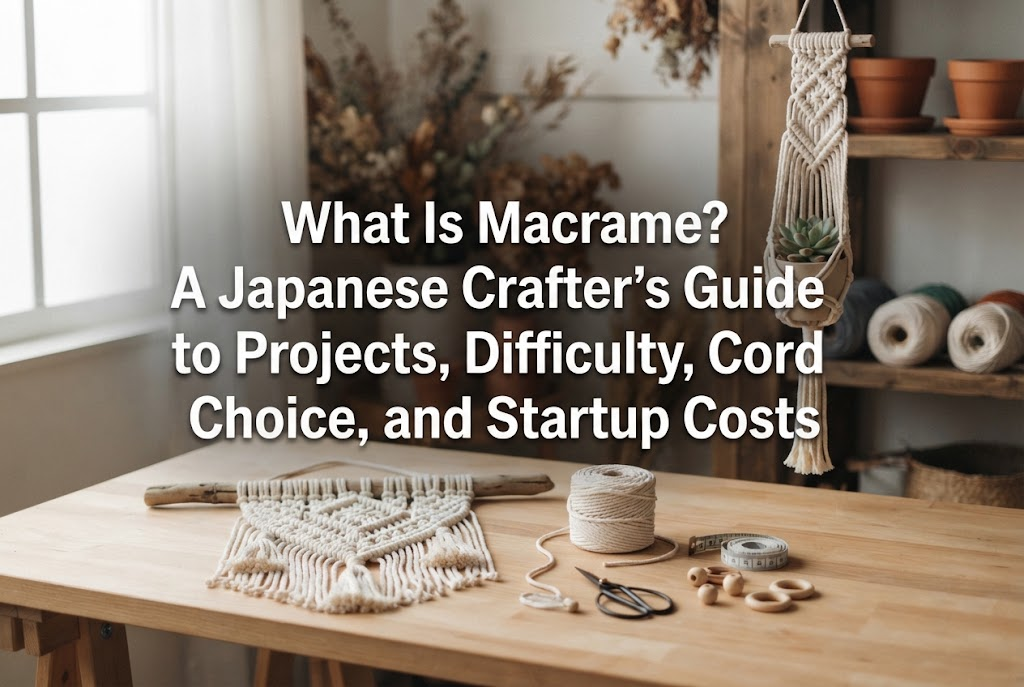
I love all kinds of handmade crafts, but among them, macrame holds a special place in my heart because it allows you to create exquisite interior decor using just your hands with almost no specialized tools! Whether I am making a wall hanging to decorate my own room or discovering stylish macrame bags in shops to add to my collection, I absolutely adore it.
Many people ask questions like: "I've been seeing macrame everywhere lately, but what kind of craft is it really?", "If you don't use knitting needles, is it easy or complicated?", or "Do I need a large room to make bigger pieces?"
In this article, I will pour all of my knowledge and experience into a complete guide covering everything from the fundamental concept of macrame to the items you can make, realistic difficulty levels, how to choose cord without failing, necessary workspace, and initial startup costs! By reading this guide, you will gain a complete understanding of macrame and be able to take your very first step with confidence.
Macrame is a traditional handcrafting technique where you create beautiful patterns and three-dimensional structures by tying several strands of thread or cord together using only your fingertips, without using special knitting needles or equipment.
By repeatedly applying the extremely simple action of "knotting," you can create everything from flat woven textiles to 3D bags and home interior decorations. First, let's clarify the structural characteristics of macrame and its decisive differences from other crafts.
Crochet and knitting are techniques where needles or hooks are used to create loops and interlock them to form fabric. In contrast, macrame is a technique where cords are directly tied together to create knots.
The basic knots used in macrame are actually quite few. By simply combining a few fundamental knots—such as the square knot, spiral knot, lark's head knot, and double half hitch—you can produce an infinite variety of patterns.
Because there are no tools intermediate between your hands and the material, the greatest appeal of macrame is being able to directly feel the texture and tension of the cord through your fingertips as you work.
Fabrics made through knitting or crocheting are highly elastic, but they tend to stretch out of shape when holding heavy objects. Macrame, however, securely ties cords together, giving the fabric exceptional strength and firm structure.
Additionally, unlike tufting used for rug making, macrame does not require large power tools or oversized frames like tufting guns. All you need is a length of cord, your hands, and a hook or board to hold the cord in place. This lightness and agility—allowing you to start crafting anywhere right away—is macrame's unique strength.
By changing the thickness and material of the cord, macrame allows you to create an astonishingly wide variety of items, from large room decorations to delicate wearable jewelry. Here are the representative categories along with their features and charm.
The synonym for macrame is the wall hanging that brightens up interior walls. Cords are attached to driftwood or wooden dowels and knotted into geometric patterns. Hanging just one piece in a room instantly transforms the space into a warm, natural, or BOHO-style environment.
Plant hangers are another timelessly popular project. Designed to wrap around houseplant pots and hang them from ceilings or hooks, they make full use of the structural strength of 3D knotting.
Additionally, you can freely create practical home accessories such as coasters, placemats, and party garlands.
Fashion items that combine practicality and style are another strong point of macrame. Macrame bags and net bags knotted with thicker cotton cord are sturdy, hold their shape well, and are perfect for summer outfits or daily use.
Furthermore, items like phone shoulder straps, camera straps, and keychains are exceptionally popular because beginners can make them in a short time. They are highly functional and make wonderful gifts, so I strongly recommend them as first projects.
By using fine polyester waxed cord, you can create intricate jewelry pieces. Wrapping undrilled gemstones (cabochons) using only knotting techniques—known as frame weaving or stone wrapping—is considered the peak of macrame jewelry craft. Fixing stones securely without glue requires high artistic skill, yielding heirloom-quality jewelry such as bracelets, rings, and earrings.
In macrame, choosing the right cord accounts for 80% of the final outcome and quality of your project. Selecting the wrong material, structure, or thickness can lead to pieces losing their intended shape or making knotting so difficult that you give up. Be sure to memorize these essential rules.
The main materials used in macrame are listed below. Choose strictly according to your project's purpose:
Even with cotton cord, the twist structure changes the artistic expression completely. Understanding these differences is key to moving beyond beginner level:
Clear criteria exist for choosing cord thickness. Picking a size that doesn't fit the scale of your project will ruin the design:
For absolute beginners, the first purchase should be a 3mm, 3-ply cotton cord. The knots are clearly visible and easy to undo if you make a mistake, making it perfect for both practice and real projects.
In the overall handmade world, macrame’s technical difficulty ranges from low to moderate. You don't need to memorize complex crochet charts; success depends more on memorizing steps and repetition than intricate hand dexterity.
However, taking it too lightly can lead to common stumbling blocks. Here are the 3 major failure patterns beginners encounter and how to completely avoid them.
When tying knots, if your tightening strength is inconsistent, the entire piece can warp or become uneven in length between left and right sides. A classic mistake is tying very tightly at first when energetic, then tying loosely as you tire out.
[How to Avoid] You do not need to pull knots as hard as possible. Train your muscle memory to "gently pull until the knot meets the base with consistent force." Keep a ruler at your workspace and check regularly that knot intervals remain even—a professional golden rule.
The most heartbreaking moment in macrame is running out of cord right when you are almost finished. Knotting consumes cord much faster than you might imagine.
[How to Avoid] The absolute standard formula for cord length in macrame is 4 to 6 times the finished dimensions of the project. Furthermore, for designs with dense knots or long fringes, estimate 6 to 8 times.
The golden rule is "when in doubt, cut longer." Joining short cords mid-project significantly spoils the appearance, so it is far smarter to cut extra length and reuse leftover cord for small keychains or fringe accents.
The basic square knot alternates between crossing the right cord over and crossing the left cord over. If you take a break or lose concentration, you might forget whether right or left comes next, causing the pattern to twist.
[How to Avoid] Look closely at the side of the knot. When a square knot is made correctly, a vertical "bump" (axis node) forms on the side that was tied last. Once you learn the rule that the next cord to move is always on the side with the bump, you will never lose your place even if you step away from your desk.
When starting macrame, some people worry that they need an entire wall space or that their room is too small. That is a major misconception! As long as you organize an appropriate environment suited to the size of your project, you can craft comfortably in any space.
There are two primary work styles in macrame: flat desktop work and hanging work. Choose based on what you are making:
For small projects like coasters, keychains, phone straps, and jewelry, working flat on a desk is by far the easiest. Pin the top of your cords onto a corkboard or specialized macrame board and tie them right in front of you. A space equivalent to a laptop workspace (about 50cm wide x 40cm deep) is more than enough.
On the other hand, for large wall hangings, plant hangers, or long bags, hanging work is essential. Gravity pulls the cords down, making any knot distortion instantly visible and allowing your hands to move much more freely.
To create a comfortable crafting setup, here are tools I personally use and strongly recommend:
Unless properly maintained, completed macrame pieces can develop messy fringes or collect dust over time. Here is how to keep them in beautiful condition for a long time.
Fringes on wall hangings or coasters can easily tangle due to humidity or handling. Here is the professional rule for keeping them immaculate:
First, use a pet slicker brush or a fine-toothed comb to gently comb from the base of the fringe down to the ends. This alone aligns the fibers beautifully.
Next, if you want to lock the combed shape in place long-term, lightly spray garment spray starch or fabric stiffening spray over the fringe. This creates crisp stiffness that keeps the fringe perfect even in a breeze.
Wall hangings naturally accumulate dust due to static electricity. Wiping them with your hands pushes dirt deeper into the fibers, so avoid doing that.
For routine care, gently brush dust away using a soft makeup brush (like a blush brush), or vacuum on low setting with a nylon stocking stretched over the nozzle. Applying anti-static spray or fabric protector beforehand dramatically prevents dirt from sticking.
Cotton macrame pieces can be hand-washed, but full immersion carries a high risk of knot shrinkage or warping. The rule is spot cleaning: gently dab dirty spots using a tightly wrung cloth dampened with mild detergent.
When taking up a new hobby, startup cost is often the top concern. In short, macrame is one of the most economical crafts in the handmade world.
Here is a breakdown of realistic budgets and smart shopping strategies.
If you start with minimal tools and supplies, you only need around 1,000 to 2,000 yen. Unlike resin or ceramics, there is no need to buy expensive UV lamps, kilns, or specialized liquids.
[Minimal Starter Kit Breakdown]
With just this, you can complete 2 to 3 projects like phone straps, plant hangers, or small wall hangings. This simplicity is the true power of macrame!
If you want a stress-free experience aimed at professional-level quality from day one, budget around 4,000 to 6,000 yen for specialized tools.
[Recommended Full Tool Kit]
Do not compromise on scissors! Cutting thick cotton or multi-strand macrame cords with dull scissors crushes the cross-section, leaving fuzzy ends that ruin the finish. A sharp pair of fabric shears ensures clean cuts and guarantees project quality.
We've covered everything about macrame—from its charm and technical structure to rules for avoiding failure.
To recap, here are the top reasons to start macrame today:
Watching a single cord gradually form patterns and turn into a beautiful 3D piece under your own hands brings incomparable joy and relaxation. Using wall hangings or bags you made yourself adds special warmth to daily life.
Pick up a roll of 3mm cotton cord and start by knotting a simple phone strap or coaster. I am certain that the warm creations from your hands will enrich your life!
If you enjoyed this article, sharing it with friends on social media or messaging apps would mean the world to me and keep me motivated! See you in the next article! This was Yassy from Crafters!


For example, if you are looking for articles about mizuhiki, try searching for "mizuhiki"; if you are interested in tools, try keywords like "nippers" or "pliers."
