How to Choose and Use Craft Sponges and Foam Brushes: A Complete Guide to Flawless Finishes
yassy
Crafters!

Hello, this is Yassy from Crafters! (・∀・)
Tufting has become immensely popular as a craft that lets you create original rugs and interior accents. With so many creations popping up on social media and video sharing sites lately, more and more people are eager to give it a try.
The indispensable primary tool for tufting is the tufting gun. However, when you start researching one to buy, you encounter numerous technical terms like cut pile, loop pile, and 2-in-1, which can make it hard to figure out what to choose.
It is completely natural to worry: "This is an expensive tool, so I don't want to make a mistake," or "Will I be able to handle its weight and specific type?"
In this guide, I will walk you through the fundamental types and mechanisms of tufting guns, key points beginners should check before buying, and essential safety precautions! Let's find the perfect tufting gun for you and dive into the fun world of rug making!
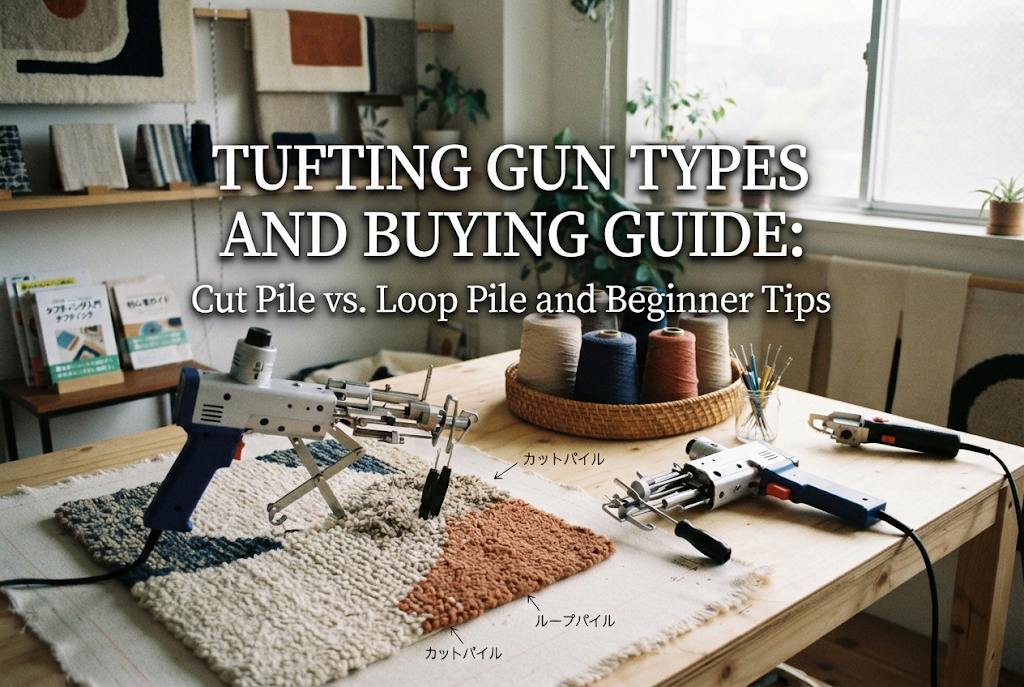
A tufting gun is a power tool shaped like a handheld drill or pistol that punches yarn at high speed into a specialized backing fabric called tufting cloth.
When you pull the trigger, the needle at the tip moves back and forth rapidly, pushing yarn through to the other side of the cloth. Compared to punch needle or traditional embroidery where you push stitches by hand one by one, a tufting gun works at an incomparable speed, allowing you to whip up plush rugs in no time.
Punch needles are also used for rug making, but because everything is done entirely by hand, completing a large piece can take days. It also places a heavy strain on your arms and wrists.
In contrast, using a tufting gun allows you to finish even a large rug within several hours to a single day. Another huge advantage is that the motorized, uniform force and rhythm make it much easier to achieve an evenly aligned, beautiful yarn pile across the surface.
If you want to create full-sized interior rugs or high-quality pieces that look retail-ready, a tufting gun will undoubtedly be your best companion.
Tufting guns come in three main varieties, categorized by how they finish the pile (yarn ends). It is essential to pick the type that best suits the aesthetic you want to create.
With a cut pile gun, a tiny pair of scissor-like blades snips the tip of the yarn loop as it is punched through the cloth, causing the yarn fibers to open up into a fluffy surface.
This produces the soft, plush texture that we commonly associate with cozy rugs. It is currently the most popular and common type among tufting guns sold for crafters.
A loop pile gun leaves the yarn uncut, anchoring continuous loops into the backing fabric as you move.
Because the surface consists of tight loops, it creates a firm, resilient fabric with high durability and resistance to friction. It yields a structured, slightly firmer texture similar to commercial hotel carpets or office flooring.
A 2-in-1 gun is a versatile model that can switch between cut pile and loop pile on a single machine by removing, replacing, or adjusting parts such as the front scissors mechanism.
Many tufting guns currently available in craft shops and online stores are sold as 2-in-1 models. They are popular among crafters who want to explore both expressions without purchasing two separate tools.
When purchasing a tufting gun, it is important not just to look at the price tag, but to evaluate usability, safety features, and technical specifications. Here are five crucial checkpoints to ensure you choose wisely.
Tufting guns generally weigh around 1.4 kg to 1.5 kg (roughly 3 to 3.3 lbs). You might think, "1.5 kg is just about the weight of a standard water bottle, that sounds light!" However, lifting this weight and pressing it firmly against taut vertical fabric for hours at a time puts noticeable strain on your arms and shoulders.
To minimize fatigue during long sessions, look for models engineered as lightly as possible (around 1.4 kg). Make sure to also check whether the handle grip is non-slip and shaped for a secure, comfortable hold.
When purchasing imported tufting guns, you need to pay close attention to voltage and plug shapes. For instance, Japanese household outlets run on AC 100V (50/60Hz), whereas some overseas products operate strictly on 220V or feature incompatible plug styles.
Using a machine with mismatched voltage can lead to insufficient power, malfunction, or even fire hazards. Always confirm that the tool is a universal model specifying "Input AC 100V–240V compatible," or that it comes with the correct plug and voltage compatibility for your domestic electrical setup.
Controlling the tufting speed is one of the biggest hurdles beginners face. If the gun runs too fast before you get the hang of it, you will fail to keep up with its movement, causing tears in the tufting cloth or uneven lines running off course.
Always choose a model equipped with a speed control knob or dial, usually located near the base or handle. Turning this dial lets you adjust the motor speed incrementally from low to high. Practicing on the slowest speed first and gradually increasing it as you gain confidence is the fastest shortcut to mastering the craft.
A tufting gun is a precision power tool fitted with sharp blades and high-speed gears. If you buy cheap grey-market imports or bargain knock-offs, they may arrive with manuals in unfamiliar languages or offer zero replacement support if the unit has defects straight out of the box.
Beginners are particularly prone to early hiccups like yarn jams or unfamiliar mechanical noises. I strongly recommend buying from reputable craft specialty suppliers or shops that provide clear documentation and reliable initial warranty coverage.
Every tufting gun has a designated pile height range it can punch (often around 7 mm to 19 mm). Standard baseline models are typically factory-set to produce pile lengths between 7 mm and 14 mm.
Adjusting the pile longer gives a plusher, deeper feel, while a shorter setting yields a compact, dense finish. For your very first gun, choosing a versatile standard model that operates around the 7 mm to 14 mm range is a reliable choice.
You might be thinking, "I understand the specs and types now, but which one should I personally buy?" Here is my candid advice on how I would choose if I were buying my first machine today!
If a beginner friend asked me what to purchase, I would recommend a dedicated cut pile gun or a 2-in-1 model pre-configured for cut pile right out of the box without hesitation.
The reason is simple: it is the easiest and most direct way to create the fluffy, charming rugs that make tufting so appealing.
Furthermore, cut pile allows you to carve and level the surface after tufting using clippers or scissors. Even if your lines are slightly uneven during the punching stage, you have plenty of room to clean them up and shape them beautifully during the finishing stage.
Many crafters think, "A 2-in-1 gives me both for the price of one, so that's the obvious choice!" However, there is a catch.
Switching a 2-in-1 model from cut pile to loop pile requires using included wrenches and hex keys to remove the front scissor blades and precisely re-align the foot height. This structural adjustment can be somewhat tricky for beginners who are not used to mechanics. If the blade alignment is off, the yarn will not cut properly, or you may accidentally slice open your backing cloth.
Therefore, the most stress-free approach is to use it thoroughly in cut pile mode first, and then attempt switching to loop mode once you are completely comfortable operating and handling the tool.
A tufting gun is a wonderful creative tool, but you must remember that it is also a high-speed power tool equipped with sharp blades. To prevent injury and mechanical breakdown, always maintain proper safety habits and maintenance routines.
Before turning on your machine, always implement the following safety practices:
In particular, never forget the golden rule: unplug the power supply before touching the needle or blade area. Accidentally triggering the switch while your fingers are near the mechanism can result in severe injury. Always read the manufacturer's manual carefully and follow all operational guidelines.
Because a tufting gun uses rapid mechanical movement, regular upkeep is essential for longevity.
After every tufting session, make sure to clean away yarn lint and fiber buildup from around the gears and needle area using a brush or a can of compressed air (air duster). Letting lint accumulate can cause gears to bind or overload the motor, potentially leading to burnout.
Additionally, apply 1 to 2 drops of machine lubricant (such as sewing machine oil) to the moving parts and friction points periodically. This simple step keeps the mechanism gliding smoothly, prevents abnormal friction noise, and minimizes wear and tear.
You cannot make a rug with a tufting gun alone. Here are the core items you will need to prepare before starting a project:
Here are answers to common questions crafters have before making a purchase:
A tufting gun produces a rapid, mechanical thumping sound and noticeable vibration, similar to an electric sewing machine or an impact driver running continuously.
In apartment buildings with thin walls or late at night, it is best avoided to prevent noise friction with neighbors. Consider working during daylight hours, laying anti-vibration mats on your floor, or attaching vibration-damping pads under the feet of your tufting frame.
I would generally advise against it. Secondhand units or individual reseller listings often involve machines whose internal gears were misaligned by the previous owner, or units with severely dulled blades.
Because tufting guns require precise mechanical calibration, purchasing a brand-new unit from a trustworthy specialty shop or authorized distributor with a warranty and responsive customer support offers the greatest peace of mind.
In this guide, we explored the different types of tufting guns, their unique features, and practical checkpoints for choosing your first tool without regret!
Tufting guns primarily come in cut pile, loop pile, and 2-in-1 formats. For beginners looking for an approachable start and beautiful results, a dedicated cut pile gun (or a 2-in-1 model pre-set to cut pile) is the top recommendation.
When purchasing, always verify the four core factors: weight, speed control capability, proper electrical voltage/plug match, and warranty/support backing.
At first, the weight and speed of the machine might feel intimidating, but once you find your rhythm, you will be captivated by the feeling of watching a custom rug take shape right before your eyes! Keep safety and routine maintenance in mind, and enjoy creating your very own original handmade rugs!
If you found this guide helpful, sharing it with your fellow crafter friends on social media is always deeply appreciated!
See you in the next post! This was Yassy from Crafters!


For example, if you are looking for articles about mizuhiki, try searching for "mizuhiki"; if you are interested in tools, try keywords like "nippers" or "pliers."
