Preventing Wood Warping in Japanese Yosegi-zaiku: Essential Drying and Storage Tips
yassy
Crafters!

Hello, craft lovers! It's Yassy from Crafters! (・∀・)
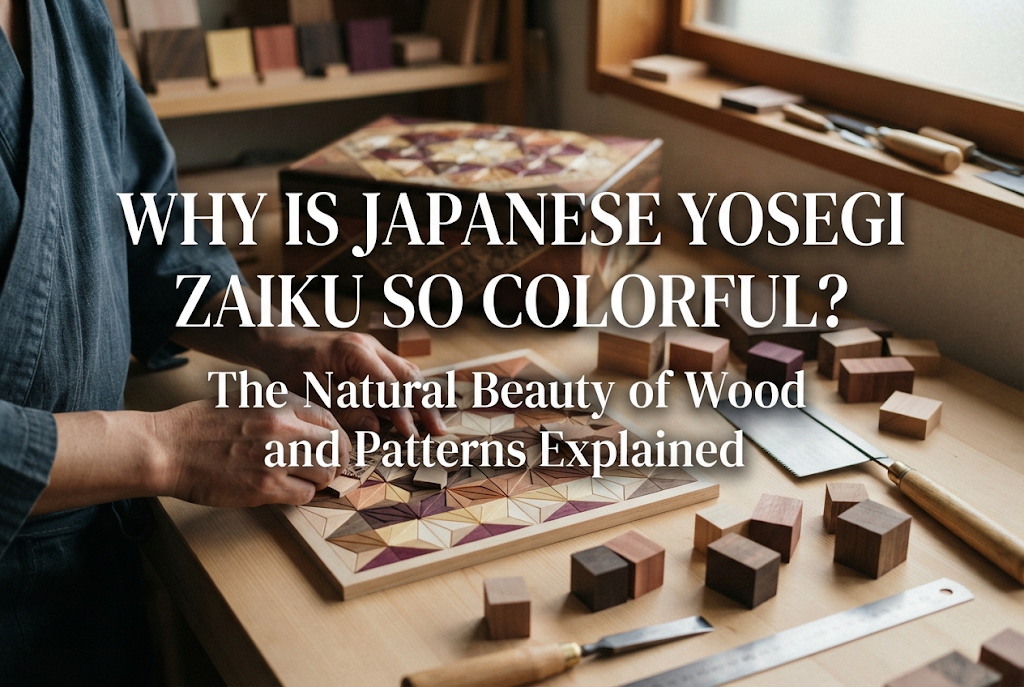
Have you ever come across Yosegi Zaiku (traditional Japanese marquetry) on boxes, trays, or fashion accessories? Looking at those neatly arranged geometric patterns in vivid shades of red, yellow, green, black, and white is enough to make anyone swoon.
When people see Yosegi Zaiku for the first time, many assume, "With colors this vibrant, the wood must be stained or painted." However, in traditional Yosegi Zaiku, the colors of the timber are completely unpainted and undyed. Every single color comes from the natural hue of the wood itself.
In this article, I will explain why natural timber can produce such a rich palette, introduce the specific wood species used, and break down how those mesmerizing geometric patterns are crafted—in a way that is both thorough and easy to understand!
The most surprising aspect of Yosegi Zaiku's color palette is that it relies entirely on combining uncolored natural woods. Craftsmen do not paint the surfaces or soak dyes into the wood fibers.
There are tens of thousands of tree species across the globe, each possessing a completely unique wood tone depending on its growing environment and internal chemical composition. Yosegi Zaiku is a traditional craft technique that highlights the natural, unadorned tones of diverse woods collected from across Japan and around the world.
The vast variety of wood colors stems from a tree's growth process and the chemical compounds stored within its cells. As a tree grows, the role of the inner trunk differs significantly from the outer layer.
The outer portion of the trunk (closest to the bark) is known as sapwood (called shirata in Japanese). Its main job is to transport water and nutrients. Because it contains high moisture levels, sapwood generally has a light, pale appearance.
On the other hand, the center of the trunk is called heartwood (or akami in Japanese). The cells in the heartwood are no longer active in nutrient transport; instead, they serve as a sturdy structural column supporting the tree. During the transition into heartwood, the tree deposits extractives—such as polyphenols, tannins, flavonoids, and pigments—into its core.
Depending on the types and amounts of these extractives, rich colors like deep brown, red, yellow, and purple are formed. In short, the color of the cut lumber changes dramatically depending on the tree species chosen and which section of the trunk is harvested.
The Hakone mountain region in Kanagawa Prefecture, famous as the birthplace of Yosegi Zaiku, boasts one of the richest varieties of tree species in Japan. Traditional Hakone Yosegi Zaiku skillfully combines abundant timber harvested from local mountains with rare precious woods imported from around the world.
Here is a breakdown of the tree species used to achieve specific colors in Yosegi Zaiku:
White woods play a vital role in highlighting adjacent darker elements. Mizuki, in particular, resists warping even after drying, making it an indispensable foundation material for Yosegi Zaiku.
Ancient timber like Jindai Sugi (known as Jindaiboku) acquires its deep dark gray shade naturally through a chemical reaction between iron in volcanic ash or soil and tannins in the wood. This produces a unique texture impossible to replicate artificially.
Including red-toned woods instantly brightens up Yosegi Zaiku patterns. Unlike red paint, natural wood fibers remain visible, giving the red hue a deep, three-dimensional look.
Yellow woods enhance pattern readability when paired with black or white. Their sharp brightness makes complex arrangements stand out clearly.
People are often most surprised by green wood, especially the heartwood of Ho-no-ki. Rather than a bright neon green, its refined, matcha-like green imparts an elegant, calming feel to the overall piece.
When freshly cut, Purpleheart appears pale brown, but exposure to sunlight and UV rays turns it a brilliant purple. It is extremely popular in modern Yosegi creations and handmade jewelry.
Once natural woods of various colors are gathered, the next step is combining them to create patterns. Here is the basic process behind how those incredibly fine, accurate designs are formed.
Yosegi Zaiku starts by shaving different colored woods into thin rods. Their cross-sections are planed into precise angles—squares, rectangles, triangles, or diamonds—depending on the intended design.
At this stage, an error of even 1/100th of a millimeter in angle or size can multiply across hundreds of combined pieces, causing gaps and destroying the pattern. Artisans craft these rods by hand without a millimeter of error using custom hand planes (kanna) and specialized jigs.
Next, the colored wooden rods are glued together according to a master plan. Artisans carefully bundle each piece to construct traditional Japanese motifs, such as Asanoha (hemp leaf pattern), Kikko (tortoiseshell pattern), or Ichimatsu (checkerboard pattern).
The bundled wood rods are tightly bound with string, cord, or straps to apply firm pressure until the wood glue dries completely. This single thick block of pattern is called a unit pattern or tanegi (seed wood).
The completed unit pattern block is then sliced with a saw into multiple plates sharing the exact same cross-section pattern. These plates are laid out seamlessly side by side and glued together to create a large block with a continuous pattern (known as Ozeyose).
At this point, a large block of wood is created—much like a log of candy where the same geometric pattern appears no matter where you cut it.
Once the Ozeyose block is complete, there are two main methods to finish the final product:
In Hakone Yosegi Zaiku, affordable items featuring delicate sheet-like patterns use the zuku technique, while heavy, solid items where the pattern continues inside are made using muku.
Crafts made from natural wood colors possess unique qualities—and require special care—that painted wooden items do not.
The greatest charm of natural wood is aging—the gradual change in color over time. Freshly crafted Yosegi Zaiku displays sharp, vivid contrasts between colors. However, as you use it over years and decades, exposure to light and air matures the natural compounds inside the wood, blending the colors into a warm, amber-like, deep tone.
While painted colors simply chip or fade, natural wood Yosegi Zaiku gains an antique character the more you use it. Enjoying this transformation is the true joy of owning natural wood crafts.
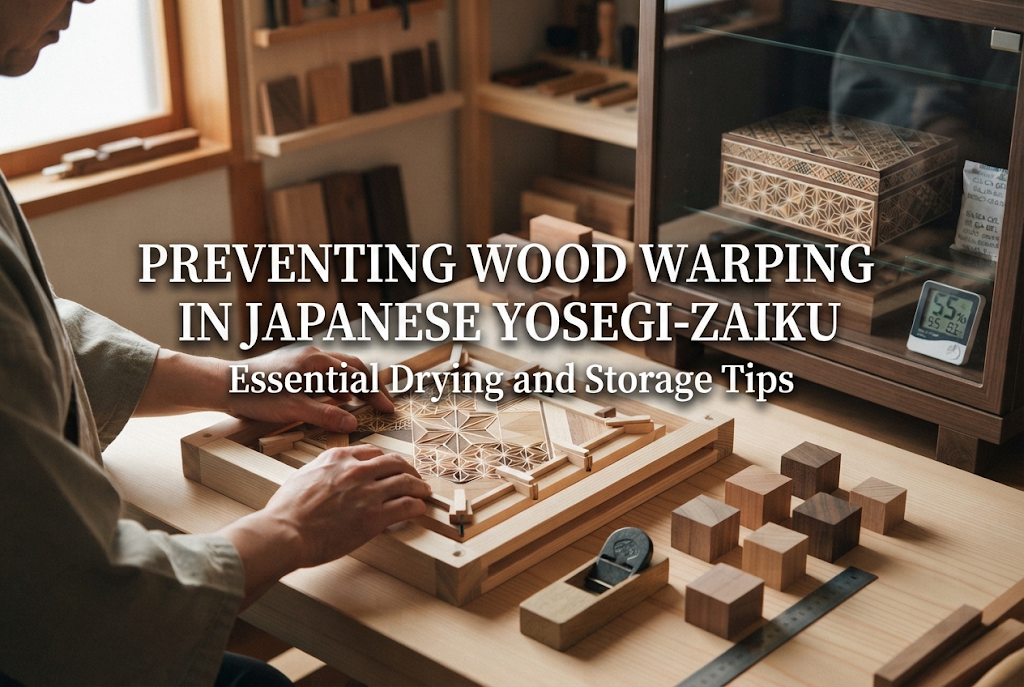
Because Yosegi Zaiku is made of natural timber, it is sensitive to humidity and extreme dryness. Wood naturally expands when absorbing moisture and contracts when dry.
If left in direct sunlight or directly in front of air conditioner vents, different wood species will shrink at different rates. This can cause gaps between joined parts or, in severe cases, crack the glue joints. For daily care, simply wipe gently with a soft, dry cloth. If it gets dirty, wipe with a tightly wrung damp cloth and dry immediately. Applying a thin coat of natural beeswax or wood oil periodically preserves moisture and maintains the wood's vivid hues.
Now that we've explored the world of Yosegi Zaiku, you might be thinking, "I'd love to make something combining different woods myself!"
While building complex geometric designs with millimeter precision like a professional artisan requires specialized tools and years of practice, there are plenty of ways for beginners to enjoy Yosegi-style woodcraft easily!
Processing lumber from raw logs is tough. Start by purchasing a "mixed wood scrap set" or "small square wood strips" from local craft stores, home improvement centers, or online shops.
Sets containing pre-sorted contrasting woods—such as Walnut (dark brown), Agathis or Hinoki Cypress (white/yellow), and Padauk (red)—are easiest to work with.
If beginners jump straight into complex Asanoha (hemp leaf) or Kikko (tortoiseshell) patterns, minor angle errors will leave gaps and ruin the project. Starting with straight-line designs like stripes or Ichimatsu (checkerboard) patterns is the key to success. Simply gluing alternating wood strips of equal width produces amazingly stylish coasters or chopstick rests!
The most crucial tool in Yosegi crafting isn't a saw or sandpaper—it's the clamp! Simply applying wood glue and pressing by hand leaves air pockets and loose joints. After applying wood glue, use bar clamps or F-clamps to tighten the assembly firmly until excess glue squeezes out. Clamping tightly until fully dry creates seamless, durable joints that look like a single solid piece of wood.
Right after gluing, the surface will feel uneven due to minor height differences and squeezed-out glue. Don't give up here—sanding will fix it! Wrap 240-grit sandpaper around a flat wood block and sand until smooth. Finish with fine 400-grit (or higher) sandpaper, then apply wood oil or beeswax. You'll be amazed as the vivid colors of each wood species pop instantly!
The reason Yosegi Zaiku woodcrafts are so colorful is not paint or dye, but the exquisite combination of natural wood tones crafted by the Earth itself.
The white of Mizuki, the red of Padauk, the yellow of Nigaki, the green of Ho-no-ki, and the dark gray of Jindai Sugi—these unique colors, paired with the flawless precision of master artisans, give birth to one-of-a-kind geometric art.
Because it uses natural timber, you can enjoy watching the colors deepen over time. If you own a piece of Yosegi Zaiku or spot one in a shop, take a moment to look closely and wonder, "Which tree did this color come from?"
Understanding the rich harmony of natural blessings and human skill behind Yosegi Zaiku will surely inspire your handmade craft journey!
If you enjoyed this article, sharing it with friends on social media would mean the world to me!
Until next time, happy crafting! This was Yassy from Crafters!




For example, if you are looking for articles about mizuhiki, try searching for "mizuhiki"; if you are interested in tools, try keywords like "nippers" or "pliers."
